From the Department of Pathology, University of Texas M. D. Anderson Cancer Center, Houston.
Arch Pathol Lab Med. 2013 Oct;137(10):1337-41. doi: 10.5858/arpa.2012-0322-OA.
Urothelial tumors are rare in young patients. Because of their rarity, the natural history of the disease in young patients remains poorly understood.
To understand the pathologic and clinical features of urothelial tumors of the urinary bladder in young patients.
We identified 59 young patients with urothelial tumors of the urinary bladder treated at our institution and analyzed the tumors' pathologic features and the patients' clinical outcomes.
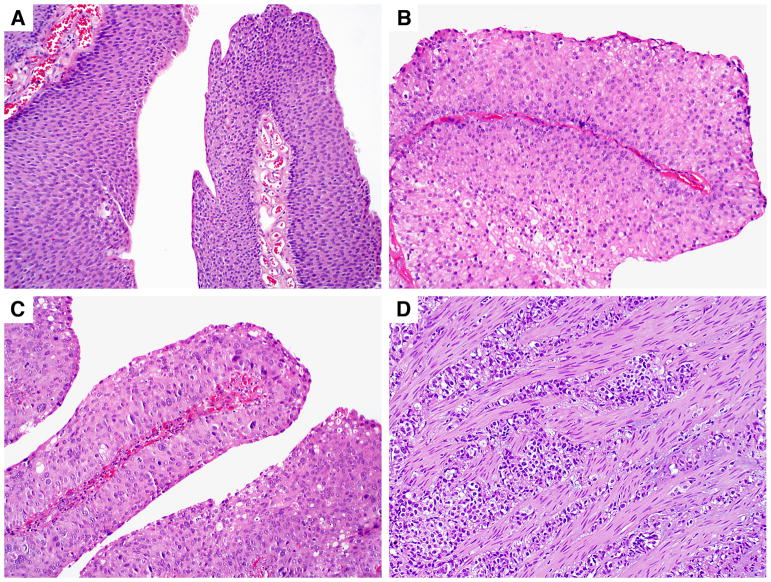
All patients were 30 years or younger, with a mean age of 23.5 years (range, 4-30). Thirty-eight patients (64%) were male, and 21 (36%) were female. Most tumors were noninvasive, papillary urothelial tumors (49 of 59; 83%), including papillary urothelial neoplasms of low malignant potential (7 of 49; 14%), low-grade papillary urothelial carcinomas (38 of 49; 78%), and high-grade papillary urothelial carcinomas (4 of 49; 8%). Only a few (n=10) of the urothelial tumors were invasive, invading the lamina propria (n=5; 50%), muscularis propria (n=4; 40%), or perivesical soft tissue (n=1; 10%). Clinical follow-up information was available for 41 patients (69%), with a mean follow-up time of 77 months. Of 31 patients with noninvasive papillary urothelial tumors, only 1 patient (3%) later developed an invasive urothelial carcinoma and died of the disease, and 30 of these patients (97%) were alive at the end of follow-up, although 10 (32%) had local tumor recurrences. In the 10 patients with invasive urothelial carcinomas, 3 patients (30%) died of the disease and 5 others (50%) were alive with metastases (the other 2 [20%] were alive with no recurrence).
Urothelial tumors in young patients are mostly noninvasive, papillary carcinomas and have an excellent prognosis; however, a small subset of patients may present with high-grade invasive urothelial carcinomas that result in poor clinical outcomes.
在年轻患者中,尿路上皮肿瘤较为罕见。由于其罕见性,年轻患者疾病的自然史仍了解甚少。
了解年轻患者膀胱尿路上皮肿瘤的病理和临床特征。
我们确定了在我院治疗的 59 例年轻患者的膀胱尿路上皮肿瘤,并分析了肿瘤的病理特征和患者的临床结局。
所有患者均为 30 岁或以下,平均年龄为 23.5 岁(范围为 4-30 岁)。38 例(64%)为男性,21 例(36%)为女性。大多数肿瘤为非浸润性、乳头状尿路上皮肿瘤(59 例中的 49 例;83%),包括低级别乳头状尿路上皮肿瘤(49 例中的 7 例;14%)、低级别乳头状尿路上皮癌(49 例中的 38 例;78%)和高级别乳头状尿路上皮癌(49 例中的 4 例;8%)。只有少数(n=10)尿路上皮肿瘤为浸润性,侵犯固有层(n=5;50%)、肌层(n=4;40%)或膀胱周围软组织(n=1;10%)。可获得 41 例患者(69%)的临床随访信息,平均随访时间为 77 个月。31 例非浸润性乳头状尿路上皮肿瘤患者中,仅有 1 例(3%)患者后来发展为浸润性尿路上皮癌并死于该疾病,而这些患者中有 30 例(97%)在随访结束时存活,尽管 10 例(32%)有局部肿瘤复发。在 10 例浸润性尿路上皮癌患者中,3 例(30%)患者死于该疾病,5 例(50%)患者有转移仍存活(其余 5 例(50%)有转移但仍存活)。
年轻患者的尿路上皮肿瘤多为非浸润性、乳头状癌,预后良好;然而,一小部分患者可能表现为高级别浸润性尿路上皮癌,导致不良的临床结局。