Department of Neurology, Mayo Clinic, Rochester, MN, USA.
Department of Health Science Research, Mayo Clinic, Rochester, MN, USA.
J Alzheimers Dis. 2021;80(2):683-693. doi: 10.3233/JAD-201166.
Transactive response DNA-binding protein of 43 kDa (TDP-43) is associated with memory impairment and overall cognitive decline. It is unclear how TDP-43 contributes to the rate of clinical decline.
To determine whether cross-sectional and longitudinal cognitive and functional decline are associated with anatomical distribution of TDP-43 in the brain.
Longitudinal clinical-neuropathologic autopsy cohort study of 385 initially cognitively normal/mildly impaired older adults prospectively followed until death. We investigated how TDP-43, amyloid-β (Aβ), tau neurofibrillary tangles (NFT), Lewy body disease (LBD), age, sex, and genetics are associated with clinical scores and rates of their longitudinal decline.
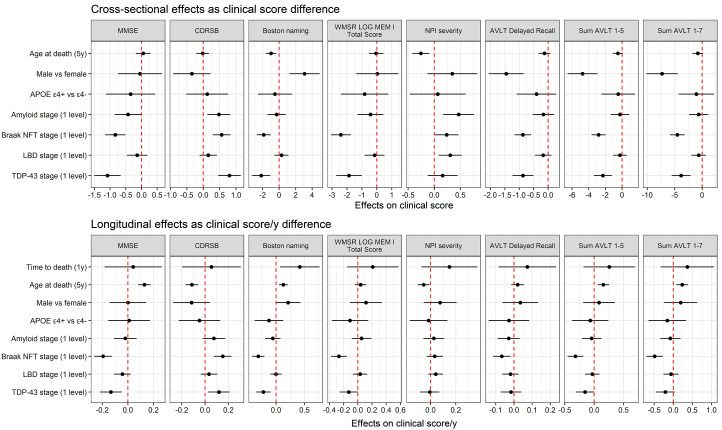
Of 385 participants, 260 (68%) had no TDP-43, 32 (8%) had TDP-43 limited to amygdala, and 93 (24%) had TDP-43 in the hippocampus and beyond. Higher TDP-43 and Braak NFT stages independently were associated with faster decline in global cognition, functional performance measured by Clinical Dementia Rating scale, and naming and episodic memory, whereas older age was associated with slower rate of cognitive, psychiatric, and functional decline. Cross-sectionally the following associations were found: higher TDP-43 and Braak NFT - worse performance; higher Aβ burden - worse global cognition, more behavioral changes, the latter also with higher LBD; older age - worse naming, lower frequency of behavioral changes; female sex - more impaired naming and better preserved episodic memory. There were no genetic associations.
The association of TDP-43 distribution with decline in cognitive and functional performance suggests that TDP-43 is playing a role in the clinical progression to dementia. Further characterization of clinical features associated with TDP-43 can facilitate establishment of antemortem diagnosis.
43kDa 转导反应 DNA 结合蛋白(TDP-43)与记忆障碍和整体认知能力下降有关。目前尚不清楚 TDP-43 如何导致临床衰退速度加快。
确定 TDP-43 在大脑中的解剖分布与认知和功能的横断面和纵向下降是否相关。
对 385 名最初认知正常/轻度受损的老年人进行前瞻性纵向临床神经病理学尸检队列研究,直至死亡。我们研究了 TDP-43、淀粉样蛋白-β(Aβ)、tau 神经原纤维缠结(NFT)、路易体病(LBD)、年龄、性别和遗传因素与临床评分及其纵向下降率的关系。
在 385 名参与者中,260 名(68%)无 TDP-43,32 名(8%)仅在杏仁核中有 TDP-43,93 名(24%)在海马体及其以外部位有 TDP-43。较高的 TDP-43 和 Braak NFT 分期与全球认知、临床痴呆评定量表(CDR)测量的功能表现以及命名和情景记忆的下降速度较快独立相关,而年龄较大与认知、精神和功能下降的速度较慢相关。横断面研究发现:较高的 TDP-43 和 Braak NFT-表现较差;较高的 Aβ负担-认知能力较差,行为变化较多,后者也与 LBD 较高有关;年龄较大-命名能力较差,行为变化频率较低;女性-命名障碍更严重,情景记忆保存更好。未发现遗传相关性。
TDP-43 分布与认知和功能表现下降的相关性表明,TDP-43 在向痴呆的临床进展中起作用。进一步描述与 TDP-43 相关的临床特征有助于建立生前诊断。