Department of Pathology, Louisiana State University Health Sciences Center, New Orleans, LA.
J Am Heart Assoc. 2013 Sep 30;2(5):e000457. doi: 10.1161/JAHA.113.000457.
Our laboratory has previously demonstrated the importance of a cytoskeletal-based survival signaling pathway using in vitro models of ischemia/reperfusion (IR). However, the importance of this pathway in mediating stress-elicited survival signaling in vivo is unknown.
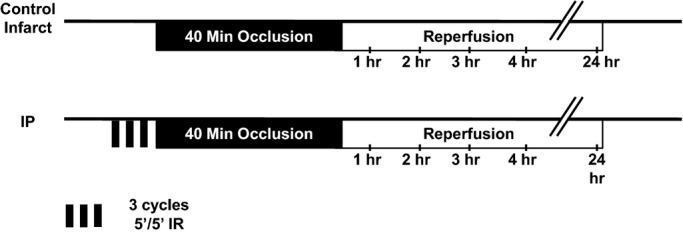
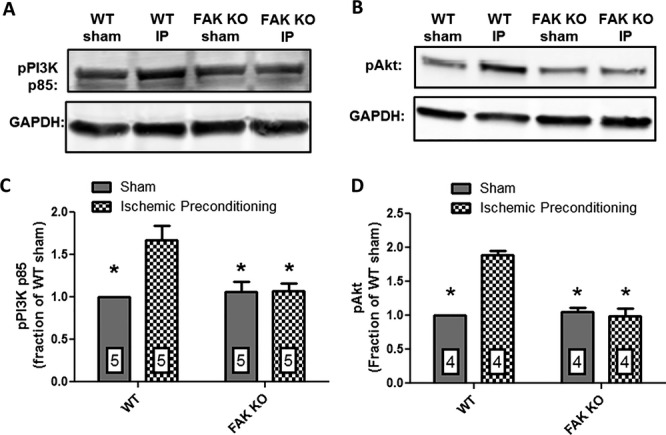
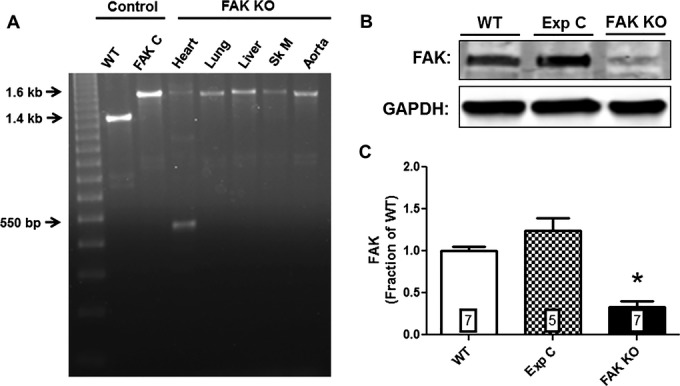
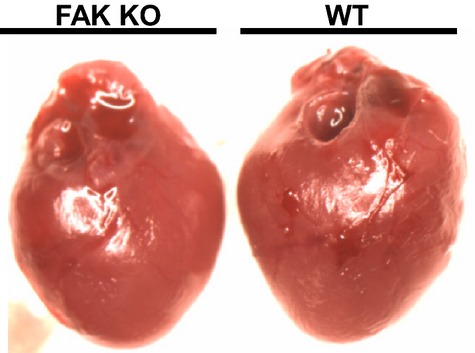
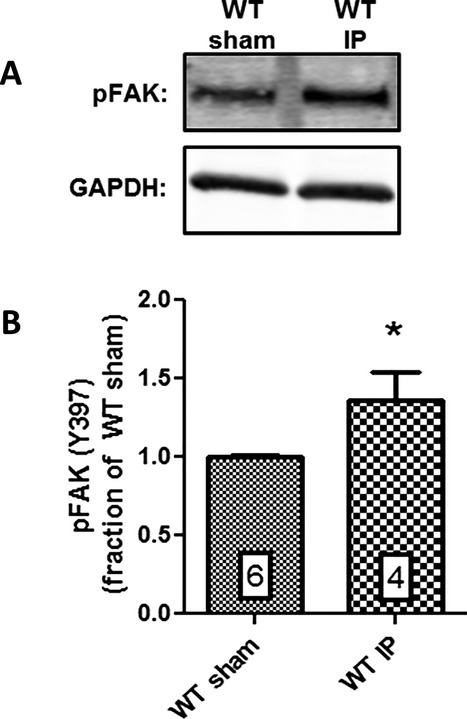
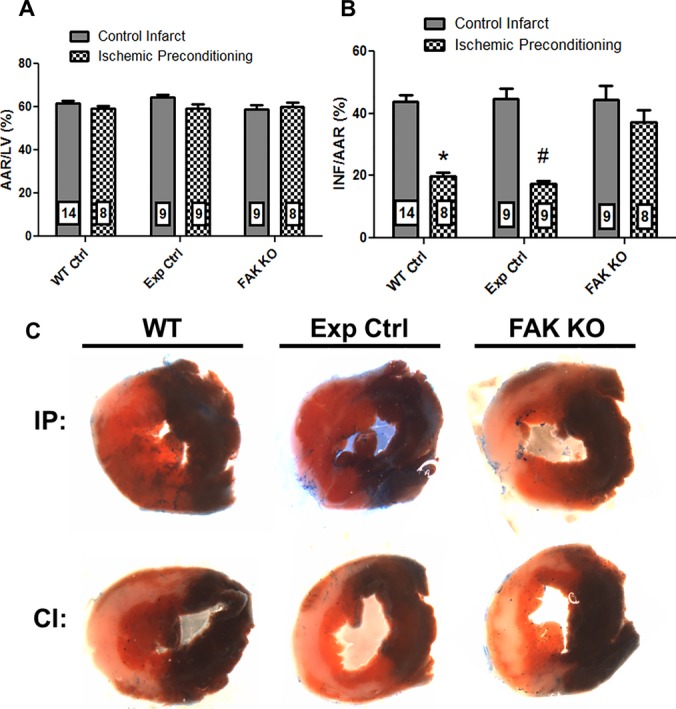
The essential cytoskeletal signaling pathway member focal adhesion kinase (FAK) was selectively deleted in adult cardiac myocytes using a tamoxifen-inducible Cre-Lox system (α-MHC-MerCreMer). Polymerase chain reaction (PCR) and Western blot were performed to confirm FAK knockout (KO). All mice were subjected to a 40-minute coronary occlusion followed by 24 hours of reperfusion. Ischemic preconditioning (IP) was performed using a standard protocol. Control groups included wild-type (WT) and tamoxifen-treated α-MHC-MerCreMer+/-/FAK(WT/WT) (experimental control) mice. Infarct size was expressed as a percentage of the risk region. In WT mice IP significantly enhanced the expression of activated/phosphorylated FAK by 36.3% compared to WT mice subjected to a sham experimental protocol (P ≤ 0.05; n = 6 hearts [sham], n = 4 hearts [IP]). IP significantly reduced infarct size in both WT and experimental control mice (43.7% versus 19.8%; P ≤ 0.001; 44.7% versus 17.5%; P ≤ 0.001, respectively). No difference in infarct size was observed between preconditioned FAK KO and nonpreconditioned controls (37.1% versus 43.7% versus 44.7%; FAK KO versus WT versus experimental control; P=NS). IP elicited a 67.2%/88.8% increase in activated phosphatidylinositol-3-kinase (PI3K) p85/activated Akt expression in WT mice, but failed to enhance the expression of either in preconditioned FAK KO mice.
Our results indicate that FAK is an essential mediator of IP-elicited cardioprotection and provide further support for the hypothesis that cytoskeletal-based signaling is an important component of stress-elicited survival signaling.
本实验室先前使用体外缺血/再灌注(IR)模型证明了细胞骨架相关存活信号通路的重要性。然而,该通路在介导体内应激诱导的存活信号中的重要性尚不清楚。
使用他莫昔芬诱导的 Cre-Lox 系统(α-MHC-MerCreMer)在成年心肌细胞中选择性删除基本细胞骨架信号通路成员粘着斑激酶(FAK)。进行聚合酶链反应(PCR)和 Western blot 以确认 FAK 敲除(KO)。所有小鼠均接受 40 分钟的冠状动脉闭塞,然后再进行 24 小时的再灌注。使用标准方案进行缺血预处理(IP)。对照组包括野生型(WT)和他莫昔芬处理的α-MHC-MerCreMer+/-/FAK(WT/WT)(实验对照)小鼠。梗死面积表示为危险区域的百分比。在 WT 小鼠中,IP 与 WT 小鼠进行假手术实验方案相比,显著增强了激活/磷酸化 FAK 的表达 36.3%(P ≤ 0.05;n = 6 个心脏 [假手术],n = 4 个心脏 [IP])。IP 显著减少了 WT 和实验对照组小鼠的梗死面积(分别为 43.7%与 19.8%;P ≤ 0.001;44.7%与 17.5%;P ≤ 0.001)。在预处理 FAK KO 与非预处理对照组之间,未观察到梗死面积的差异(37.1%与 43.7%与 44.7%;FAK KO 与 WT 与实验对照组;P=NS)。IP 在 WT 小鼠中诱导激活的磷脂酰肌醇-3-激酶(PI3K)p85/激活的 Akt 表达增加了 67.2%/88.8%,但未能增强预处理 FAK KO 小鼠中这些物质的表达。
我们的结果表明 FAK 是 IP 诱导的心脏保护的重要介质,并进一步支持了这样的假设,即细胞骨架相关信号是应激诱导的存活信号的重要组成部分。