Radcliffe Rachel A, Bixler Danae, Moorman Anne, Hogan Vicki A, Greenfield Vickie S, Gaviria Diana M, Patel Priti R, Schaefer Melissa K, Collins Amy S, Khudyakov Yury E, Drobeniuc Jan, Gooch Barbara F, Cleveland Jennifer L
Dr. Radcliffe was with the Epidemic Intelligence Service, Centers for Disease Control and Prevention, Atlanta, when the investigation described in this article was conducted. She now is a program manager, Division of Acute Disease Epidemiology, South Carolina Department of Health and Environmental Control, Columbia.
J Am Dent Assoc. 2013;144(10):1110-8. doi: 10.14219/jada.archive.2013.0029.
Although hepatitis B virus (HBV) transmission in dental settings is rare, in 2009 a cluster of acute HBV infections was reported among attendees of a two-day portable dental clinic in West Virginia.
The authors conducted a retrospective investigation by using treatment records and volunteer logs, interviews of patients and volunteers with acute HBV infection as well as of other clinic volunteers, and molecular sequencing of the virus from those acutely infected.
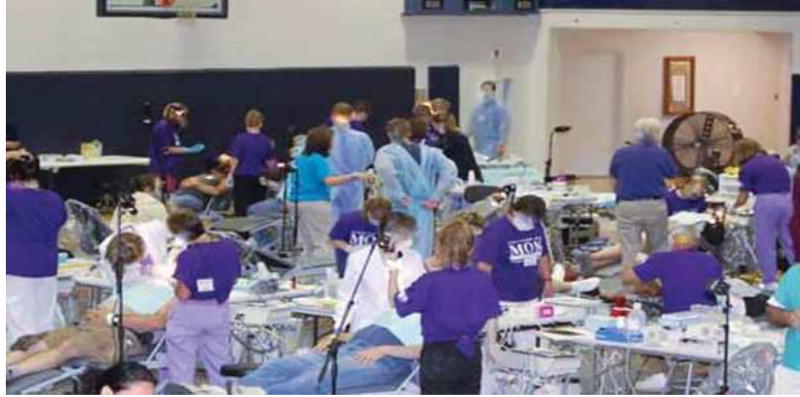
The clinic was held under the auspices of a charitable organization in a gymnasium staffed by 750 volunteers, including dental care providers who treated 1,137 adults. Five acute HBV infections-involving three patients and two volunteers-were identified by the local and state health departments. Of four viral isolates available for testing, all were genotype D. Three case patients underwent extractions; one received restorations and one a dental prophylaxis. None shared a treatment provider with any of the others. One case volunteer worked in maintenance; the other directed patients from triage to the treatment waiting area. Case patients reported no behavioral risk factors for HBV infection. The investigation revealed numerous infection control breaches.
Transmission of HBV to three patients and two volunteers is likely to have occurred at a portable dental clinic. Specific breaches in infection control could not be linked to these HBV transmissions.
All dental settings should adhere to recommended infection control practices, including oversight; training in prevention of bloodborne pathogens transmission; receipt of HBV vaccination for staff who may come into contact with blood or body fluids; use of appropriate personal protective equipment, sterilization and disinfection procedures; and use of measures, such as high-volume suction, to minimize the spread of blood.
尽管在牙科诊疗环境中乙型肝炎病毒(HBV)传播很少见,但2009年西弗吉尼亚州一家为期两天的流动牙科诊所的参与者中报告了一批急性HBV感染病例。
作者通过使用治疗记录和志愿者日志、对急性HBV感染患者和志愿者以及其他诊所志愿者进行访谈,以及对急性感染患者的病毒进行分子测序,开展了一项回顾性调查。
该诊所是在一个慈善组织的支持下在一个体育馆内举办的,有750名志愿者参与,其中包括为1137名成年人提供治疗的牙科护理人员。当地和州卫生部门确认了5例急性HBV感染病例,涉及3名患者和2名志愿者。在可供检测的4株病毒分离株中,均为D基因型。3例病例患者接受了拔牙治疗;1例接受了修复治疗,1例接受了牙齿预防保健。他们之间没有共同的治疗提供者。1例病例志愿者从事维护工作;另1例将患者从分诊处引导至治疗等候区。病例患者报告没有HBV感染的行为危险因素。调查发现了许多感染控制方面的违规行为。
在一家流动牙科诊所可能发生了HBV传播给3名患者和2名志愿者的情况。感染控制方面的具体违规行为与这些HBV传播之间没有关联。
所有牙科诊疗环境都应遵守推荐的感染控制措施,包括监督;预防血源性病原体传播的培训;可能接触血液或体液的工作人员接种HBV疫苗;使用适当的个人防护设备、灭菌和消毒程序;以及使用诸如强力吸引等措施,以尽量减少血液传播。