Paul Rudrajit, Banerjee Amit K, Guha Shantanu, Chaudhuri Utpal, Ghosh Srabani, Mondal Jayati, Bandyopadhyay Ramtanu
Department of Medicine, Medical College, Kolkata, India.
Int J Appl Basic Med Res. 2013 Jul;3(2):117-21. doi: 10.4103/2229-516X.117086.
BACKGROUND/CONTEXT: Antiplatelet drug resistance increases the risk of adverse events like stent thrombosis in acute coronary syndrome (ACS). Metabolic syndrome (MS) is a prothrombotic state and presence of MS further increases the risk of antiplatelet drug resistance.
We studied platelet aggregation characteristics in patients of ACS for aspirin or clopidogrel resistance. We studied the relation of drug resistance with blood markers like high sensitivity C-reactive protein (hsCRP). We also studied for any relation of drug resistance with presence of MS.
We studied platelet aggregation characteristics by optical aggregometry using platelet-rich plasma (PRP) of patients. Collagen (2 μg/mL) and adenosine diphosphate (ADP; 10 μmol) were used. Greater than 50% aggregation in PRP of patients was taken as an evidence of drug resistance. Suitable blood tests were done including newer risk markers like hsCRP, apolipoprotein B, and fibrinogen.
Statistical tests included Student's t-test and Kendall's rank correlation coefficient.
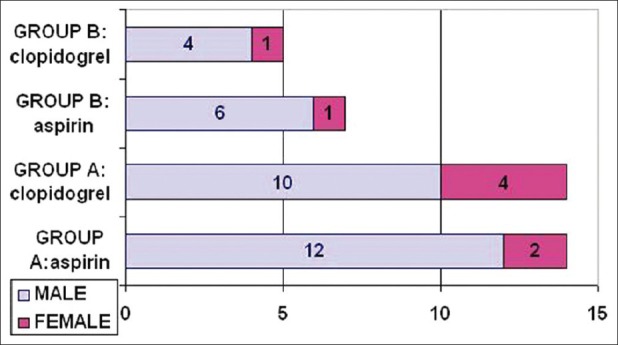
We had a total of 94 patients of ACS with 47 (50%) having MS. MS patients showed higher blood levels of hsCRP and fibrinogen. Twenty-eight (59.5%) patients with MS showed antiplatelet drug resistance compared to 12 patients without MS. Serum fibrinogen showed strongest correlation with drug resistance. HsCRP levels showed correlation with aspirin resistance (r = 0.53) only in the MS group.
We found significantly high prevalence of antiplatelet drug resistance. Aspirin and clopidogrel resistance was comparable. MS was a significant risk factor for drug resistance. The prothrombotic and proinflammatory markers showed strong correlation with drug resistance. A larger randomized trial is needed to better characterize this clinical problem.
背景/情境:抗血小板药物抵抗会增加急性冠状动脉综合征(ACS)患者发生支架血栓形成等不良事件的风险。代谢综合征(MS)是一种促血栓形成状态,MS的存在会进一步增加抗血小板药物抵抗的风险。
我们研究了ACS患者对阿司匹林或氯吡格雷抵抗的血小板聚集特征。我们研究了药物抵抗与高敏C反应蛋白(hsCRP)等血液标志物的关系。我们还研究了药物抵抗与MS存在之间的任何关系。
我们使用患者的富血小板血浆(PRP)通过光学聚集法研究血小板聚集特征。使用胶原蛋白(2μg/mL)和二磷酸腺苷(ADP;10μmol)。患者PRP中聚集率大于50%被视为药物抵抗的证据。进行了适当的血液检查,包括hsCRP、载脂蛋白B和纤维蛋白原等新的风险标志物。
统计检验包括学生t检验和肯德尔等级相关系数。
我们共有94例ACS患者,其中47例(50%)患有MS。MS患者的hsCRP和纤维蛋白原血液水平较高。28例(59.5%)患有MS的患者表现出抗血小板药物抵抗,而无MS的患者有12例。血清纤维蛋白原与药物抵抗的相关性最强。仅在MS组中,hsCRP水平与阿司匹林抵抗相关(r = 0.53)。
我们发现抗血小板药物抵抗的患病率显著较高。阿司匹林和氯吡格雷抵抗相当。MS是药物抵抗的一个重要危险因素。促血栓形成和促炎标志物与药物抵抗密切相关。需要进行更大规模的随机试验来更好地描述这一临床问题。