Department of Biosciences and Oral Diagnosis, Univ Estadual Paulista/UNESP, São José dos Campos, SP 12245000, Brazil.
BMC Microbiol. 2013 Oct 1;13:217. doi: 10.1186/1471-2180-13-217.
Candida spp. are recognized as a primary agent of severe fungal infection in immunocompromised patients, and are the fourth most common cause of bloodstream infections. Our study explores treatment with photodynamic therapy (PDT) as an innovative antimicrobial technology that employs a nontoxic dye, termed a photosensitizer (PS), followed by irradiation with harmless visible light. After photoactivation, the PS produces either singlet oxygen or other reactive oxygen species (ROS) that primarily react with the pathogen cell wall, promoting permeabilization of the membrane and cell death. The emergence of antifungal-resistant Candida strains has motivated the study of antimicrobial PDT (aPDT) as an alternative treatment of these infections. We employed the invertebrate wax moth Galleria mellonella as an in vivo model to study the effects of aPDT against C. albicans infection. The effects of aPDT combined with conventional antifungal drugs were also evaluated in G. mellonella.
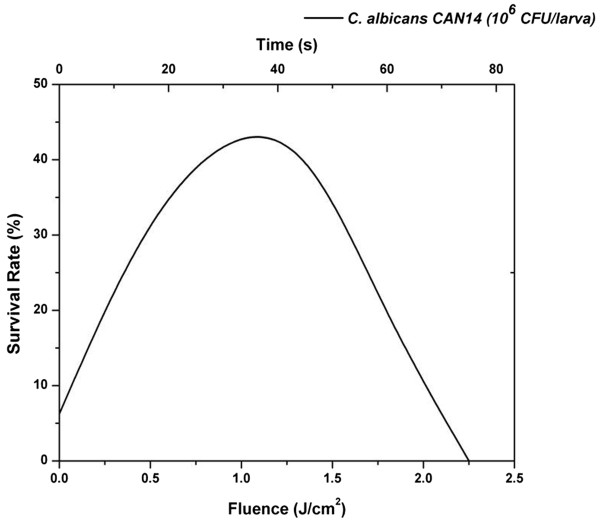
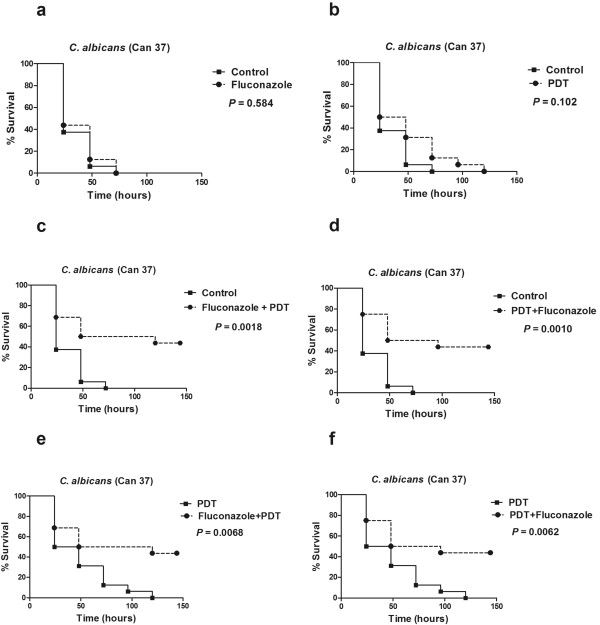
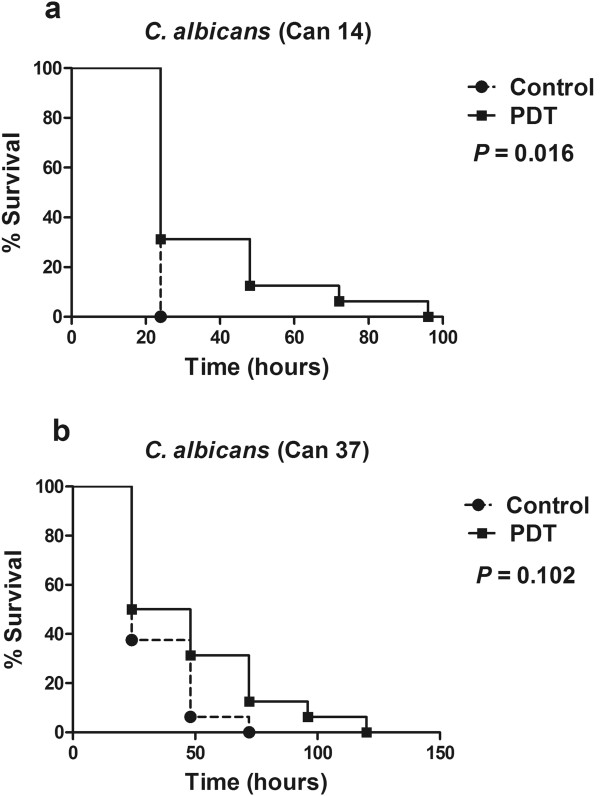
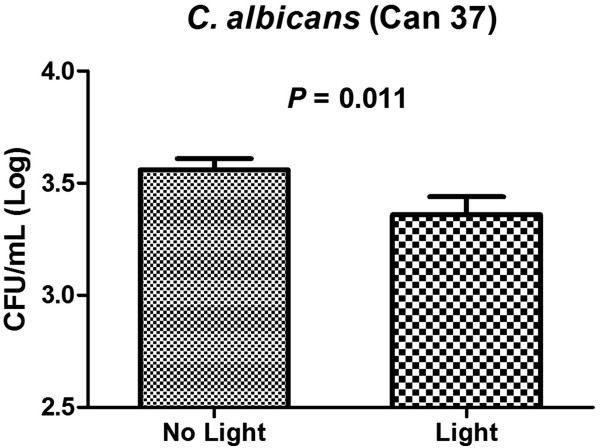
We verified that methylene blue-mediated aPDT prolonged the survival of C. albicans infected G. mellonella larvae. The fungal burden of G. mellonella hemolymph was reduced after aPDT in infected larvae. A fluconazole-resistant C. albicans strain was used to test the combination of aPDT and fluconazole. Administration of fluconazole either before or after exposing the larvae to aPDT significantly prolonged the survival of the larvae compared to either treatment alone.
G. mellonella is a useful in vivo model to evaluate aPDT as a treatment regimen for Candida infections. The data suggests that combined aPDT and antifungal therapy could be an alternative approach to antifungal-resistant Candida strains.
念珠菌属被认为是免疫功能低下患者严重真菌感染的主要病原体,也是血流感染的第四大常见原因。我们的研究探讨了光动力疗法(PDT)作为一种创新的抗菌技术的治疗方法,该技术使用一种无毒染料,称为光敏剂(PS),然后用无害的可见光照射。光激活后,PS 产生单线态氧或其他活性氧物质(ROS),主要与病原体细胞壁反应,促进膜的通透性和细胞死亡。抗真菌耐药念珠菌菌株的出现促使人们研究抗菌 PDT(aPDT)作为这些感染的替代治疗方法。我们使用无脊椎动物黄粉虫作为体内模型来研究 aPDT 对白色念珠菌感染的影响。还评估了 aPDT 与常规抗真菌药物联合使用对黄粉虫的影响。
我们验证了亚甲蓝介导的 aPDT 延长了感染白色念珠菌的黄粉虫幼虫的存活时间。在感染幼虫中进行 aPDT 后,黄粉虫血淋巴中的真菌负荷减少。使用氟康唑耐药的白色念珠菌菌株测试 aPDT 和氟康唑的联合用药。与单独使用任何一种治疗方法相比,在将幼虫暴露于 aPDT 之前或之后给予氟康唑均可显著延长幼虫的存活时间。
黄粉虫是评估 aPDT 作为念珠菌感染治疗方案的有用体内模型。数据表明,联合 aPDT 和抗真菌治疗可能是对抗真菌耐药念珠菌菌株的一种替代方法。