Division of Genetics and Molecular Biology, Institute of Biological Sciences, Faculty of Science, University of Malaya, Kuala Lumpur 50603, Malaysia.
Sensors (Basel). 2013 Sep 30;13(10):13217-27. doi: 10.3390/s131013217.
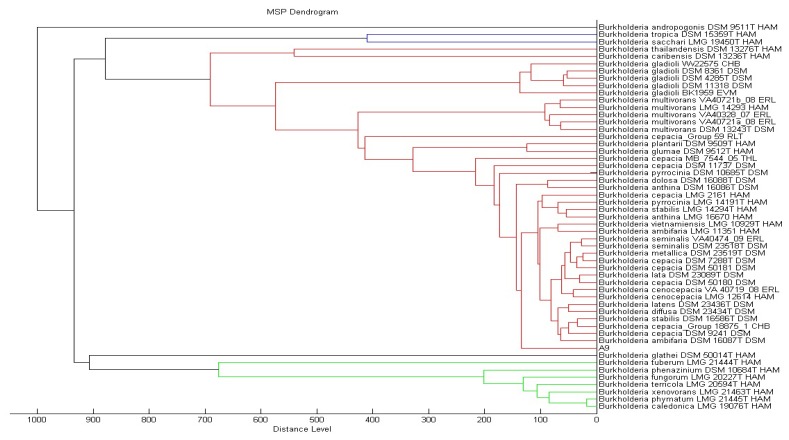
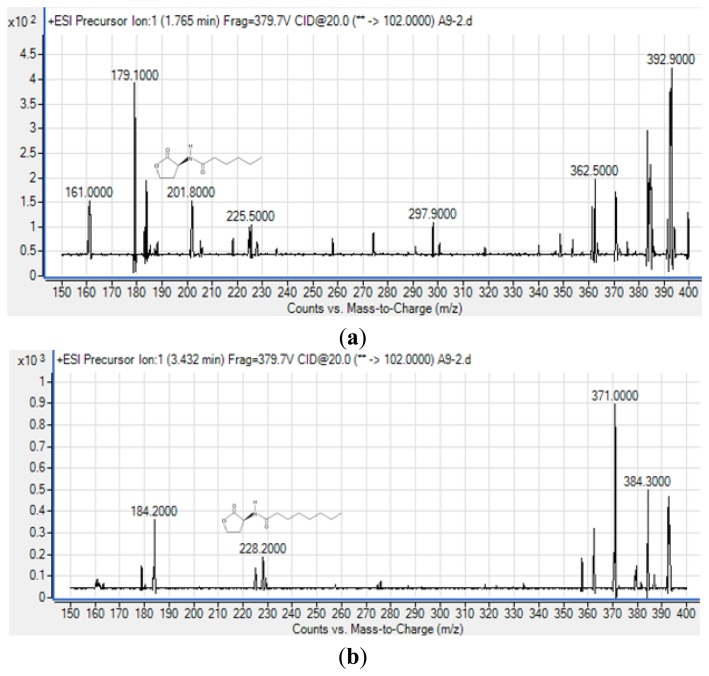
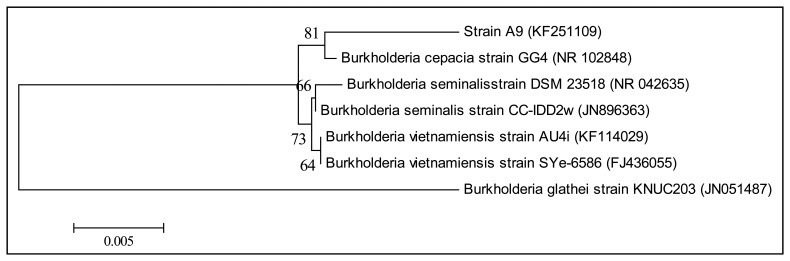
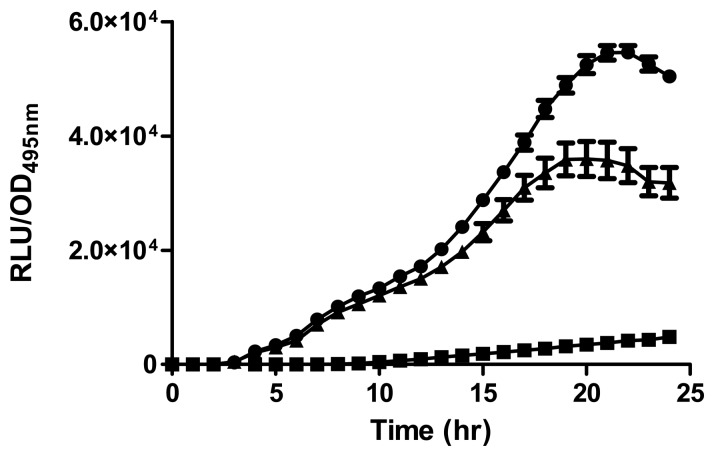
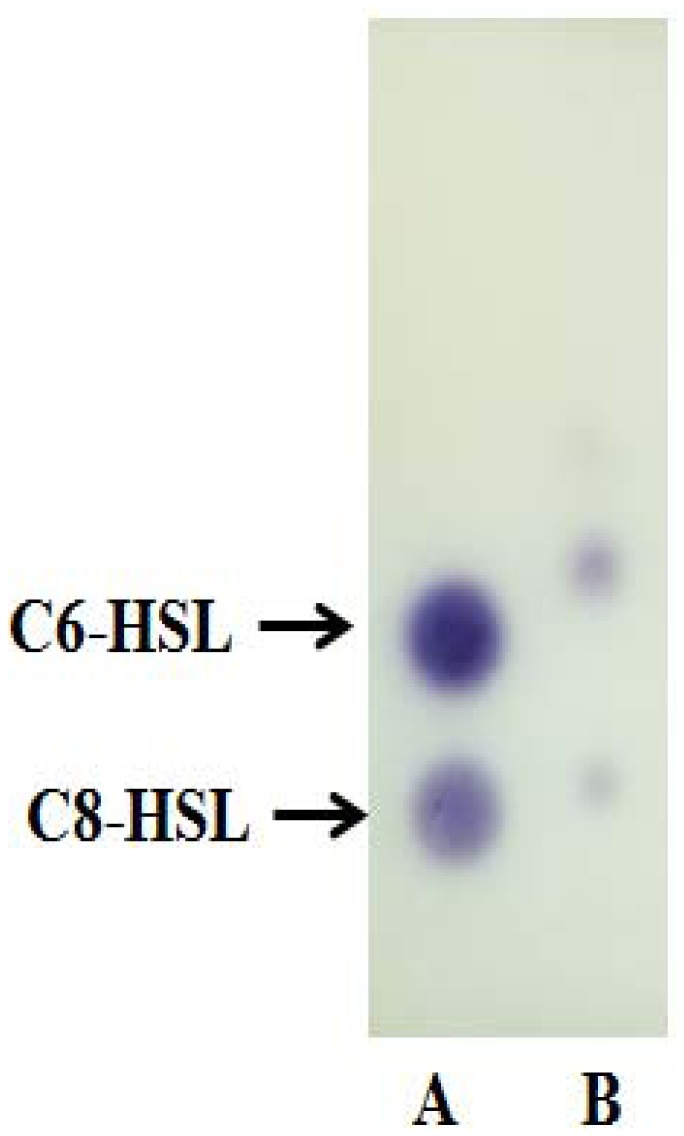
In the bacteria kingdom, quorum sensing (QS) is a cell-to-cell communication that relies on the production of and response to specific signaling molecules. In proteobacteria, N-acylhomoserine lactones (AHLs) are the well-studied signaling molecules. The present study aimed to characterize the production of AHL of a bacterial strain A9 isolated from a Malaysian tropical soil. Strain A9 was identified as Burkholderia sp. using matrix-assisted laser desorption ionization-time-of-flight mass spectrometry and 16S rDNA nucleotide sequence analysis. AHL production by A9 was detected with two biosensors, namely Chromobacterium violaceum CV026 and Escherichia coli [pSB401]. Thin layer chromatography results showed N-hexanoylhomoserine lactone (C6-HSL) and N-octanoylhomoserine lactone (C8-HSL) production. Unequivocal identification of C6-HSL and C8-HSL was achieved by high resolution triple quadrupole liquid chromatography-mass spectrometry analysis. We have demonstrated that Burkholderia sp. strain A9 produces AHLs that are known to be produced by other Burkholderia spp. with CepI/CepR homologs.
在细菌王国中,群体感应(QS)是一种依赖于特定信号分子的产生和响应的细胞间通讯。在变形菌门中,N-酰基高丝氨酸内酯(AHLs)是研究得最多的信号分子。本研究旨在表征从马来西亚热带土壤中分离的细菌菌株 A9 产生 AHL 的特性。使用基质辅助激光解吸电离飞行时间质谱和 16S rDNA 核苷酸序列分析,菌株 A9 被鉴定为伯克霍尔德菌属。使用两种生物传感器,即紫色色杆菌 CV026 和大肠杆菌 [pSB401] 检测 A9 的 AHL 产生。薄层层析结果显示 N-己酰基高丝氨酸内酯(C6-HSL)和 N-辛酰基高丝氨酸内酯(C8-HSL)的产生。通过高分辨率三重四极杆液质联用分析,明确鉴定出 C6-HSL 和 C8-HSL。我们已经证明,伯克霍尔德菌属菌株 A9 产生 AHL,这些 AHL 是其他伯克霍尔德菌属与 CepI/CepR 同源物一起产生的。