Department of Experimental Medicine, Section of Human Physiology and Centro Polifunzionale di Scienze Motorie, University of Genoa, Genoa, Italy.
PLoS One. 2013 Sep 23;8(9):e75454. doi: 10.1371/journal.pone.0075454. eCollection 2013.
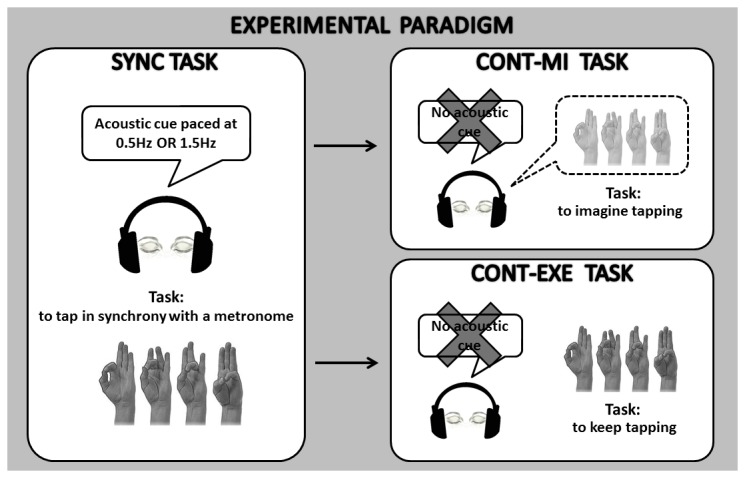
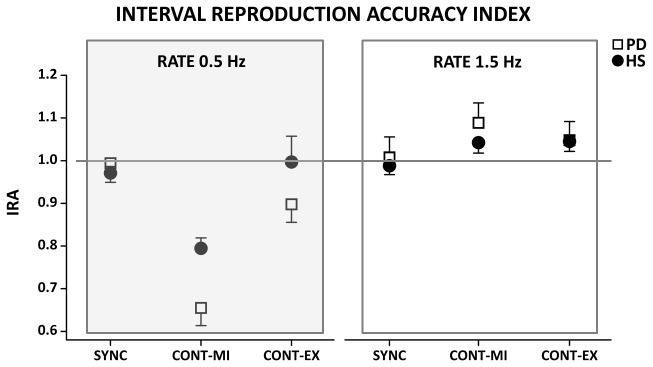
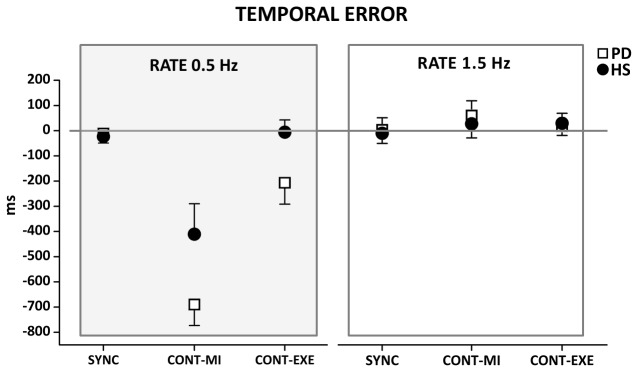
Timing of sequential movements is altered in Parkinson disease (PD). Whether timing deficits in internally generated sequential movements in PD depends also on difficulties in motor planning, rather than merely on a defective ability to materially perform the planned movement is still undefined. To unveil this issue, we adopted a modified version of an established test for motor timing, i.e. the synchronization-continuation paradigm, by introducing a motor imagery task. Motor imagery is thought to involve mainly processes of movement preparation, with reduced involvement of end-stage movement execution-related processes. Fourteen patients with PD and twelve matched healthy volunteers were asked to tap in synchrony with a metronome cue (SYNC) and then, when the tone stopped, to keep tapping, trying to maintain the same rhythm (CONT-EXE) or to imagine tapping at the same rhythm, rather than actually performing it (CONT-MI). We tested both a sub-second and a supra-second inter-stimulus interval between the cues. Performance was recorded using a sensor-engineered glove and analyzed measuring the temporal error and the interval reproduction accuracy index. PD patients were less accurate than healthy subjects in the supra-second time reproduction task when performing both continuation tasks (CONT-MI and CONT-EXE), whereas no difference was detected in the synchronization task and on all tasks involving a sub-second interval. Our findings suggest that PD patients exhibit a selective deficit in motor timing for sequential movements that are separated by a supra-second interval and that this deficit may be explained by a defect of motor planning. Further, we propose that difficulties in motor planning are of a sufficient degree of severity in PD to affect also the motor performance in the supra-second time reproduction task.
帕金森病(PD)患者的连续运动时序会发生改变。在 PD 患者中,内部产生的连续运动的定时缺陷是否也取决于运动规划的困难,而不仅仅是由于无法实际执行计划的运动,目前仍未确定。为了揭示这个问题,我们采用了一种已建立的运动定时测试的修改版本,即同步-延续范式,通过引入运动意象任务。运动意象被认为主要涉及运动准备过程,而与末端运动执行相关的过程参与度降低。我们要求 14 名 PD 患者和 12 名匹配的健康志愿者在节拍器提示下同步敲击(SYNC),然后当声音停止时,继续敲击,尝试保持相同的节奏(CONT-EXE)或想象以相同的节奏敲击,而不是实际执行(CONT-MI)。我们测试了提示之间的亚秒和超秒两种刺激间隔。使用传感器工程手套记录性能,并通过测量时间误差和间隔再现准确性指数来分析。与健康受试者相比,PD 患者在执行延续任务(CONT-MI 和 CONT-EXE)时,在超秒时间再现任务中的准确性较低,而在同步任务中和涉及亚秒间隔的所有任务中,都没有差异。我们的发现表明,PD 患者在超秒间隔的连续运动时序中表现出选择性的运动定时缺陷,而这种缺陷可能可以用运动规划缺陷来解释。此外,我们提出 PD 患者的运动规划困难程度足以影响超秒时间再现任务中的运动表现。