Division of Nephrology, Department of Internal Medicine, Chonnam National University Medical School, Gwangju, Korea.
PLoS One. 2013 Sep 24;8(9):e75583. doi: 10.1371/journal.pone.0075583. eCollection 2013.
Hospital-acquired anemia (HAA) is common in patients with acute myocardial infarction (AMI) and is an independent indicator of long-term mortality in these patients. However, limited information exists regarding the development and prognostic impact of HAA associated with acute kidney injury (AKI) and chronic kidney disease (CKD) in AMI patients.
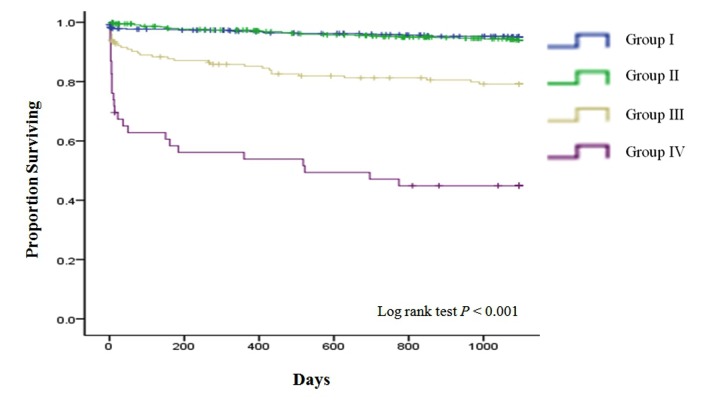
We retrospectively analyzed 2,289 patients with AMI, and excluded those with anemia at admission. The study population included 1,368 patients, of whom 800 (58.5%) developed HAA. Age, Hgb level at admission, Length of hospital stay, documented in-hospital bleeding and use of glycoprotein IIb/IIIa inhibitor, presence of CKD and occurrence of AKI were significantly associated with the development of HAA. HAA was significantly associated with higher 3-year mortality (4.8% and 11.4% for non-HAA and HAA patients, respectively; P < 0.001). After adjustment for multivariable confounders, the risk for long-term mortality was increased in HAA patients with AKI and/or CKD but not in HAA patients without AKI and/or CKD, compared to non-HAA patients (HAA patients without AKI and CKD, hazard ratio [HR]: 1.34, 95% confidence interval [CI]: 0.70-2.56; HAA patients with either AKI or CKD, HR: 2.80, 95% CI: 1.37-5.73; HAA patients with AKI and CKD, HR: 3.25, 95% CI: 1.28-8.24; compared with the non-HAA group).
AKI and CKD were strongly associated with the development of HAA in AMI patients. HAA, when accompanied by AKI or CKD, is an independent risk predictor for long-term mortality in AMI patients.
医院获得性贫血(HAA)在急性心肌梗死(AMI)患者中很常见,是这些患者长期死亡率的独立指标。然而,关于与急性肾损伤(AKI)和慢性肾病(CKD)相关的 HAA 在 AMI 患者中的发展和预后影响的信息有限。
我们回顾性分析了 2289 名 AMI 患者,并排除了入院时即有贫血的患者。研究人群包括 1368 名患者,其中 800 名(58.5%)发生了 HAA。年龄、入院时 Hgb 水平、住院时间、住院期间出血记录和使用糖蛋白 IIb/IIIa 抑制剂、CKD 存在和 AKI 的发生与 HAA 的发生显著相关。HAA 与较高的 3 年死亡率显著相关(非 HAA 组和 HAA 组分别为 4.8%和 11.4%;P<0.001)。在校正多变量混杂因素后,与非 HAA 患者相比,AKI 和/或 CKD 合并 HAA 的患者发生长期死亡的风险增加,但无 AKI 和/或 CKD 的 HAA 患者的风险未增加(无 AKI 和 CKD 的 HAA 患者,风险比[HR]:1.34,95%置信区间[CI]:0.70-2.56;仅 AKI 或 CKD 的 HAA 患者,HR:2.80,95% CI:1.37-5.73;AKI 和 CKD 并存的 HAA 患者,HR:3.25,95% CI:1.28-8.24;与非 HAA 组相比)。
AKI 和 CKD 与 AMI 患者 HAA 的发生密切相关。当 HAA 伴有 AKI 或 CKD 时,是 AMI 患者长期死亡率的独立危险因素。