Institut Pasteur, Unité d'Epidémiologie et Physiopathologie des Virus Oncogènes, Département de Virologie, Paris, France ; CNRS, UMR 3569, Paris, France.
PLoS Negl Trop Dis. 2013 Sep 26;7(9):e2418. doi: 10.1371/journal.pntd.0002418. eCollection 2013.
HTLV-1 infection is endemic among people of Melanesian descent in Papua New Guinea, the Solomon Islands and Vanuatu. Molecular studies reveal that these Melanesian strains belong to the highly divergent HTLV-1c subtype. In Australia, HTLV-1 is also endemic among the Indigenous people of central Australia; however, the molecular epidemiology of HTLV-1 infection in this population remains poorly documented.
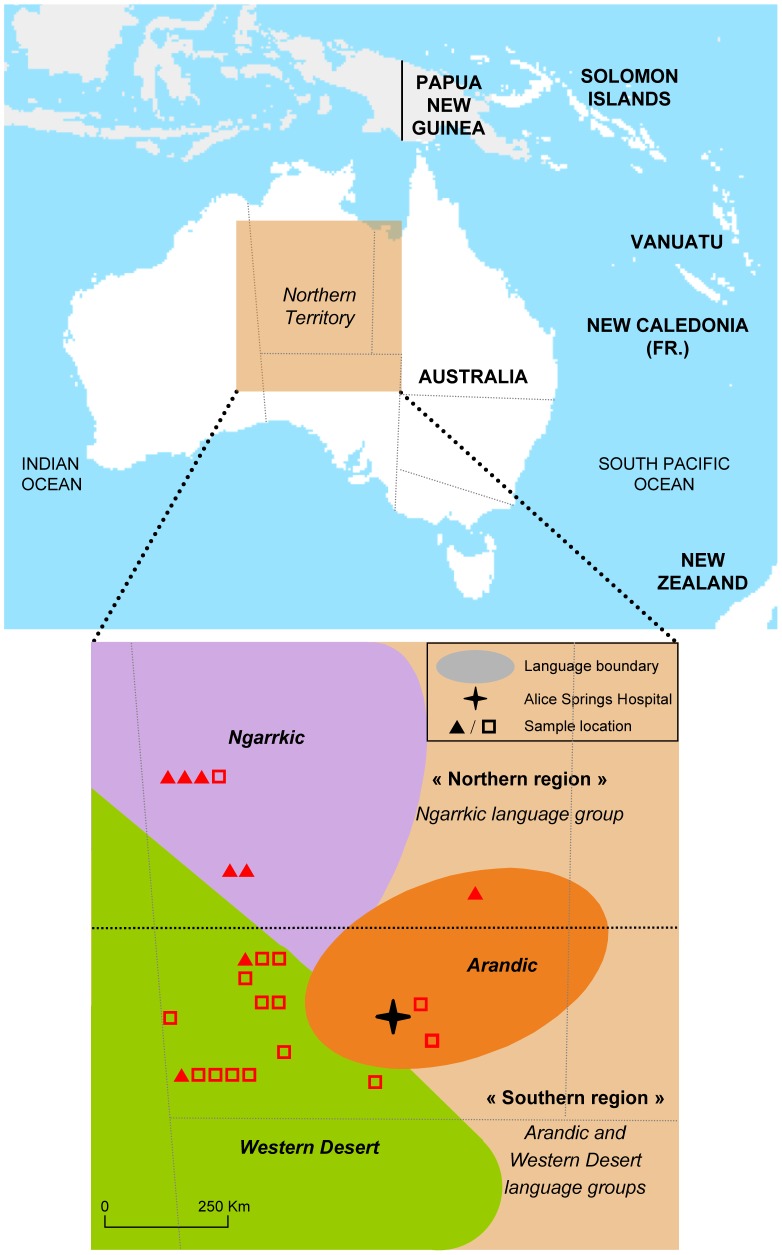
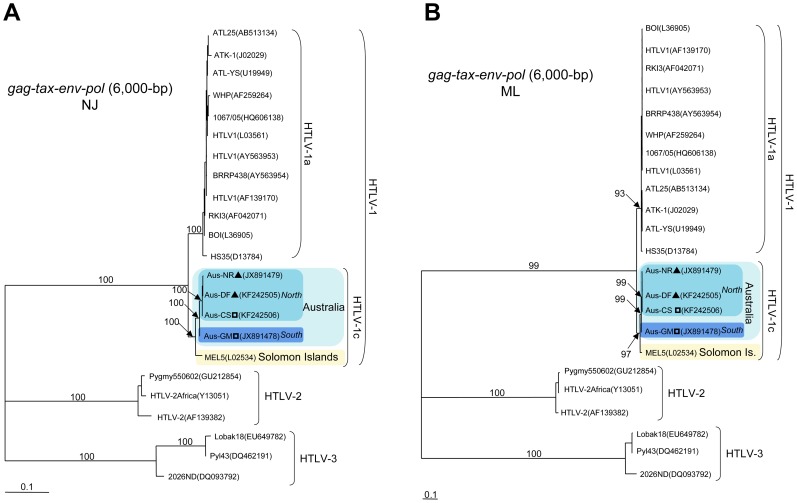
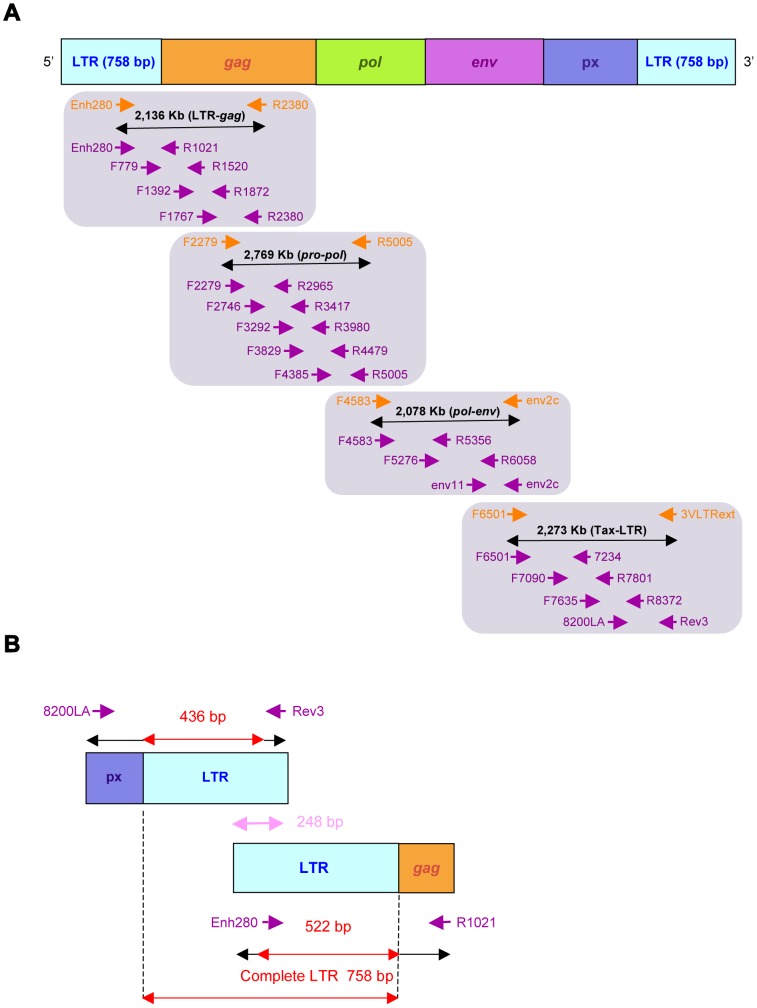
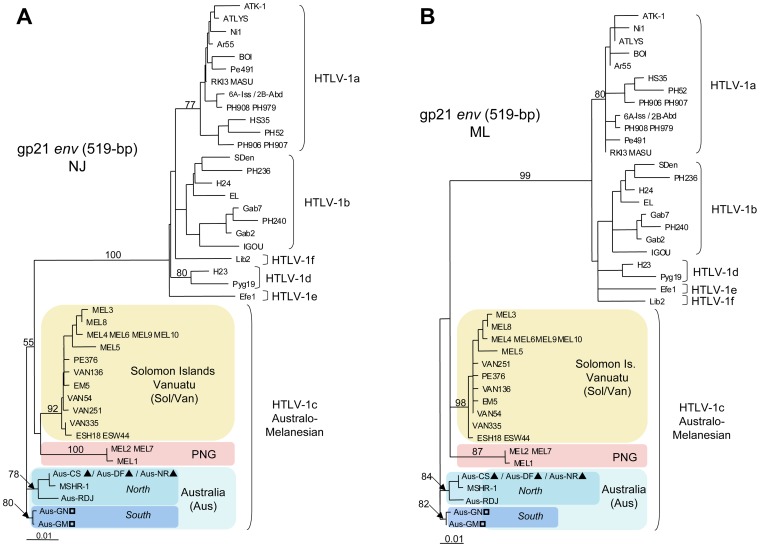
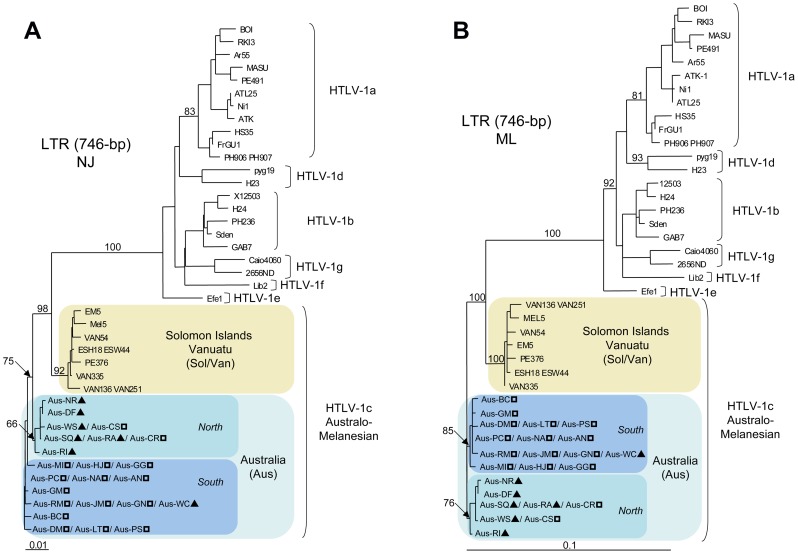
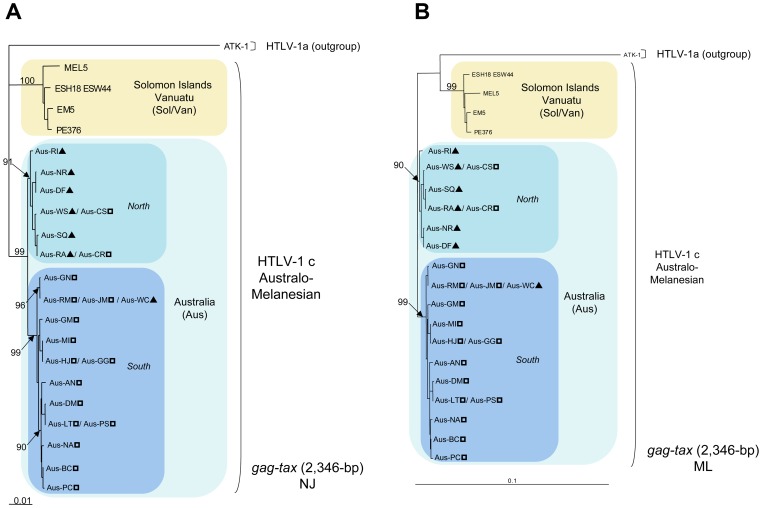
Studying a series of 23 HTLV-1 strains from Indigenous residents of central Australia, we analyzed coding (gag, pol, env, tax) and non-coding (LTR) genomic proviral regions. Four complete HTLV-1 proviral sequences were also characterized. Phylogenetic analyses implemented with both Neighbor-Joining and Maximum Likelihood methods revealed that all proviral strains belong to the HTLV-1c subtype with a high genetic diversity, which varied with the geographic origin of the infected individuals. Two distinct Australians clades were found, the first including strains derived from most patients whose origins are in the North, and the second comprising a majority of those from the South of central Australia. Time divergence estimation suggests that the speciation of these two Australian clades probably occurred 9,120 years ago (38,000-4,500).
The HTLV-1c subtype is endemic to central Australia where the Indigenous population is infected with diverse subtype c variants. At least two Australian clades exist, which cluster according to the geographic origin of the human hosts. These molecular variants are probably of very ancient origin. Further studies could provide new insights into the evolution and modes of dissemination of these retrovirus variants and the associated ancient migration events through which early human settlement of Australia and Melanesia was achieved.
HTLV-1 感染在巴布亚新几内亚、所罗门群岛和瓦努阿图的美拉尼西亚人中有流行。分子研究表明,这些美拉尼西亚株属于高度分化的 HTLV-1c 亚型。在澳大利亚,HTLV-1 也在澳大利亚中部的土著人中流行;然而,该人群中 HTLV-1 感染的分子流行病学仍记录甚少。
通过对澳大利亚中部土著居民的 23 株 HTLV-1 株进行研究,我们分析了编码( gag 、 pol 、 env 、 tax )和非编码( LTR )基因组前病毒区。还对 4 个完整的 HTLV-1 前病毒序列进行了特征描述。使用邻接法和最大似然法进行的系统发育分析表明,所有前病毒株均属于 HTLV-1c 亚型,具有高度的遗传多样性,其变化与受感染个体的地理起源有关。发现了两个独特的澳大利亚分支,第一个分支包括大多数起源于北部的患者的株,第二个分支包括大多数来自澳大利亚中部南部的株。时间分歧估计表明,这两个澳大利亚分支的物种形成可能发生在 9120 年前(38000-4500)。
HTLV-1c 亚型在澳大利亚中部流行,那里的土著居民感染了多种亚型 c 变体。至少存在两个澳大利亚分支,它们根据人类宿主的地理起源聚类。这些分子变异可能起源非常古老。进一步的研究可以提供新的见解,了解这些逆转录病毒变异的进化和传播模式,以及与早期人类定居澳大利亚和美拉尼西亚相关的古代迁移事件。