Chang Irene J, Huang Rong, He Wei, Zhang Shao-Kai, Wang Shao-Ming, Zhao Fang-Hui, Smith Jennifer S, Qiao You-Lin
Department of Epidemiology, Cancer Institute of Chinese Academy of Medical Sciences, Peking Union Medical College, Beijing, P,R, China.
BMC Public Health. 2013 Oct 2;13:916. doi: 10.1186/1471-2458-13-916.
Due to the potential of human papillomavirus (HPV) vaccination for decreasing cervical cancer rates in Mainland China, where some of the highest incidences in the world have been reported, our study aimed to assess HPV and HPV vaccine knowledge, and to evaluate the effect of a brief educational intervention on HPV knowledge and vaccine acceptability in Chinese undergraduate students and employed women.
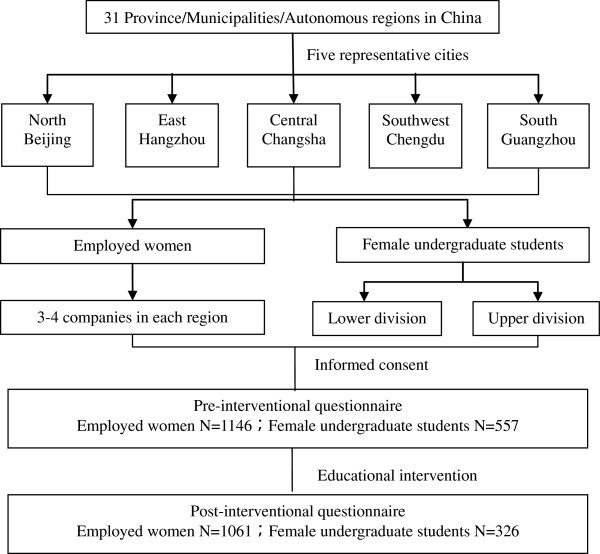
This multi-center, cross-sectional study was conducted across five representative cities of the five main geographical regions of Mainland China. Participants were selected from one comprehensive university and three to four companies in each city for a total of six comprehensive universities and 16 companies. A 62-item questionnaire on HPV knowledge and HPV vaccine acceptability was administered to participants before and after an educational intervention. The intervention consisted of an informative group lecture.
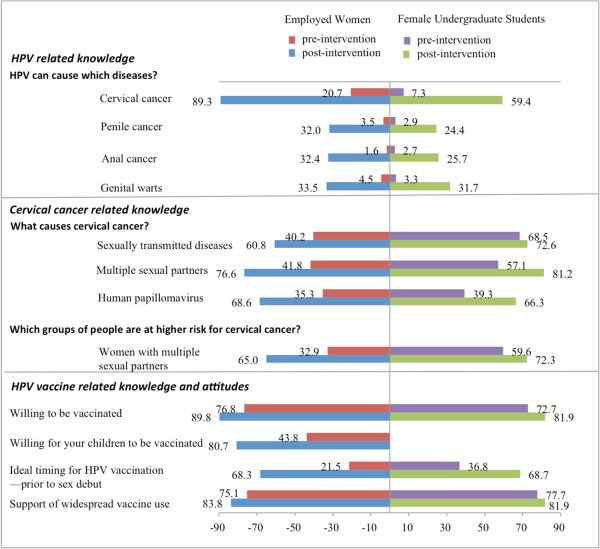
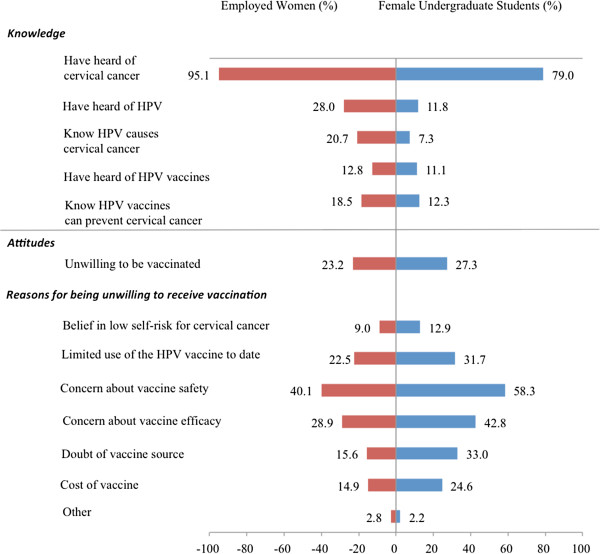
A total of 1146 employed women and 557 female undergraduate students were surveyed between August and November 2011. Baseline HPV knowledge was low among both groups--320/1146 (28%) of employed women and 66/557 (12%) of students had heard of HPV, while only 237/1146 (21%) of employed women and 40/557 (7.2%) of students knew that HPV is related to cervical cancer. After educational instruction, 947/1061 (89%) of employed women and 193/325 (59%) of students knew the relationship between HPV and cervical cancer (χ2 = 1041.8, p < 0.001 and χ2 = 278.5, p < 0.001, respectively). Post-intervention, vaccine acceptability increased from 881/1146 (77%) to 953/1061 (90%), (p = <0.001) in employed women and 405/557 (73%) in students to 266/325 (82%), (p < 0.001). Women in both groups cited concerns about the HPV vaccine's safety, efficacy, and limited use to date as reasons for being unwilling to receive vaccination. 502/1146 (44%) of women were willing to vaccinate their children at baseline, which increased to 857/1061 (81%) post-intervention, p < 0.001.
Incorporation of our lecture-based education initiative into a government-sponsored or school-based program may improve HPV-related knowledge and HPV vaccine acceptability. Further studies are needed to evaluate and standardize HPV education programs in China.
由于人乳头瘤病毒(HPV)疫苗接种在中国大陆具有降低宫颈癌发病率的潜力(据报道,中国大陆是世界上宫颈癌发病率最高的地区之一),我们的研究旨在评估HPV及HPV疫苗知识,并评价一项简短教育干预对中国本科学生和职业女性的HPV知识及疫苗可接受性的影响。
这项多中心横断面研究在中国大陆五个主要地理区域的五个代表性城市开展。从每个城市的一所综合性大学和三到四家公司选取参与者,共计六所综合性大学和16家公司。在教育干预前后,向参与者发放一份关于HPV知识和HPV疫苗可接受性的62项问卷。干预包括一场信息丰富的小组讲座。
2011年8月至11月期间,共对1146名职业女性和557名本科女生进行了调查。两组的基线HPV知识水平都较低——1146名职业女性中有320人(28%)、557名学生中有66人(12%)听说过HPV,而1146名职业女性中只有237人(21%)、557名学生中只有40人(7.2%)知道HPV与宫颈癌有关。经过教育指导后,1061名职业女性中有947人(89%)、325名学生中有193人(59%)知道了HPV与宫颈癌的关系(χ2 = 1041.8,p < 0.001;χ2 = 278.5,p < 0.001)。干预后,职业女性的疫苗可接受性从1146人中的881人(77%)增至1061人中的953人(90%),(p = <0.001),学生的疫苗可接受性从557人中的405人(73%)增至325人中的266人(82%),(p < 0.001)。两组女性都表示,担心HPV疫苗的安全性、有效性以及目前使用范围有限是她们不愿接种疫苗的原因。1146名女性中有502人(44%)在基线时愿意为自己的孩子接种疫苗,干预后这一比例增至1061人中的857人(81%),p < 0.001。
将我们基于讲座的教育倡议纳入政府资助或学校项目中,可能会提高与HPV相关的知识以及HPV疫苗的可接受性。需要进一步开展研究,以评估和规范中国的HPV教育项目。