Wahyuni Tutik Sri, Tumewu Lydia, Permanasari Adita Ayu, Apriani Evhy, Adianti Myrna, Rahman Abdul, Widyawaruyanti Aty, Lusida Maria Inge, Fuad Achmad, Fuchino Hiroyuki, Kawahara Nobuo, Shoji Ikuo, Deng Lin, Aoki Chie, Hotta Hak
Virol J. 2013 Aug 13;10:259. doi: 10.1186/1743-422X-10-259.
Hepatitis C virus (HCV) is a major cause of liver disease and a potential cause of substantial morbidity and mortality worldwide. The overall prevalence of HCV infection is 2%, representing 120 million people worldwide. Current standard treatment using pegylated interferon and ribavirin is effective in only 50% of the patients infected with HCV genotype 1, and is associated with significant side effects. Therefore, it is still of importance to develop new drugs for treatment of HCV. Antiviral substances obtained from natural products, including medicinal plants, are potentially good targets to study. In this study, we evaluated Indonesian medicinal plants for their anti-HCV activities.
Ethanol extracts of 21 samples derived from 17 species of medicinal plants explored in the East Java region were tested. Anti-HCV activities were determined by a cell culture method using Huh7.5 cells and HCV strains of 9 different genotypes (1a to 7a, 1b and 2b).
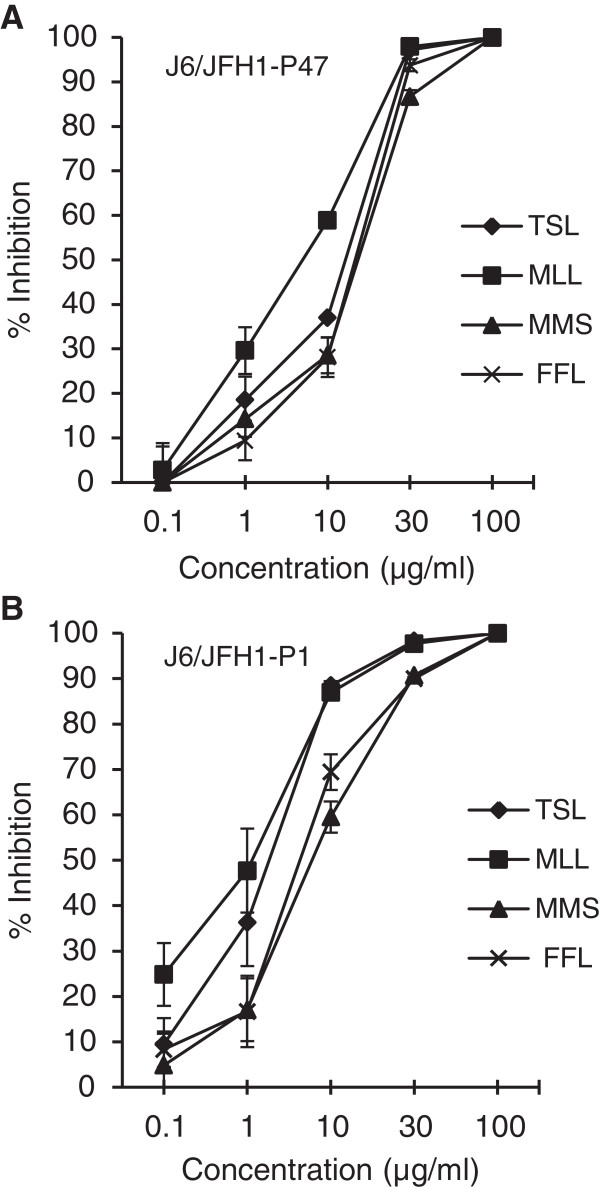
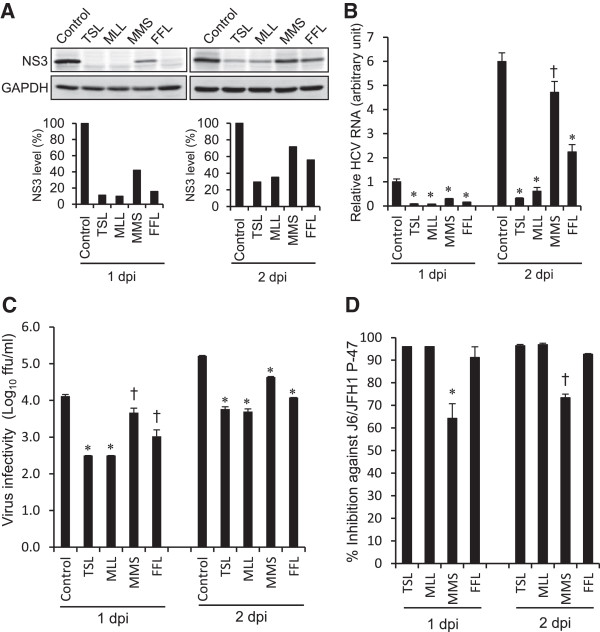
Four of the 21 samples tested showed antiviral activities against HCV: Toona sureni leaves (TSL) with 50% inhibitory concentrations (IC50) of 13.9 and 2.0 μg/ml against the HCV J6/JFH1-P47 and -P1 strains, respectively, Melicope latifolia leaves (MLL) with IC50 of 3.5 and 2.1 μg/ml, respectively, Melanolepis multiglandulosa stem (MMS) with IC50 of 17.1 and 6.2 μg/ml, respectively, and Ficus fistulosa leaves (FFL) with IC50 of 15.0 and 5.7 μg/ml, respectively. Time-of-addition experiments revealed that TSL and MLL inhibited both at the entry and post-entry steps while MMS and FFL principally at the entry step. TSL and MLL inhibited all of 11 HCV strains of all the genotypes tested to the same extent. On the other hand, FFL showed significantly weaker inhibitory activities against the HCV genotype 1a strain, and MMS against the HCV strains of genotypes 2b and 7a to a lesser extent, compared to the other HCV genotypes.
Ethanol extracts of TSL, MLL, MMS and FFL showed antiviral activities against all the HCV genotypes tested with the exception that some genotype(s) showed significant resistance to FFL and to MMS to a lesser extent. These plant extracts may be good candidates for the development of anti-HCV drugs.
丙型肝炎病毒(HCV)是导致肝脏疾病的主要原因,在全球范围内是引发大量发病和死亡的潜在因素。HCV感染的总体患病率为2%,全球约有1.2亿人感染。目前使用聚乙二醇化干扰素和利巴韦林的标准治疗方法仅对50%的HCV 1型感染患者有效,且伴有明显的副作用。因此,开发治疗HCV的新药仍然很重要。从包括药用植物在内的天然产物中获得的抗病毒物质是潜在的良好研究对象。在本研究中,我们评估了印度尼西亚药用植物的抗HCV活性。
对来自东爪哇地区17种药用植物的21个样品的乙醇提取物进行了测试。使用Huh7.5细胞和9种不同基因型(1a至7a、1b和2b)的HCV毒株,通过细胞培养方法测定抗HCV活性。
测试的21个样品中有4个显示出对HCV的抗病毒活性:红椿叶(TSL)对HCV J6/JFH1 - P47和 - P1毒株的50%抑制浓度(IC50)分别为13.9和2.0μg/ml,阔叶蜜茱萸叶(MLL)的IC50分别为3.5和2.1μg/ml,多腺黑鳞木茎(MMS)的IC50分别为17.1和6.2μg/ml,以及无花果叶(FFL)的IC50分别为15.0和5.7μg/ml。加药时间实验表明,TSL和MLL在病毒进入和进入后阶段均有抑制作用,而MMS和FFL主要在病毒进入阶段起作用。TSL和MLL对所有测试基因型的11种HCV毒株均有同等程度的抑制作用。另一方面,与其他HCV基因型相比,FFL对HCV 1a基因型毒株的抑制活性明显较弱,MMS对HCV 2b和7a基因型毒株的抑制作用较小。
TSL、MLL、MMS和FFL的乙醇提取物对所有测试的HCV基因型均显示出抗病毒活性,但某些基因型对FFL表现出明显抗性,对MMS的抗性较小。这些植物提取物可能是开发抗HCV药物的良好候选物。