Neto Marcos S Regueira, de Souza Maria José, Loreto Vilma
Departamento de Genética, CCB, Universidade Federal de Pernambuco, Pernambuco, Recife, Brazil.
Mol Cytogenet. 2013 Oct 3;6(1):41. doi: 10.1186/1755-8166-6-41.
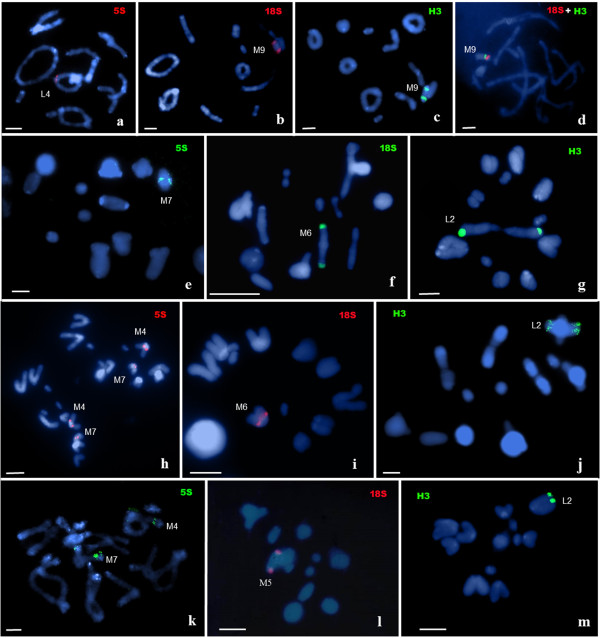
Grasshoppers from the Romaleidae family are well distributed in the Neotropical Region and represent a diversified and multicolored group in which the karyotype is conserved. Few studies have been conducted to understand the evolutionary dynamics of multigene families. Here, we report the chromosomal locations of the 18S and 5S rDNA and H3 histone multigene families in four grasshopper species from the Romaleidae family, revealed by fluorescent in situ hybridization (FISH).
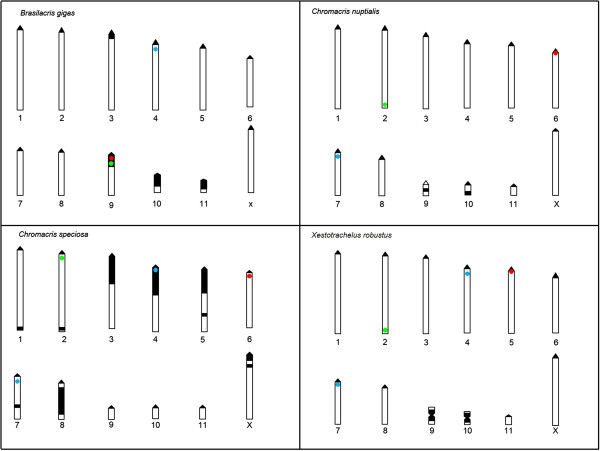
The 5S rDNA gene was located in one or two chromosome pairs, depending on the species, and was found in a basal distribution pattern. Its chromosomal location was highly conserved among these species. The 18S rDNA was located in a single medium-sized chromosomal pair in all species analyzed. Its chromosomal location was near the centromere in the proximal or pericentromeric regions. The location of the H3 histone gene was highly conserved, with slight chromosomal location differences among some species. To our knowledge, this is the first report of a megameric chromosome carrying both the chromosomal markers 18S rDNA and the H3 histone genes, thereby expanding our understanding of such chromosomes.
The 5S and 18S rDNA genes and the H3 histone genes showed a conservative pattern in the species that we analyzed. A basal distribution pattern for 5S rDNA was observed with a location on the fourth chromosomal pair, and it was identified as the possible ancestral bearer. The 18S rDNA and H3 histone genes were restricted to a single pair of chromosomes, representing an ancestral pattern. Our results reinforce the known taxonomic relationships between Chromacris and Xestotrachelus, which are two close genera.
瘤蝗科的蝗虫在新热带地区分布广泛,是一个多样化且色彩斑斓的类群,其核型保守。关于多基因家族进化动态的研究较少。在此,我们通过荧光原位杂交(FISH)揭示了瘤蝗科四个蝗虫物种中18S和5S核糖体DNA以及H3组蛋白多基因家族的染色体定位。
5S核糖体DNA基因根据物种不同位于一对或两对染色体上,呈基部分布模式。其染色体定位在这些物种中高度保守。18S核糖体DNA在所有分析物种中都位于一对中等大小的染色体上。其染色体定位在近端或着丝粒周围区域靠近着丝粒的位置。H3组蛋白基因的定位高度保守,一些物种之间染色体定位略有差异。据我们所知,这是首次报道携带18S核糖体DNA染色体标记和H3组蛋白基因的巨型染色体,从而扩展了我们对这类染色体的认识。
5S和18S核糖体DNA基因以及H3组蛋白基因在我们分析的物种中呈现出保守模式。观察到5S核糖体DNA的基部分布模式位于第四对染色体上,并被确定为可能的祖先携带者。18S核糖体DNA和H3组蛋白基因局限于一对染色体上,代表一种祖先模式。我们的结果强化了Chromacris和Xestotrachelus这两个近缘属之间已知的分类关系。