Harvard School of Public Health, Harvard University, Boston, MA 02115, United States.
Addict Behav. 2014 Jan;39(1):133-9. doi: 10.1016/j.addbeh.2013.09.016. Epub 2013 Sep 20.
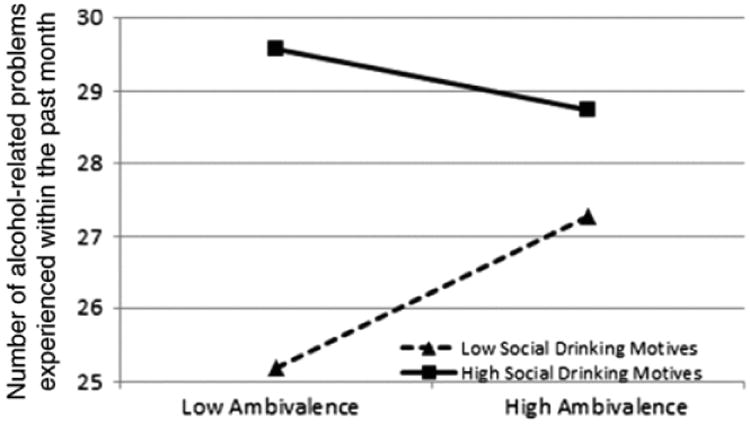
The current study seeks to evaluate relationships between drinking motives and alcohol-related ambivalence in the prediction of problem drinking. We expected that: 1) main effects would emerge such that alcohol-related ambivalence would be positively associated with peak drinking and problems; drinking motives would be positively associated with drinking and problems, and 2) interactions would emerge between motives and ambivalence in predicting problematic drinking such that drinking motives would be positively associated with peak drinking and problems, especially among those high in ambivalence over drinking. Six hundred sixty-nine undergraduate students (mean age=22.95, SD=5.47, 82.22% female) completed study materials. Results showed that consistent with expectations, ambivalence was positively associated with peak drinking and problems. Further, consistent with expectations, drinking motives were positively associated with peak drinking and problems. Additionally, ambivalence was positively associated with drinking motives. Significant interactions emerged between drinking motives (social and coping) and ambivalence when predicting peak drinking and alcohol-related problems. These findings highlight the importance of considering motives in the relationship between ambivalence and drinking. Clinical implications include the need for tailoring interventions to target individual difference factors that increase risk for heavy drinking and associated problems. This is especially important among college students who may be at risk for problematic behavior.
本研究旨在评估饮酒动机与饮酒矛盾态度在预测饮酒问题中的关系。我们预计:1)会出现主要效应,即饮酒矛盾态度与饮酒量峰值和问题呈正相关,饮酒动机与饮酒和问题呈正相关;2)在预测饮酒问题方面,动机与矛盾态度之间会出现交互作用,即饮酒动机与饮酒量峰值和问题呈正相关,特别是在那些对饮酒有较高矛盾态度的人中。669 名大学生(平均年龄=22.95,标准差=5.47,82.22%为女性)完成了研究材料。结果表明,与预期一致,矛盾态度与饮酒量峰值和问题呈正相关。此外,与预期一致,饮酒动机与饮酒量峰值和问题呈正相关。此外,矛盾态度与饮酒动机呈正相关。在预测饮酒量峰值和与酒精相关问题时,饮酒动机(社交和应对)与矛盾态度之间出现了显著的交互作用。这些发现强调了在矛盾态度与饮酒之间的关系中考虑动机的重要性。临床意义包括需要针对增加重度饮酒和相关问题风险的个体差异因素定制干预措施。对于那些可能有行为问题风险的大学生来说,这一点尤为重要。