Nusselder Wilma J, Slockers Marcel T, Krol Luuk, Slockers Colette T, Looman Caspar W N, van Beeck Ed F
Department of Public Health, Erasmus MC, University Medical Center Rotterdam, Rotterdam, The Netherlands.
PLoS One. 2013 Oct 2;8(10):e73979. doi: 10.1371/journal.pone.0073979. eCollection 2013.
Data on mortality among homeless people are limited. Therefore, this study aimed to describe mortality patterns within a cohort of homeless adults in Rotterdam (the Netherlands) and to assess excess mortality as compared to the general population in that city.
Based on 10-year follow-up of homeless adults aged ≥ 20 years who visited services for homeless people in Rotterdam in 2001, and on vital statistics, we assessed the association of mortality with age, sex and type of service used (e.g. only day care, convalescence care, other) within the homeless cohort, and also compared mortality between the homeless and general population using Poisson regression. Life tables and decomposition methods were used to examine differences in life expectancy.
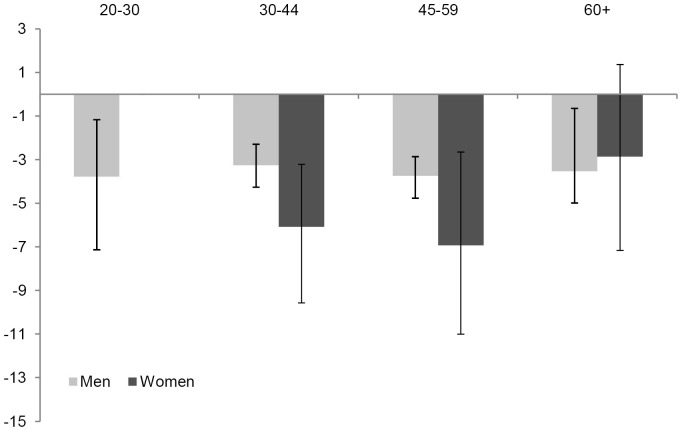
During follow-up, of the 2096 adult homeless 265 died. Among the homeless, at age 30 years no significant sex differences were found in overall mortality rates and life expectancy. Compared with the general Rotterdam population, mortality rates were 3.5 times higher in the homeless cohort. Excess mortality was larger in women (rate ratio [RR] RR 5.56, 95% CI 3.95-7.82) as compared to men (RR 3.31, 95% CI 2.91-3.77), and decreased with age (RR 7.67, 95% CI 6.87-8.56 for the age group 20-44 and RR 1.63, 95% CI 1.41-1.88 for the age group 60+ years). Life expectancy at age 30 years was 11.0 (95% CI 9.1-12.9) and 15.9 (95% CI 10.3-21.5) years lower for homeless men and women compared to men and women in the general population respectively.
Homeless adults face excessive losses in life expectancy, with greatest disadvantages among homeless women and the younger age groups.
关于无家可归者死亡率的数据有限。因此,本研究旨在描述鹿特丹(荷兰)一群无家可归成年人的死亡模式,并评估与该市普通人群相比的超额死亡率。
基于对2001年在鹿特丹使用无家可归者服务的20岁及以上无家可归成年人进行的10年随访以及人口动态统计数据,我们评估了无家可归者队列中死亡率与年龄、性别及所使用服务类型(如仅日间照料、康复护理、其他)之间的关联,并使用泊松回归比较了无家可归者与普通人群之间的死亡率。采用生命表和分解方法来研究预期寿命的差异。
在随访期间,2096名成年无家可归者中有265人死亡。在无家可归者中,30岁时总体死亡率和预期寿命未发现明显性别差异。与鹿特丹普通人群相比,无家可归者队列的死亡率高出3.5倍。女性的超额死亡率(率比[RR]为5.56,95%置信区间为3.95 - 7.82)高于男性(RR为3.31,95%置信区间为2.91 - 3.77),且随年龄增长而降低(20 - 44岁年龄组的RR为7.67,95%置信区间为6.87 - 8.56;60岁及以上年龄组的RR为1.63,95%置信区间为1.41 - 1.88)。与普通人群中的男性和女性相比,无家可归的男性和女性在30岁时的预期寿命分别低11.0(95%置信区间为9.1 - 12.9)岁和15.9(95%置信区间为10.3 - 21.5)岁。
无家可归的成年人面临预期寿命的过度损失,其中无家可归的女性和较年轻年龄组处于最不利地位。