Dünner Natalia, Quezada Carolina, Berndt F Andrés, Cánovas José, Rojas Cecilia V
Institute of Biomedical Sciences, Faculty of Medicine, Universidad de Chile, Santiago, Chile.
PLoS One. 2013 Oct 2;8(10):e75440. doi: 10.1371/journal.pone.0075440. eCollection 2013.
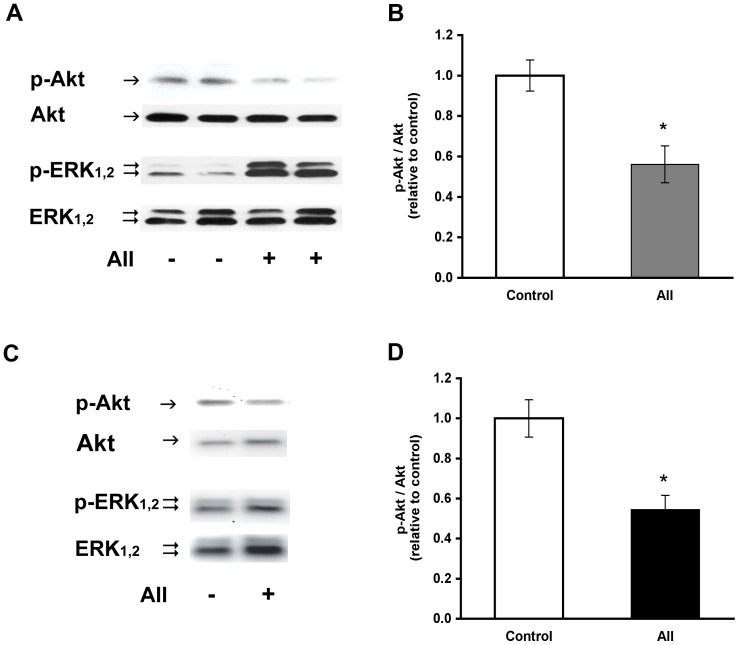
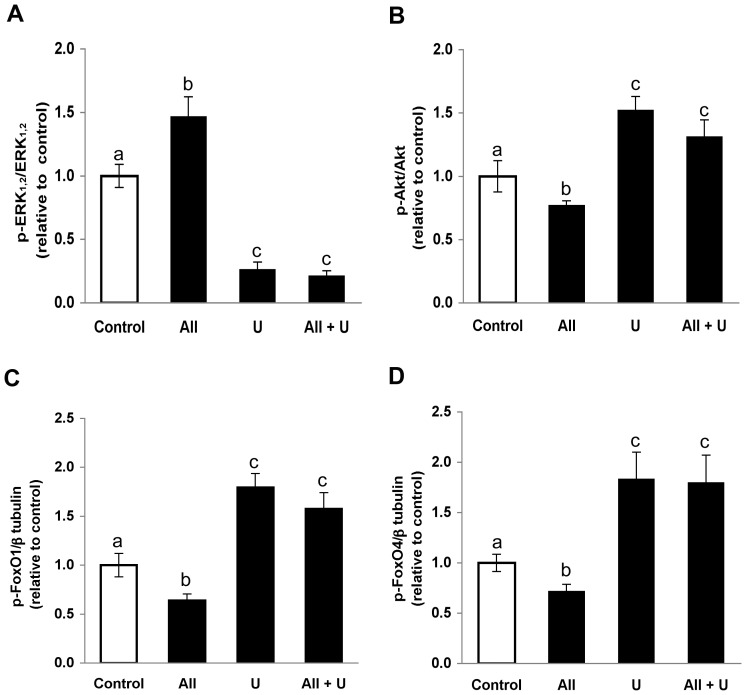
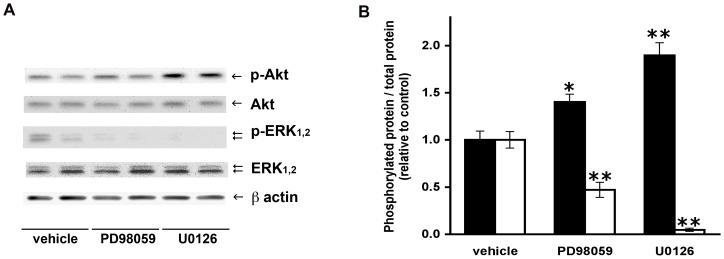
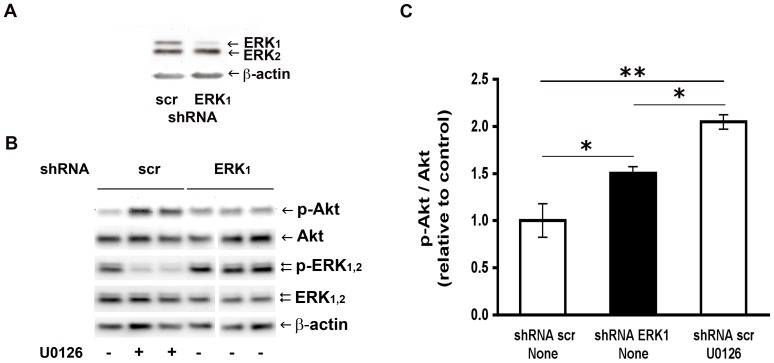
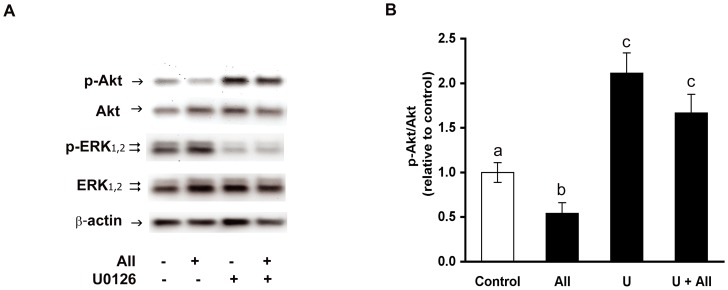
The renin-angiotensin system expressed in adipose tissue has been implicated in the modulation of adipocyte formation, glucose metabolism, triglyceride accumulation, lipolysis, and the onset of the adverse metabolic consequences of obesity. As we investigated angiotensin II signal transduction mechanisms in human preadipose cells, an interplay of extracellular-signal-regulated kinases 1 and 2 (ERK1,2) and Akt/PKB became evident. Angiotensin II caused attenuation of phosphorylated Akt (p-Akt), at serine 473; the p-Akt/Akt ratio decreased to 0.5±0.2-fold the control value without angiotensin II (p<0.001). Here we report that the reduction of phosphorylated Akt associates with ERK1,2 activities. In the absence of angiotensin II, inhibition of ERK1,2 activation with U0126 or PD98059 resulted in a 2.1±0.5 (p<0.001) and 1.4±0.2-fold (p<0.05) increase in the p-Akt/Akt ratio, respectively. In addition, partial knockdown of ERK1 protein expression by the short hairpin RNA technique also raised phosphorylated Akt in these cells (the p-Akt/Akt ratio was 1.5±0.1-fold the corresponding control; p<0.05). Furthermore, inhibition of ERK1,2 activation with U0126 prevented the reduction of p-Akt/Akt by angiotensin II. An analogous effect was found on the phosphorylation status of Akt downstream effectors, the forkhead box (Fox) proteins O1 and O4. Altogether, these results indicate that angiotensin II signaling in human preadipose cells involves an ERK1,2-dependent attenuation of Akt activity, whose impact on the biological functions under its regulation is not fully understood.
脂肪组织中表达的肾素-血管紧张素系统与脂肪细胞形成、葡萄糖代谢、甘油三酯积累、脂肪分解以及肥胖不良代谢后果的发生调节有关。在我们研究人脂肪前体细胞中的血管紧张素II信号转导机制时,细胞外信号调节激酶1和2(ERK1,2)与Akt/PKB之间的相互作用变得明显。血管紧张素II导致丝氨酸473位点的磷酸化Akt(p-Akt)衰减;p-Akt/Akt比值降至无血管紧张素II时对照值的0.5±0.2倍(p<0.001)。我们在此报告,磷酸化Akt的减少与ERK1,2活性相关。在无血管紧张素II的情况下,用U0126或PD98059抑制ERK1,2激活分别导致p-Akt/Akt比值增加2.1±0.5倍(p<0.001)和1.4±0.2倍(p<0.05)。此外,通过短发夹RNA技术部分敲低ERK1蛋白表达也提高了这些细胞中的磷酸化Akt(p-Akt/Akt比值为相应对照的1.5±0.1倍;p<0.05)。此外,用U0126抑制ERK1,2激活可防止血管紧张素II导致的p-Akt/Akt降低。在Akt下游效应物叉头框(Fox)蛋白O1和O4的磷酸化状态上也发现了类似的效应。总之,这些结果表明,人脂肪前体细胞中的血管紧张素II信号传导涉及ERK1,2依赖性的Akt活性衰减,其对其调控下生物学功能的影响尚未完全了解。