Ottawa Institute of Systems Biology, Department of Biochemistry, Microbiology and Immunology, Faculty of Medicine, University of Ottawa, Ontario, Canada.
PLoS One. 2013 Oct 2;8(10):e76269. doi: 10.1371/journal.pone.0076269. eCollection 2013.
Clostridium difficile is an anaerobic, spore-forming bacterium that is the most common cause of healthcare-associated diarrhea in developed countries. A significant proportion of patients receiving oral vancomycin or metronidazole for treatment of Clostridium difficile infection (CDI) develop recurrences. However, the period of vulnerability to re-establishment of colonization by C. difficile after therapy is not well defined.
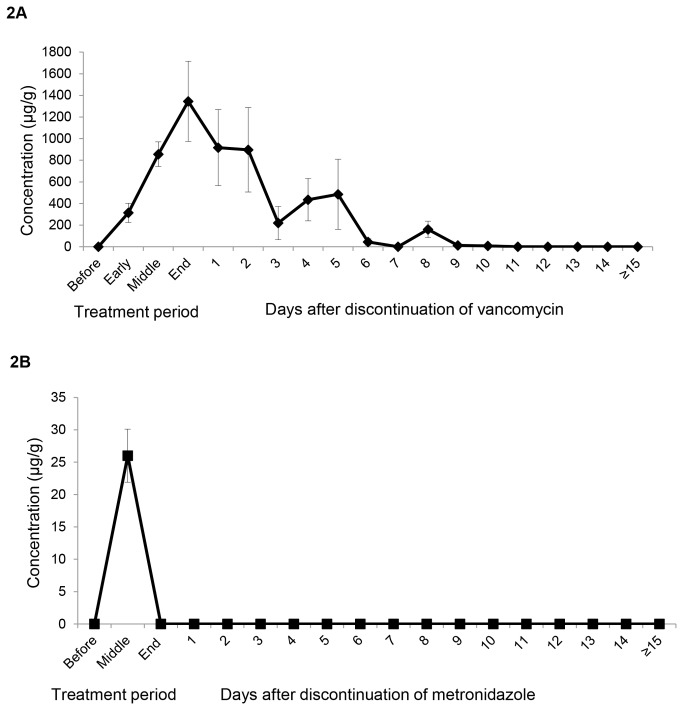
In a prospective study of CDI patients, we demonstrated that most vancomycin-treated patients maintained inhibitory concentrations of vancomycin in stool for 4 to 5 days after therapy, whereas metronidazole was only detectable during therapy. From the time of elimination of the antibiotics to 14 to 21 days after therapy, a majority of stool suspensions supported growth of C. difficile and deep 16S rRNA sequencing demonstrated persistent marked alteration of the indigenous microbiota. By 21 to 28 days after completion of CDI treatment, a majority of stool suspensions inhibited growth of C. difficile and there was evidence of some recovery of the microbiota.
These data demonstrate that there is a vulnerable period for re-establishment of C. difficile colonization after CDI treatment that begins within a few days after discontinuation of treatment and extends for about 3 weeks in most patients.
艰难梭菌是一种厌氧、产芽孢的细菌,是发达国家最常见的医疗保健相关腹泻的病因。相当一部分接受口服万古霉素或甲硝唑治疗艰难梭菌感染(CDI)的患者会复发。然而,治疗后再次发生艰难梭菌定植的脆弱期尚未明确。
在一项 CDI 患者的前瞻性研究中,我们发现大多数接受万古霉素治疗的患者在治疗后 4 至 5 天粪便中仍保持万古霉素的抑制浓度,而甲硝唑仅在治疗期间可检测到。从抗生素清除到治疗后 14 至 21 天,大多数粪便悬液支持艰难梭菌的生长,并且深度 16S rRNA 测序显示内源性微生物群持续存在明显改变。在 CDI 治疗完成后 21 至 28 天,大多数粪便悬液抑制了艰难梭菌的生长,并且微生物群有一定程度的恢复。
这些数据表明,CDI 治疗后存在艰难梭菌定植再次建立的脆弱期,该期在治疗停止后几天内开始,并在大多数患者中持续约 3 周。