Hausman Bryan S, Memic Samir, Cadnum Jennifer L, Zink Elizabeth G, Wilson Brigid M, Donskey Curtis J
Case Western Reserve University School of Medicine, Cleveland, Ohio.
Research Service, Louis Stokes Cleveland VA Medical Center, Cleveland, Ohio.
Pathog Immun. 2024 Sep 24;9(2):194-204. doi: 10.20411/pai.v9i2.711. eCollection 2024.
The potential for promotion of intestinal colonization with healthcare-associated pathogens by new antibiotics used to treat infections due to multidrug-resistant Gram-negative bacilli is unclear.
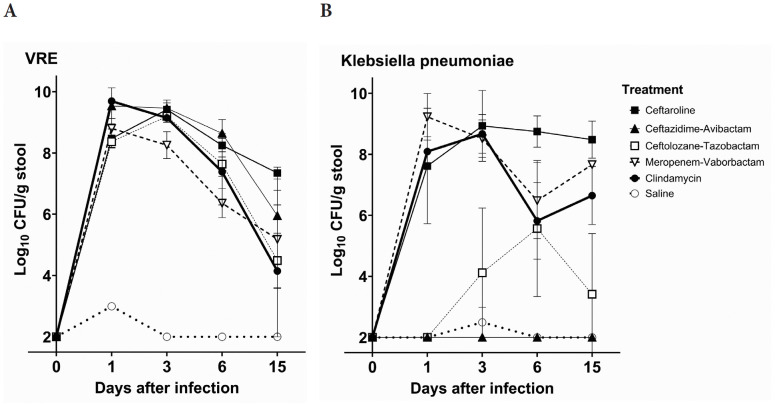
Mice treated for 3 days with daily subcutaneous phosphate-buffered saline (control), ceftazidime/avibactam, ceftolozane/tazobactam, ceftaroline, and meropenem/vaborbactam were challenged with 10,000 colony-forming units (CFU) of vancomycin-resistant (VRE) resistant to each of the antibioics or carbapenemase-producing 1 day after the final treatment dose. The concentrations of VRE or in stool were measured on days 1, 3, 6, and 15 after challenge.
Control mice had transient low levels of VRE or (<3 log CFU/g) detected in stool with negative cultures on days 6 and 15 after challenge. In comparison to control mice, each of the antibiotics promoted establishment of high-density colonization with VRE (mean concentration, >8 log CFU/g of stool on day 1 after challenge) that persisted at >4 log CFU/g of stool through day 15 (<0.01). In comparison to control mice, meropenem/vaborbactam and ceftaroline promoted high-density colonization with (peak concentration, >8 log CFU/g of stool) (<0.01), ceftolozane/tazobactam promoted colonization to a lesser degree (peak concentration, >5 log CFU/g of stool), and ceftazidime/avibactam did not promote colonization (>0.05).
Our results suggest that several beta-lactam antibiotics recently developed for treatment of infections with resistant Gram-negative bacilli have the potential to promote colonization by healthcare-associated pathogens. Additional studies are needed to examine the impact of these agents in patients.
用于治疗耐多药革兰氏阴性杆菌感染的新型抗生素促进医疗保健相关病原体肠道定植的可能性尚不清楚。
用每日皮下注射磷酸盐缓冲盐水(对照)、头孢他啶/阿维巴坦、头孢洛扎/他唑巴坦、头孢罗星和美罗培南/瓦博巴坦治疗3天的小鼠,在最后一剂治疗后1天,用对每种抗生素耐药的10000个万古霉素耐药肠球菌(VRE)或产碳青霉烯酶肠杆菌科细菌的菌落形成单位(CFU)进行攻击。在攻击后第1、3、6和15天测量粪便中VRE或产碳青霉烯酶肠杆菌科细菌的浓度。
对照小鼠在攻击后第6天和第15天粪便中检测到短暂的低水平VRE或产碳青霉烯酶肠杆菌科细菌(<3 log CFU/g),培养结果为阴性。与对照小鼠相比,每种抗生素都促进了VRE的高密度定植(攻击后第1天粪便平均浓度>8 log CFU/g),并持续到第15天,粪便中>4 log CFU/g(<0.01)。与对照小鼠相比,美罗培南/瓦博巴坦和头孢罗星促进了产碳青霉烯酶肠杆菌科细菌的高密度定植(峰值浓度>8 log CFU/g粪便)(<0.01),头孢洛扎/他唑巴坦促进定植的程度较小(峰值浓度>5 log CFU/g粪便),而头孢他啶/阿维巴坦未促进定植(>0.05)。
我们的结果表明,最近开发的几种用于治疗耐革兰氏阴性杆菌感染的β-内酰胺类抗生素有可能促进医疗保健相关病原体的定植。需要进一步研究来检查这些药物对患者的影响。