Leeds Musculoskeletal and Rehabilitation Service, Leeds Community Healthcare, Leeds, United Kingdom ; Leeds Institute of Rheumatic and Musculoskeletal Disease, Faculty of Health, University of Leeds, Leeds, United Kingdom.
PLoS One. 2013 Sep 30;8(9):e72878. doi: 10.1371/journal.pone.0072878. eCollection 2013.
To compare the effectiveness of a physiotherapy programme with a control treatment of advice and education in patients with neurogenic claudication symptoms.
Pragmatic randomised controlled clinical trial.
Primary care-based musculoskeletal service.
Adults aged 50 or over with neurogenic claudication symptoms causing limitation of walking.
Condition-specific home exercises combined with advice and education, or advice and education alone.
The primary outcome was the difference in improvement of symptom severity scores on the Swiss Spinal Stenosis Scale at eight weeks. Secondary outcomes included measures of physical function, pain and general well-being at eight weeks and 12 months.
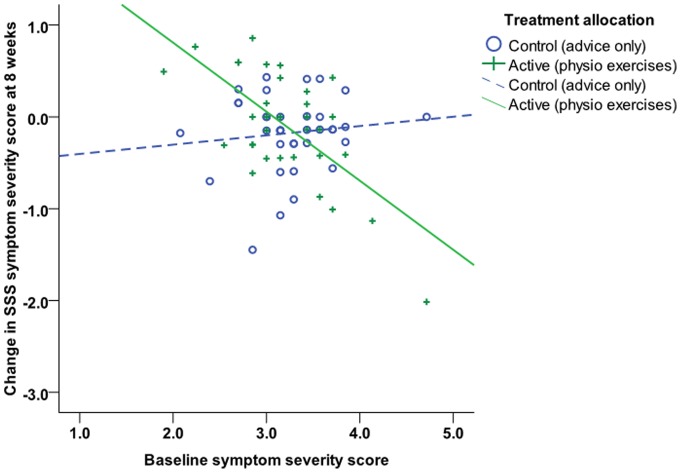
There was no significant difference between groups in the Swiss Spinal Stenosis symptom severity scale at eight weeks (t = 0.47, p = 0.643): mean change (SD) control group -0.18 (0.47), treatment group -0.10 (0.66), difference (95% CI) 0.08 (-0.19, 0.35); baseline-adjusted difference 0.06 (-0.19, 0.31)]. An unplanned subgroup analysis suggested that for patients with the top 25% of baseline symptom severity scores, the physiotherapy exercise programme resulted in an improvement in the primary outcome, and modest but consistently better secondary outcomes at both time-points compared to the control group. The effectiveness in different subgroups requires further direct evaluation.
In the treatment of patients with neurogenic claudication symptoms, a physiotherapist-prescribed home exercise programme is no more effective than advice and education.
The study was approved by Leeds Central Ethics Committee and informed consent was given by all participating patients.
The Corresponding Author has the right to grant on behalf of all authors and does grant on behalf of all authors, a worldwide licence to the Publishers and its licensees in perpetuity, in all forms, formats and media (whether known now or created in the future), to i) publish, reproduce, distribute, display and store the Contribution, ii) translate the Contribution into other languages, create adaptations, reprints, include within collections and create summaries, extracts and/or, abstracts of the Contribution, iii) create any other derivative work(s) based on the Contribution, iv) to exploit all subsidiary rights in the Contribution, v) the inclusion of electronic links from the Contribution to third party material where-ever it may be located; and, vi) licence any third party to do any or all of the above.
ISRCTN 78288224 - doi10.1186/ISRCTN35836727; UKCRN 4814.
比较物理治疗方案与建议和教育的对照治疗在神经源性跛行症状患者中的疗效。
务实的随机对照临床试验。
基于初级保健的肌肉骨骼服务。
年龄在 50 岁或以上,有神经源性跛行症状导致行走受限的成年人。
针对特定疾病的家庭锻炼与建议和教育相结合,或仅提供建议和教育。
八周时瑞士脊柱狭窄症严重程度评分的改善差异是主要结果。次要结局包括八周和 12 个月时的身体功能、疼痛和总体健康状况的测量。
在八周时,两组在瑞士脊柱狭窄症严重程度量表上没有显著差异(t=0.47,p=0.643):对照组平均变化(SD)-0.18(0.47),治疗组-0.10(0.66),差异(95%CI)0.08(-0.19,0.35);基线调整差异 0.06(-0.19,0.31))。一项未计划的亚组分析表明,对于基线症状严重程度评分最高的 25%的患者,物理治疗运动方案在主要结局方面有改善,并且在两个时间点与对照组相比,次要结局均有适度但一致的改善。不同亚组中的效果需要进一步的直接评估。
在治疗神经源性跛行症状患者时,物理治疗师开具的家庭运动方案并不比建议和教育更有效。
该研究得到了利兹中央伦理委员会的批准,并获得了所有参与患者的同意。
通信作者有权代表所有作者授予出版商及其被许可人在所有形式、格式和媒体(无论现在已知或未来创建)中的永久性全球许可,以(i)发布、复制、分发、展示和存储稿件,(ii)将稿件翻译成其他语言,创建改编作品、再版、包含在收藏中以及创建稿件的摘要、摘录和/或摘要,(iii)基于稿件创建任何其他衍生作品,(iv)利用稿件的所有附属权利,(v)从稿件链接到第三方材料的电子链接,无论该链接可能位于何处;以及,(vi)许可任何第三方进行上述任何或全部操作。
ISRCTN 78288224- doi10.1186/ISRCTN35836727;UKCRN 4814。