King's College London, Department of Palliative Care, Policy and Rehabilitation, Cicely Saunders Institute, Bessemer Road, London SE5 9PJ, UK.
BMC Palliat Care. 2013 Oct 7;12(1):35. doi: 10.1186/1472-684X-12-35.
Despite the huge burden of HIV in sub-Saharan Africa, there is little evidence of the multidimensional needs of patients with HIV infection to inform the person-centred care across physical, psychological, social and spiritual domains stipulated in policy guidance. We aimed to describe the problems experienced by people with HIV in Kenya and Uganda and the management of these problems by HIV outpatient services.
Local researchers conducted in depth qualitative interviews with HIV patients, caregivers and service staff at 12 HIV outpatient facilities (6 in Kenya, 6 in Uganda). Interview data were analysed thematically.
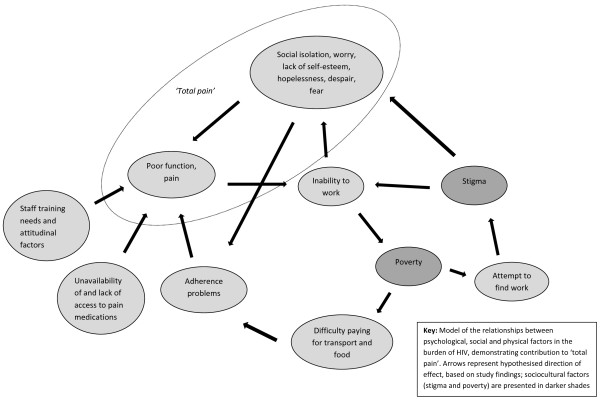
189 people were interviewed (83 patients, 47 caregivers, 59 staff). The impact of pain and symptoms and their causes (HIV, comorbidities, treatment side-effects) were described. Staff reported that effective pain relief was not always available, particularly in Kenya. Psychosocial distress (isolation, loneliness, worry) was exacerbated by stigma and poverty, and detrimentally affected adherence. Illness led to despair and hopelessness. Provision of counselling was reported, but spiritual support appeared to be less common. Neither pain nor psychosocial problems were routinely reported to service staff. Collaboration with local hospices and income-generation activities for patients were highlighted as useful.
The findings demonstrate the multiple and interrelated problems associated with living with HIV and how psychosocial and spiritual distress can contribute to 'total pain' in this population. In line with the palliative care approach, HIV care requires holistic care and assessment that take into account psychological, socioeconomic and spiritual distress alongside improved access to pain-relieving drugs, including opioids.
尽管撒哈拉以南非洲地区艾滋病毒负担沉重,但几乎没有证据表明艾滋病毒感染者的多维度需求,这些需求是艾滋病毒政策指导中规定的以患者为中心的关怀,涵盖身体、心理、社会和精神领域。我们旨在描述肯尼亚和乌干达艾滋病毒感染者所面临的问题,以及艾滋病毒门诊服务对这些问题的管理。
当地研究人员在 12 个艾滋病毒门诊机构(肯尼亚 6 个,乌干达 6 个)对艾滋病毒患者、照顾者和服务人员进行了深入的定性访谈。对访谈数据进行了主题分析。
共对 189 人进行了访谈(83 名患者、47 名照顾者、59 名工作人员)。描述了疼痛和症状的影响及其原因(艾滋病毒、合并症、治疗副作用)。工作人员报告说,并非总能有效缓解疼痛,特别是在肯尼亚。耻辱感和贫困加剧了心理社会困扰(孤立、孤独、担忧),并对治疗依从性产生不利影响。疾病导致绝望和无助。报告了提供咨询的情况,但似乎很少提供精神支持。工作人员没有例行报告疼痛或心理社会问题。与当地临终关怀机构的合作以及为患者创造收入的活动被认为是有用的。
研究结果表明,与艾滋病毒共存相关的多种且相互关联的问题,以及心理社会和精神困扰如何导致该人群的“总疼痛”。按照姑息治疗的方法,艾滋病毒护理需要整体护理和评估,除了改善获得缓解疼痛药物(包括阿片类药物)的机会外,还需要考虑到心理、社会经济和精神困扰。