Division of Molecular Biology, Department of Microbiology, Paris-Lodron University, Salzburg, Austria.
Cell Commun Signal. 2013 Oct 7;11:77. doi: 10.1186/1478-811X-11-77.
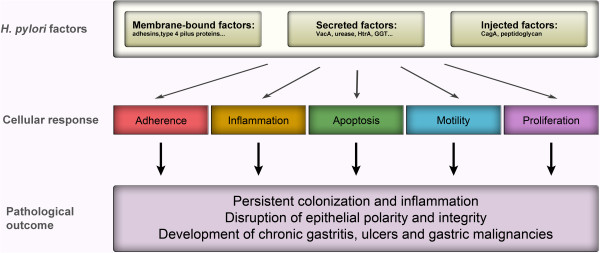
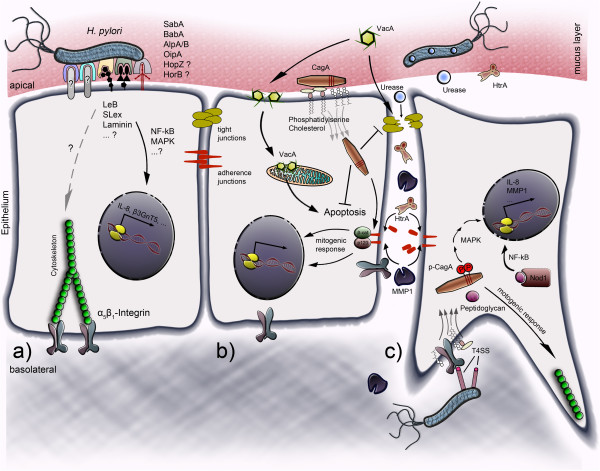
Infections with the human pathogen Helicobacter pylori (H. pylori) can lead to severe gastric diseases ranging from chronic gastritis and ulceration to neoplastic changes in the stomach. Development and progress of H. pylori-associated disorders are determined by multifarious bacterial factors. Many of them interact directly with host cells or require specific receptors, while others enter the host cytoplasm to derail cellular functions. Several adhesins (e.g. BabA, SabA, AlpA/B, or OipA) establish close contact with the gastric epithelium as an important first step in persistent colonization. Soluble H. pylori factors (e.g. urease, VacA, or HtrA) have been suggested to alter cell survival and intercellular adhesions. Via a type IV secretion system (T4SS), H. pylori also translocates the effector cytotoxin-associated gene A (CagA) and peptidoglycan directly into the host cytoplasm, where cancer- and inflammation-associated signal transduction pathways can be deregulated. Through these manifold possibilities of interaction with host cells, H. pylori interferes with the complex signal transduction networks in its host and mediates a multi-step pathogenesis.
人类病原体幽门螺杆菌(H. pylori)的感染可导致严重的胃部疾病,从慢性胃炎和溃疡到胃部的肿瘤性变化。H. pylori 相关疾病的发展和进展取决于多种细菌因素。其中许多因素直接与宿主细胞相互作用或需要特定的受体,而其他因素则进入宿主细胞质以破坏细胞功能。一些黏附素(例如 BabA、SabA、AlpA/B 或 OipA)与胃上皮细胞建立紧密接触,作为持续定植的重要第一步。可溶性 H. pylori 因子(例如脲酶、VacA 或 HtrA)被认为可以改变细胞存活和细胞间黏附。通过 IV 型分泌系统(T4SS),H. pylori 还可将效应细胞毒素相关基因 A(CagA)和肽聚糖直接转位到宿主细胞质中,从而使癌症和炎症相关的信号转导途径失活。通过与宿主细胞相互作用的这些多种可能性,H. pylori 干扰其宿主中的复杂信号转导网络,并介导多步骤发病机制。