Department of Internal Medicine, College of Medicine, National Cheng Kung University, 138 Sheng Li Road, Tainan, Taiwan.
BMC Microbiol. 2012 May 30;12:89. doi: 10.1186/1471-2180-12-89.
Intragenomic recombination between babA and babB mediates antigenic variations and may help H. pylori colonization. This study determined whether variable genotypes of babA and babB correlate to different clinical disease outcomes, and can distribute over the different gastric niches.
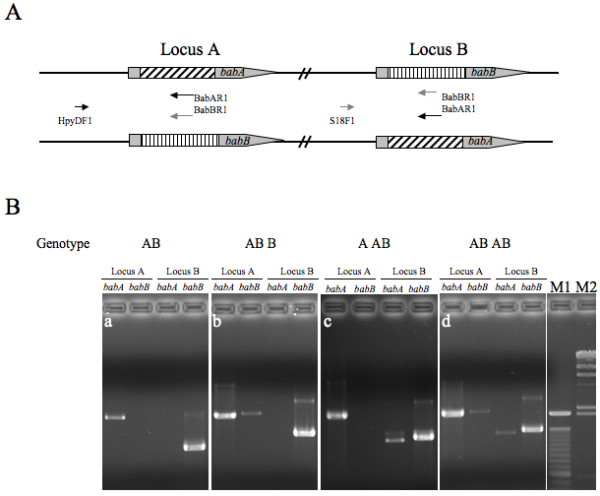
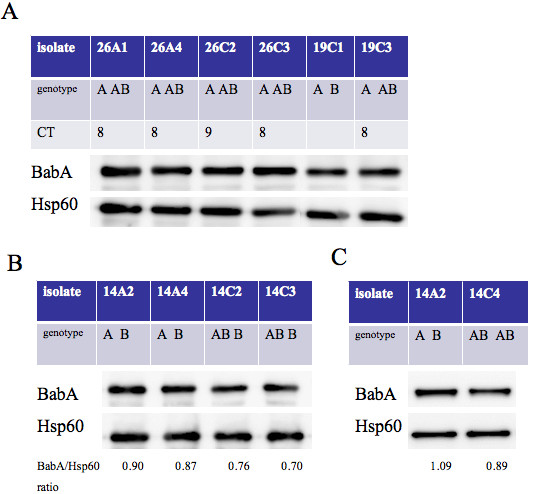
This study enrolled 92 clinical strains (45 from peptic ulcer, 27 from gastritis, and 20 from gastric cancer) to detect whether the babA and babB are at locus A or B by PCR reactions using the primers designed from the upstream and variable region of the babA and babB genes. Four genotypes of babA and babB (A B, AB B, A AB, AB AB) were found. The distribution of the 4 genotypes in 92 clinical strains was significantly different among patients with different gastric diseases (p < 0.05). The isolates from gastric cancer patients had a higher rate of AB AB genotype than those from non-cancer patients (40.0% vs. 9.7%, p < 0.05). The AB AB genotype was associated with a higher intensity of intestinal metaplasia (p < 0.05), but did not correlate with a higher inflammation and colonization density in gastric histology (p > 0.05). Besides, the study enrolled 19 patients to verify whether variable genotypes of babAB existed in the different gastric niches. Among the patients infected with more than one babAB genotypes over antrum and corpus, there were higher rate of genotypes as A B or AB AB in isolates from antrum than in those from corpus (75.0 % vs. 16.7%, p < 0.05).
The H. pylori isolate with the AB AB genotype correlates with an increased gastric cancer risk, and colonize in an antrum predominant manner.
babA 和 babB 基因内重组介导了抗原变异,可能有助于 H. pylori 定植。本研究旨在确定 babA 和 babB 的可变基因型是否与不同的临床疾病结局相关,以及是否可以分布在不同的胃腔中。
本研究共纳入 92 株临床分离株(45 株来自消化性溃疡,27 株来自胃炎,20 株来自胃癌),通过设计的 babA 和 babB 基因上游和可变区引物的 PCR 反应,检测 babA 和 babB 是否位于基因座 A 或 B。发现了 4 种 babA 和 babB 基因型(A B、AB B、A AB、AB AB)。92 株临床分离株中 4 种基因型的分布在不同胃部疾病患者之间存在显著差异(p<0.05)。胃癌患者分离株的 AB AB 基因型比例高于非癌症患者(40.0%比 9.7%,p<0.05)。AB AB 基因型与肠上皮化生强度较高相关(p<0.05),但与胃组织学炎症和定植密度无相关性(p>0.05)。此外,本研究还纳入了 19 例患者,以验证不同胃腔中 babAB 可变基因型是否存在。在感染了一种以上 babAB 基因型的患者中,与胃体相比,分离株中 babAB 基因型为 A B 或 AB AB 的比例在胃窦中更高(75.0%比 16.7%,p<0.05)。
携带 AB AB 基因型的 H. pylori 分离株与胃癌风险增加相关,并且主要定植于胃窦。