Grundström Gunilla, Christensson Anders, Alquist Maria, Nilsson Lars-Göran, Segelmark Mårten
Gambro Research, Gambro Lundia AB, Lund, Sweden.
BMC Nephrol. 2013 Oct 9;14:216. doi: 10.1186/1471-2369-14-216.
The majority of bicarbonate based dialysis fluids are acidified with acetate. Citrate, a well known anticoagulant and antioxidant, has been suggested as a biocompatible alternative. The objective of this study was to evaluate short term safety and biocompatibility of a citrate containing acetate-free dialysis fluid.
Twenty four (24) patients on maintenance dialysis three times per week, 13 on on-line hemodiafiltration (HDF) and 11 on hemodialysis (HD), were randomly assigned to start with either citrate dialysis fluid (1 mM citrate, 1.5 mM calcium) or control fluid (3 mM acetate, 1.5 mM calcium) in an open-labeled cross-over trial (6 + 6 weeks with 8 treatments wash-out in between). Twenty (20) patients, 11 on HDF and 9 on HD were included in the analyses. Main objective was short term safety assessed by acid-base status, plasma ionized calcium and parathyroid hormone (PTH). In addition, biocompatibility was assessed by markers of inflammation (pentraxin 3 (PTX-3), CRP, IL-6, TNF-α and IL-1β) and thrombogenicity (activated partial thromboplastin time (APTT) and visual clotting scores).
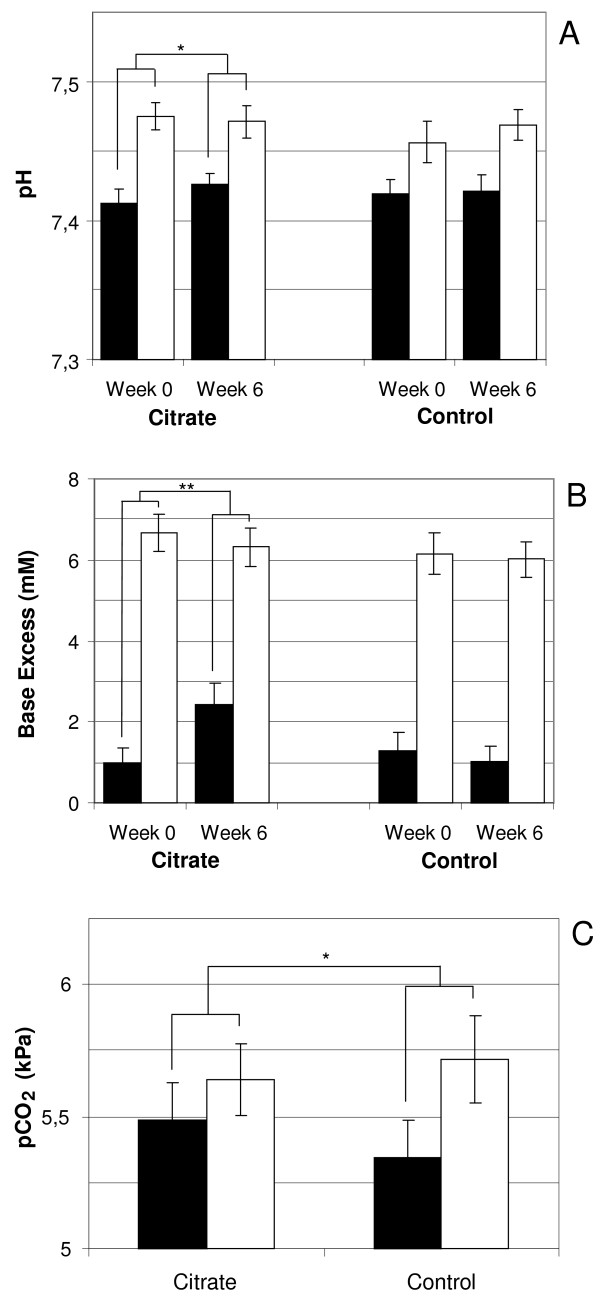
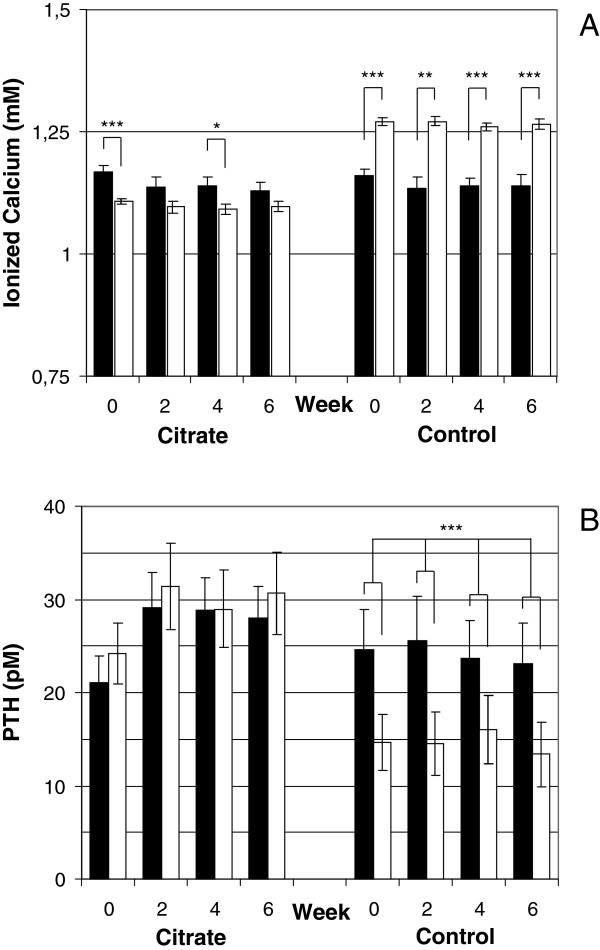
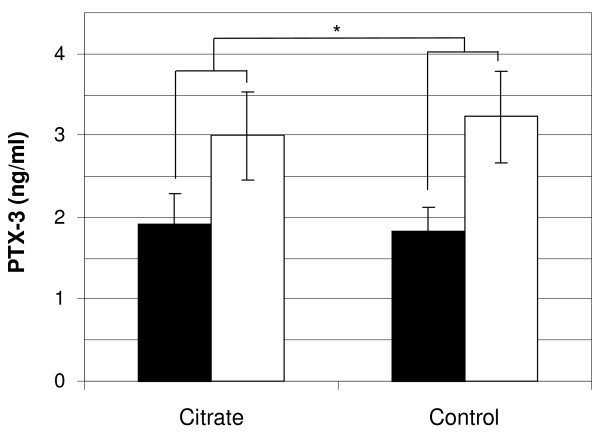
No differences dependent on randomization order or treatment mode (HD vs. HDF) were detected. Citrate in the dialysis fluid reduced the intra-dialytic shift in pH (+0.04 week 6 vs. +0.06 week 0, p = 0.046) and base excess (+3.9 mM week 6 vs. +5.6 mM week 0, p = 0.006) over the study period. Using the same calcium concentration (1.5 mM), citrate dialysis fluid resulted in lower post-dialysis plasma ionized calcium level (1.10 mM vs. 1.27 mM for control, p < 0.0001) and higher post-dialysis PTH level (28.8 pM vs. 14.7 pM for control, p < 0.0001) while pre-dialysis levels were unaffected. Citrate reduced intra-dialytic induction of PTX-3 (+1.1 ng/ml vs. +1.4 ng/ml for control, p = 0.04) but had no effect on other markers of inflammation or oxidative stress. Citrate reduced visual clotting in the arterial air chamber during HDF (1.0 vs. 1.8 for control, p = 0.03) and caused an intra-dialytic increase in APTT (+6.8 s, p = 0.003) without affecting post-dialysis values compared to control.
During this small short term study citrate dialysis fluid was apparently safe to use in HD and on-line HDF treatments. Indications of reduced treatment-induced inflammation and thrombogenicity suggest citrate as a biocompatible alternative to acetate in dialysis fluid. However, the results need to be confirmed in long term studies.
ISRCTN28536511.
大多数基于碳酸氢盐的透析液用醋酸盐酸化。柠檬酸盐是一种著名的抗凝剂和抗氧化剂,已被建议作为一种生物相容性替代品。本研究的目的是评估不含醋酸盐的含柠檬酸盐透析液的短期安全性和生物相容性。
24例每周进行3次维持性透析的患者,13例接受在线血液透析滤过(HDF),11例接受血液透析(HD),在一项开放标签的交叉试验中随机分配开始使用柠檬酸盐透析液(1 mM柠檬酸盐,1.5 mM钙)或对照液(3 mM醋酸盐,1.5 mM钙)(6 + 6周,中间有8次治疗洗脱期)。20例患者,11例接受HDF,9例接受HD,纳入分析。主要目标是通过酸碱状态、血浆离子钙和甲状旁腺激素(PTH)评估短期安全性。此外,通过炎症标志物(五聚素3(PTX - 3)、CRP、IL - 6、TNF - α和IL - 1β)和血栓形成性(活化部分凝血活酶时间(APTT)和视觉凝血评分)评估生物相容性。
未检测到依赖于随机化顺序或治疗模式(HD与HDF)的差异。在研究期间,透析液中的柠檬酸盐降低了透析期间pH值的变化(第6周+0.04 vs第0周+0.06,p = 0.046)和碱剩余(第6周+3.9 mM vs第0周+5.6 mM,p = 0.006)。使用相同的钙浓度(1.5 mM),柠檬酸盐透析液导致透析后血浆离子钙水平较低(对照为1.27 mM,柠檬酸盐为1.10 mM,p < 0.0001)和透析后PTH水平较高(对照为14.7 pM,柠檬酸盐为28.8 pM,p < 0.0001),而透析前水平未受影响。柠檬酸盐降低了透析期间PTX - 3的诱导水平(对照为+1.4 ng/ml,柠檬酸盐为+1.1 ng/ml,p = 0.04),但对其他炎症或氧化应激标志物无影响。在HDF期间,柠檬酸盐降低了动脉空气腔中的视觉凝血(对照为1.8,柠檬酸盐为1.0,p = 0.03),并导致透析期间APTT增加(+6.8 s,p = 0.003),与对照相比,透析后值未受影响。
在这项小型短期研究中,柠檬酸盐透析液在HD和在线HDF治疗中使用显然是安全的。治疗诱导的炎症和血栓形成性降低的迹象表明,柠檬酸盐可作为透析液中醋酸盐的生物相容性替代品。然而,结果需要在长期研究中得到证实。
ISRCTN:ISRCTN28536511