
坦桑尼亚北部乞力马扎罗地区纯母乳喂养妇女的流行率及其预测因素:一项基于人群的横断面研究。
Prevalence and predictors of exclusive breastfeeding among women in Kilimanjaro region, Northern Tanzania: a population based cross-sectional study.
机构信息
Department of Community Health, Kilimanjaro Christian Medical University College, Box 2240, Moshi, Tanzania.
出版信息
Int Breastfeed J. 2013 Oct 9;8(1):12. doi: 10.1186/1746-4358-8-12.
BACKGROUND
Exclusive breastfeeding (EBF) is a simple and cost-effective intervention to improve child health and survival. Effective EBF has been estimated to avert 13% - 15% of under-five mortality and contribute to reduce mother to child transmission of HIV. The prevalence of EBF for infant less than six months is low in most developing countries, including Tanzania (50%). While the Tanzania Demographic Health Survey collects information on overall EBF prevalence, it does not evaluate factors influencing EBF. The aim of this paper was to determine the prevalence and predictors of exclusive breastfeeding in urban and rural areas in Kilimanjaro region.
METHODS
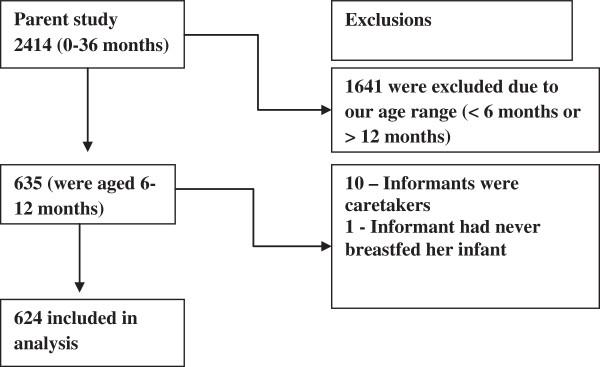
A population-based cross-sectional study was conducted between June 2010 to March 2011 among women with infants aged 6-12 months in Kilimanjaro. Multi-stage proportionate to size sampling was used to select participants from all the seven districts of the region. A standardized questionnaire was used to collect socio-demographic, reproductive, alcohol intake, breastfeeding patterns and nutritional data during the interviews. Estimation on EBF was based on recall since birth. Multivariable logistic regression was used to obtain independent predictors of EBF.
RESULTS
A total of 624 women participated, 77% (483) from rural areas. The prevalence of EBF up to six months in Kilimanjaro region was 20.7%, without significant differences in the prevalence of EBF up to six months between urban (22.7%) and rural areas (20.1%); (OR = 0.7, 95% CI 0.5,1.4).In multivariable analysis, advice on breastfeeding after delivery (Adjusted odds ratio, AOR = 2.6, 95% CI 1.5, 4.6) was positively associated with EBF up to six months. Compared to married/cohabiting and those who do not take alcohol, single mothers (AOR = 0.4, 95% CI 0.2, 0.9) and mothers who drank alcohol (AOR = 0.4, 95% CI 0.3, 0.7) had less odds to practice EBF up to six months.
CONCLUSION
Prevalence of EBF up to six months is still low in Kilimanjaro, lower than the national coverage of 50%. Strengthening of EBF counseling in all reproductive and child health clinics especially during antenatal and postnatal periods may help to improve EBF rates.
背景
纯母乳喂养(EBF)是一种简单且具有成本效益的干预措施,可改善儿童健康和生存状况。有效的 EBF 估计可避免 13%至 15%的五岁以下儿童死亡,并有助于减少母婴 HIV 传播。在大多数发展中国家,包括坦桑尼亚(50%),6 个月以下婴儿的纯母乳喂养率都很低。虽然坦桑尼亚人口与健康调查收集了关于总体 EBF 流行率的信息,但它并未评估影响 EBF 的因素。本文旨在确定 Kilimanjaro 地区城乡地区纯母乳喂养的流行率和预测因素。
方法
2010 年 6 月至 2011 年 3 月期间,在 Kilimanjaro 地区对 6-12 个月大的婴儿母亲进行了一项基于人群的横断面研究。采用多阶段按比例大小的抽样方法,从该地区的七个区中选择参与者。使用标准化问卷在访谈中收集社会人口统计学、生殖、饮酒、母乳喂养模式和营养数据。对 EBF 的估计是基于出生后的回忆。使用多变量逻辑回归获得 EBF 的独立预测因素。
结果
共有 624 名妇女参加了研究,其中 77%(483 名)来自农村地区。Kilimanjaro 地区 6 个月以下婴儿的 EBF 流行率为 20.7%,城乡地区 6 个月以下婴儿的 EBF 流行率无显著差异(城市 22.7%,农村 20.1%);(OR=0.7,95%CI 0.5,1.4)。在多变量分析中,产后母乳喂养建议(调整后的优势比,AOR=2.6,95%CI 1.5,4.6)与 6 个月以下的 EBF 呈正相关。与已婚/同居者和不饮酒者相比,单身母亲(AOR=0.4,95%CI 0.2,0.9)和饮酒的母亲(AOR=0.4,95%CI 0.3,0.7)进行 6 个月以下 EBF 的可能性较低。
结论
Kilimanjaro 地区 6 个月以下婴儿的 EBF 流行率仍然很低,低于全国 50%的覆盖率。加强所有生殖和儿童保健诊所的 EBF 咨询,特别是在产前和产后期间,可能有助于提高 EBF 率。
 Zotero 插件