Institute of Public Health, Department of Epidemiology and Biostatistics, Kilimanjaro Christian Medical University College (KCMUCo), Moshi, Tanzania.
Better Health for African Mother and Child (BHAMC), Moshi, Tanzania.
PLoS One. 2021 Oct 28;16(10):e0259041. doi: 10.1371/journal.pone.0259041. eCollection 2021.
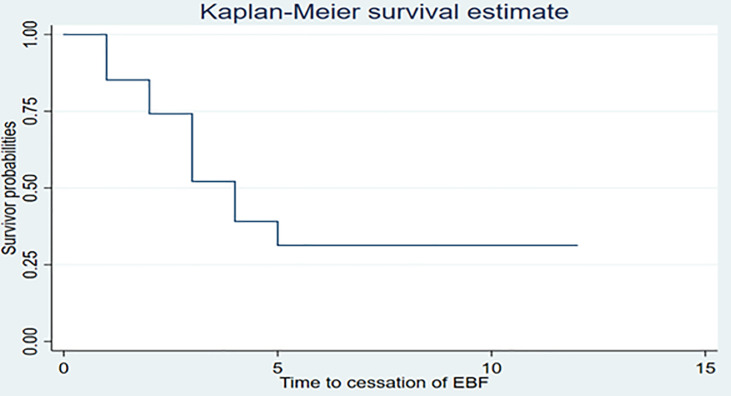
Exclusive breastfeeding (EBF) up to six months is sub-optimal globally. Tanzania has surpassed the World Health Assembly (WHA) target of increasing the rate of exclusive breastfeeding among children below six months to at least 50% by the year 2025 the median age of cessation of EBF is only three months.
To determine the time to cessation of exclusive breastfeeding and its associated factors among women with children aged 6-24 months in Kilimanjaro region, Northern Tanzania.
This was a secondary analysis of data from a community-based cross-sectional study conducted between April 2016 and April 2017 in Kilimanjaro region, northern Tanzania. In the parent study, a multistage sampling technique was used to select study participants and interviewed using a questionnaire. Data for 1291 mother-child pairs were analyzed using STATA version 15. Kaplan-Meier method with the log-rank test estimated and compared the survivor functions across covariate levels. Cox regression proportional hazards models estimated the hazard ratios (HR) and their 95% confidence intervals (CI) for factors associated with time to cessation of exclusive breastfeeding.
The prevalence of cessation of exclusive breastfeeding before six months was 68.7%, with a median age of cessation of four months (95% CI: 3, 4). In comparison to women living in Siha district, women living in Moshi Municipal (HR = 1.61; 95% CI = 1.24, 2.09), Same (HR = 1.32; 95% CI = 1.06, 1.65) and Mwanga (HR = 1.53; 95% CI = 1.20, 1.96) districts, had higher hazards of cessation of exclusive breastfeeding before six months. Women who received breastfeeding counselling at antenatal care had a lower hazard to cease EBF (HR = 0.76, 95% CI 0.65, 087) compared to those who did not receive breastfeeding counselling.
The median age of cessation of EBF is unsatisfactory but at least higher (four months) than the national level estimate of three months. District specific interventions and breastfeeding counselling at antenatal care are essential for improving time to cessation of exclusive breastfeeding. Promotion of adequate ANC visits remains one of the critical interventions to improve BF practices and other reproductive health outcomes.
全球范围内,纯母乳喂养(EBF)至六个月的比例并不理想。坦桑尼亚已经超过了世界卫生大会(WHA)的目标,即在 2025 年之前将 6 个月以下儿童的纯母乳喂养率提高到至少 50%,但中位 EBF 停止年龄仅为三个月。
在坦桑尼亚北部乞力马扎罗地区,确定 6-24 个月儿童的母亲停止纯母乳喂养的时间及其相关因素。
这是对 2016 年 4 月至 2017 年 4 月期间在坦桑尼亚北部乞力马扎罗地区进行的一项基于社区的横断面研究数据的二次分析。在母研究中,采用多阶段抽样技术选择研究参与者,并使用问卷进行访谈。使用 STATA 版本 15 对 1291 对母婴对的数据进行分析。Kaplan-Meier 方法估计并比较了各协变量水平的生存函数。Cox 回归比例风险模型估计了与停止纯母乳喂养时间相关因素的风险比(HR)及其 95%置信区间(CI)。
六个月前停止纯母乳喂养的比例为 68.7%,中位停止年龄为四个月(95%CI:3,4)。与居住在 Siha 区的妇女相比,居住在 Moshi 市(HR = 1.61;95%CI = 1.24,2.09)、Same(HR = 1.32;95%CI = 1.06,1.65)和 Mwanga(HR = 1.53;95%CI = 1.20,1.96)区的妇女更早停止纯母乳喂养。在产前保健中接受母乳喂养咨询的妇女停止 EBF 的风险较低(HR = 0.76,95%CI 0.65,087),而未接受母乳喂养咨询的妇女则较高。
中位 EBF 停止年龄不理想,但至少比全国估计的三个月要高(四个月)。地区特定的干预措施和产前保健中的母乳喂养咨询对于改善停止纯母乳喂养的时间至关重要。促进充分的 ANC 就诊仍然是改善 BF 实践和其他生殖健康结果的关键干预措施之一。