Hussein Tamara H, Mgongo Melina, Uriyo Jacqueline G, Damian Damian J, Stray-Pedersen Babill, Msuya Sia E, Wandel Margareta
Better Health for African Mother and Child, Box 8418 Moshi, Tanzania.
Department of Nutrition, Institute of Basic Medical Sciences, Faculty of Medicine, University of Oslo, Norway.
Int J MCH AIDS. 2019;8(1):32-43. doi: 10.21106/ijma.258.
Exclusive breastfeeding (EBF) has many benefits to the child from mental to physical growth and development; however, methods of measuring EBF have raised a number of policy and programmatic questions. This study assesses EBF rates and factors associated with EBF practices in Northern Tanzania using two different methodologies, namely, the 24-hours recall and recall-since-birth.
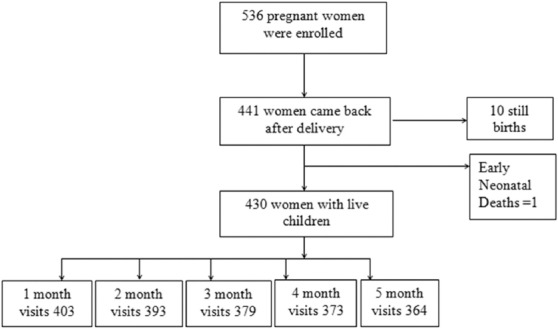
A cohort study was conducted from October 2013 to December 2015 among mother-infants' pairs. Mothers with child delivery information (N=430) were followed and included in the analyses. We enrolled pregnant women who were in their third trimesters and interviewed them with the help of questionnaires at enrollment, delivery, 7 days and thereafter monthly up to nine months after delivery. At each visit after delivery, information on breastfeeding using the two methods (24 hours recall and recall-since-birth) was collected.
The prevalence of EBF dropped from one month to six months when using both the 24 hours recall and the recall since birth methods, but at different rates. At six months, 24.2% of the mothers practiced EBF when measured with the recall since birth method, compared to 38.8% when measured with the 24 hour recall. Predictors of EBF were also different. When using the recall since birth method, women who had received counseling on infant feeding had increased odds of practicing EBF compared to those who did not receive counseling, [AOR=2.3; 95% CI (1.2, 3.7)]. When using 24 hours recall, women who were unemployed had increased odds of practicing EBF compared to those who were employed [AOR=1.5;95% CI(1.1,2.5)], and women aged 35 - 49 years had decreased odds of practicing EBF compared to younger women[AOR=0.28; 95 % CI(0.1,0.7)].
The two methods for EBF give substantially different results, both in the prevalence of EBF and factors associated with EBF. The higher EBF obtained with 24 hours recall represents an overestimation and thereby an overly positive picture of the situation.
纯母乳喂养(EBF)对儿童从心理到身体的生长发育都有诸多益处;然而,衡量纯母乳喂养的方法引发了一些政策和规划方面的问题。本研究采用两种不同方法,即24小时回顾法和自出生起回顾法,评估坦桑尼亚北部的纯母乳喂养率及与纯母乳喂养行为相关的因素。
2013年10月至2015年12月对母婴对进行了一项队列研究。对有分娩信息的母亲(N = 430)进行随访并纳入分析。我们招募了孕晚期的孕妇,并在入组时、分娩时、产后7天以及之后每月直至产后9个月,借助问卷对她们进行访谈。在产后的每次访视中,收集使用两种方法(24小时回顾法和自出生起回顾法)获取的母乳喂养信息。
使用24小时回顾法和自出生起回顾法时,纯母乳喂养率从1个月到6个月均有所下降,但下降速度不同。在6个月时,采用自出生起回顾法测量,24.2%的母亲进行纯母乳喂养;而采用24小时回顾法测量时,这一比例为38.8%。纯母乳喂养的预测因素也有所不同。采用自出生起回顾法时,接受过婴儿喂养咨询的女性进行纯母乳喂养的几率高于未接受咨询的女性,[调整后比值比(AOR)= 2.3;95%置信区间(CI)(1.2,3.7)]。采用24小时回顾法时,与就业女性相比,失业女性进行纯母乳喂养的几率增加[AOR = 1.5;95% CI(1.1,2.5)],与年轻女性相比,35 - 49岁的女性进行纯母乳喂养的几率降低[AOR = 0.28;95% CI(0.1,0.7)]。
两种纯母乳喂养方法在纯母乳喂养率及与纯母乳喂养相关的因素方面得出的结果存在显著差异。24小时回顾法得出的较高纯母乳喂养率存在高估情况,从而对实际情况呈现出过于乐观的图景。