Chang Roger L, Xie Lei, Bourne Philip E, Palsson Bernhard O
Department of Bioengineering, University of California San Diego, La Jolla, CA 92093-0412, USA.
BMC Syst Biol. 2013 Oct 10;7:102. doi: 10.1186/1752-0509-7-102.
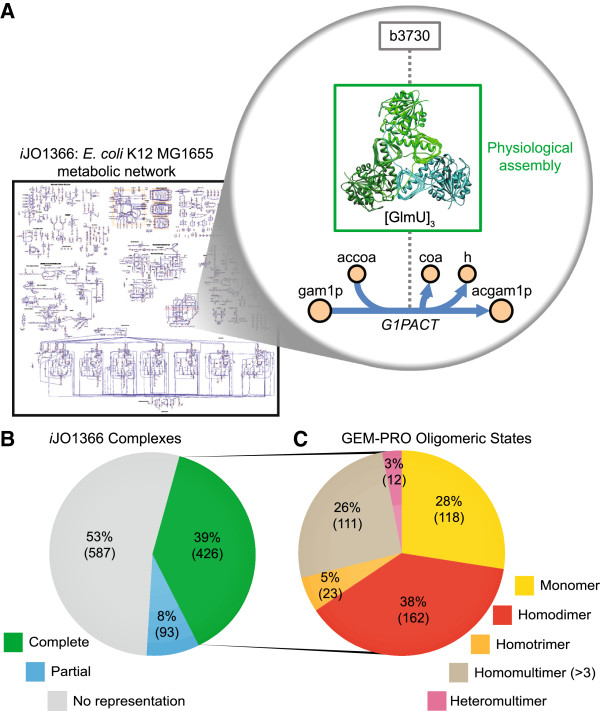
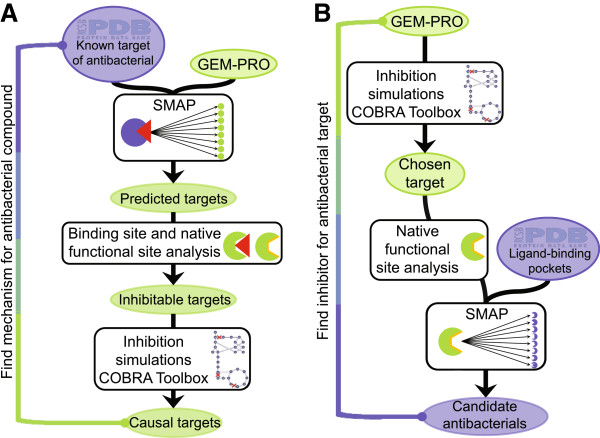
The growing discipline of structural systems pharmacology is applied prospectively in this study to predict pharmacological outcomes of antibacterial compounds in Escherichia coli K12. This work builds upon previously established methods for structural prediction of ligand binding pockets on protein molecules and utilizes and expands upon the previously developed genome scale model of metabolism integrated with protein structures (GEM-PRO) for E. coli, structurally accounting for protein complexes. Carefully selected case studies are demonstrated to display the potential for this structural systems pharmacology framework in discovery and development of antibacterial compounds.
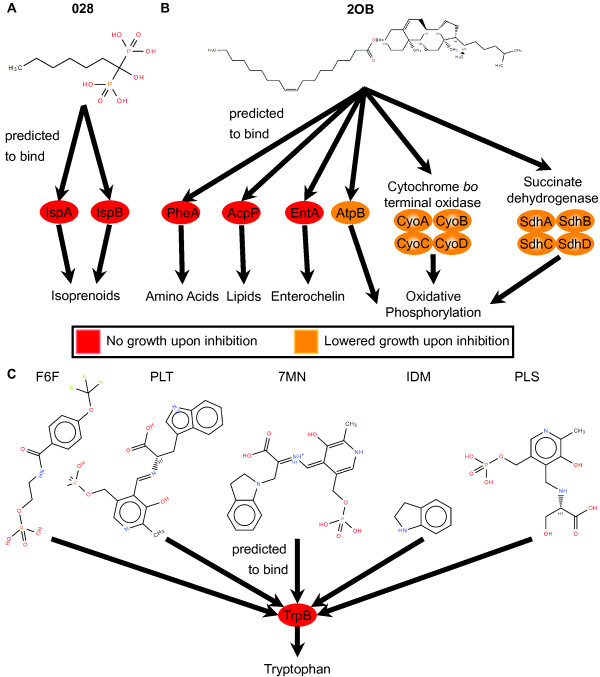
The prediction framework for antibacterial activity of compounds was validated for a control set of well-studied compounds, recapitulating experimentally-determined protein binding interactions and deleterious growth phenotypes resulting from these interactions. The antibacterial activity of fosfomycin, sulfathiazole, and trimethoprim were accurately predicted, and as a negative control glucose was found to have no predicted antibacterial activity. Previously uncharacterized mechanisms of action were predicted for compounds with known antibacterial properties, including (1-hydroxyheptane-1,1-diyl)bis(phosphonic acid) and cholesteryl oleate. Five candidate inhibitors were predicted for a desirable target protein without any known inhibitors, tryptophan synthase β subunit (TrpB). In addition to the predictions presented, this effort also included significant expansion of the previously developed GEM-PRO to account for physiological assemblies of protein complex structures with activities included in the E. coli K12 metabolic network.
The structural systems pharmacology framework presented in this study was shown to be effective in the prediction of molecular mechanisms of antibacterial compounds. The study provides a promising proof of principle for such an approach to antibacterial development and raises specific molecular and systemic hypotheses about antibacterials that are amenable to experimental testing. This framework, and perhaps also the specific predictions of antibacterials, is extensible to developing antibacterial treatments for pathogenic E. coli and other bacterial pathogens.
结构系统药理学这一不断发展的学科在本研究中被前瞻性地应用于预测大肠杆菌 K12 中抗菌化合物的药理结果。这项工作建立在先前已确立的蛋白质分子上配体结合口袋结构预测方法的基础之上,并利用和扩展了先前开发的整合了蛋白质结构的大肠杆菌基因组规模代谢模型(GEM-PRO),从结构上考虑了蛋白质复合物。精心挑选的案例研究展示了这种结构系统药理学框架在抗菌化合物发现和开发中的潜力。
针对一组经过充分研究的化合物的对照集,验证了化合物抗菌活性的预测框架,概括了实验确定的蛋白质结合相互作用以及由这些相互作用导致的有害生长表型。准确预测了磷霉素、磺胺噻唑和甲氧苄啶的抗菌活性,作为阴性对照,发现葡萄糖没有预测的抗菌活性。对于具有已知抗菌特性的化合物,包括(1-羟基庚烷-1,1-二基)双(膦酸)和胆固醇油酸酯,预测了先前未表征的作用机制。针对一种没有任何已知抑制剂的理想靶蛋白——色氨酸合酶β亚基(TrpB),预测了五种候选抑制剂。除了所呈现的预测之外,这项工作还包括对先前开发的 GEM-PRO 进行重大扩展,以考虑具有大肠杆菌 K12 代谢网络中所包含活性的蛋白质复合物结构的生理组装。
本研究中提出的结构系统药理学框架在预测抗菌化合物的分子机制方面被证明是有效的。该研究为这种抗菌药物开发方法提供了一个有前景的原理证明,并提出了关于抗菌药物的具体分子和系统假设,这些假设适合进行实验测试。这个框架,也许还有抗菌药物的具体预测,可扩展到开发针对致病性大肠杆菌和其他细菌病原体的抗菌治疗方法。