Grisenti Michela, Arnoldi Daniele, Rizzolli Franco, Giacobini Mario, Bertolotti Luigi, Rizzoli Annapaola
Edmund Mach Foundation, via E, Mach 1, San Michele all'Adige, Trento, Italy.
Virol J. 2013 Oct 11;10:306. doi: 10.1186/1743-422X-10-306.
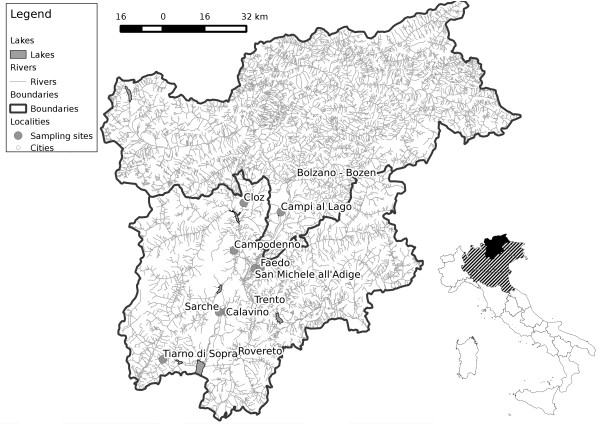
West Nile virus (WNV) and Usutu virus (USUV), both belonging to the genus Flavivirus, are emerging in Italy as important human and animal pathogens. Migratory birds are involved in the spread of Flaviviruses over long distances, particularly from Africa to Europe. Once introduced, these viruses can be further be dispersed by short-distance migratory and resident bird species. Thus far, there is still a considerable knowledge gap on the role played by different bird species in the ecology and transmission mechanisms of these viruses. The Region of Trentino-Alto Adige (north-eastern Italy) is located on the migratory route of many of the short- and long-distance migratory birds that cross the Alps, connecting northern Europe and western Asia with southern Europe and Africa. Until now, only a silent circulation of WNV and USUV within the territory of the Province of Trento has been confirmed by serological screening, whilst no cases of infected humans or animals have so far been reported. However, continuous spillover events of both viruses have been reported in neighbouring Regions. The aim of this study was to monitor the circulation of WNV and USUV in Trentino-Alto Adige, in order to detect if active virus shedding occurs in migratory birds captured during their seasonal movements and to evaluate the role that different bird species could play in the spreading of these viruses.
We carried out a biomolecular survey on oral and cloacal swabs collected from migratory birds during seasonal migrations. Birds belonging to 18 transaharian and 21 intrapaleartic species were examined during spring (n = 176) and autumn (n = 146), and were tested using a generic nested-PCR.
All samples tested negative for Flaviviruses. The possible causes of unapparent shedding, along with ecological and epidemiological implications are discussed.
The lack of detection of active virus shedding in these bird species does not exclude the circulation of these viruses within the Trentino-Alto Adige region, as reported in previous studies. The possible ecological implications are discussed.
西尼罗河病毒(WNV)和乌苏图病毒(USUV)均属于黄病毒属,在意大利正作为重要的人类和动物病原体出现。候鸟参与了黄病毒的远距离传播,尤其是从非洲到欧洲。一旦引入,这些病毒可通过短距离迁徙和留鸟物种进一步扩散。迄今为止,关于不同鸟类物种在这些病毒的生态学和传播机制中所起的作用仍存在相当大的知识空白。特伦蒂诺-上阿迪杰大区(意大利东北部)位于许多穿越阿尔卑斯山的短距离和长距离候鸟的迁徙路线上,连接着北欧和西亚与南欧和非洲。到目前为止,通过血清学筛查仅证实了特伦托省境内WNV和USUV的隐性传播,而迄今为止尚未报告人类或动物感染病例。然而,在邻近地区已报告了这两种病毒的持续溢出事件。本研究的目的是监测特伦蒂诺-上阿迪杰大区WNV和USUV的传播情况,以检测在季节性迁徙期间捕获的候鸟中是否发生活跃的病毒排泄,并评估不同鸟类物种在这些病毒传播中可能发挥的作用。
我们对季节性迁徙期间从候鸟采集的口腔和泄殖腔拭子进行了生物分子调查。在春季(n = 176)和秋季(n = 146)检查了属于18种跨撒哈拉和21种古北区内物种的鸟类,并使用通用巢式PCR进行检测。
所有样本的黄病毒检测均为阴性。讨论了隐性排泄的可能原因以及生态和流行病学意义。
如先前研究报道,在这些鸟类物种中未检测到活跃的病毒排泄并不排除这些病毒在特伦蒂诺-上阿迪杰地区内的传播。讨论了可能的生态影响。