Pannala Venkat R, Bazil Jason N, Camara Amadou K S, Dash Ranjan K
Biotechnology and Bioengineering Center and Department of Physiology and.
Department of Anesthesiology, Medical College of Wisconsin, Milwaukee, WI 53226, USA.
Free Radic Biol Med. 2013 Dec;65:1385-1397. doi: 10.1016/j.freeradbiomed.2013.10.001. Epub 2013 Oct 9.
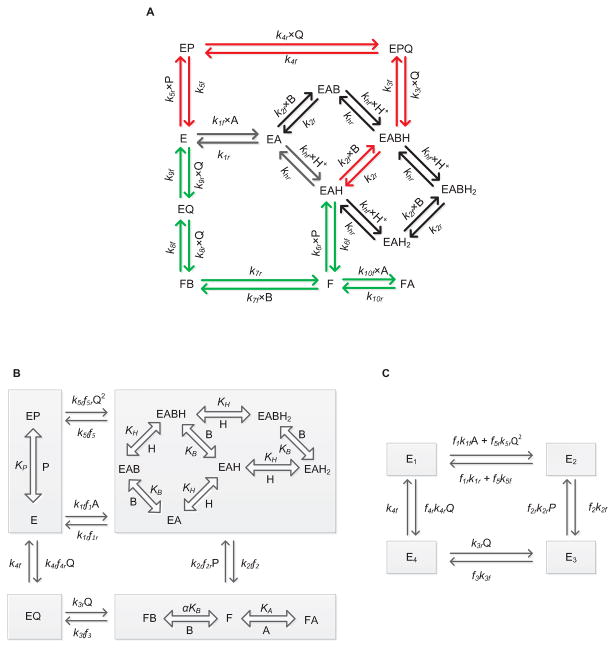
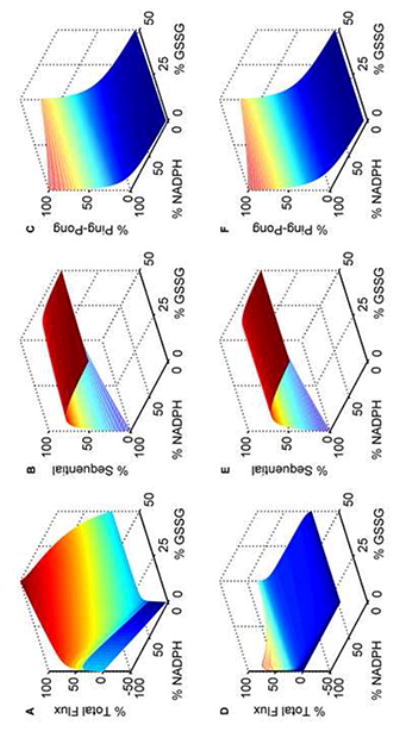
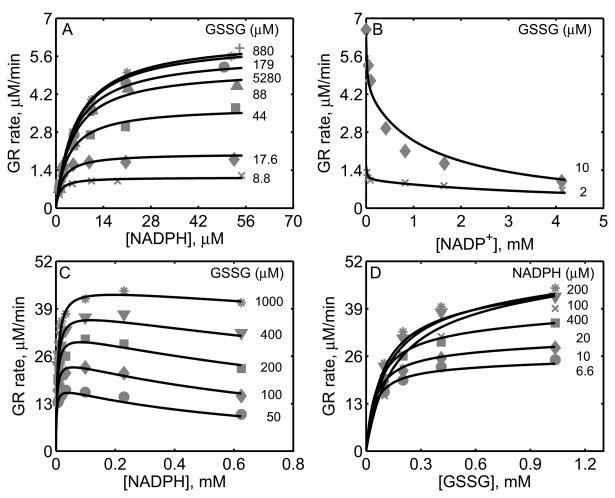
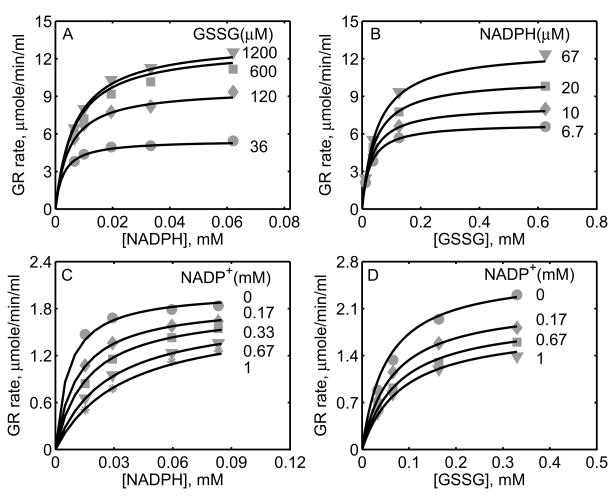
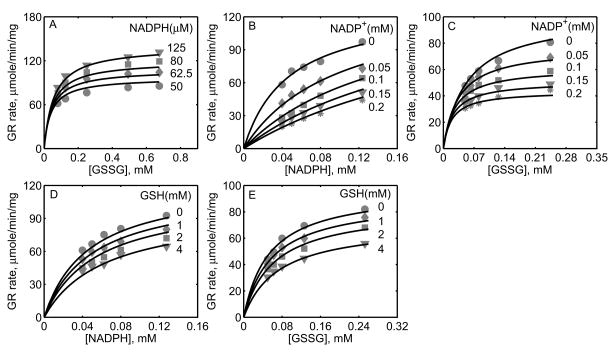
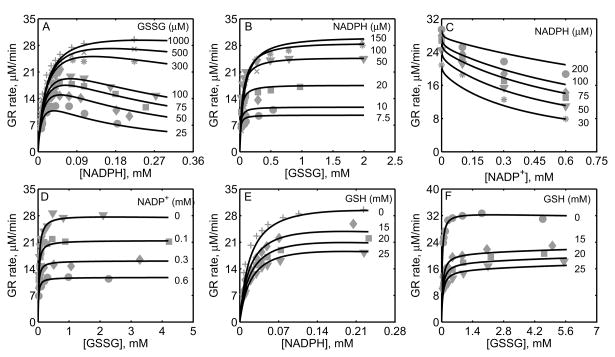
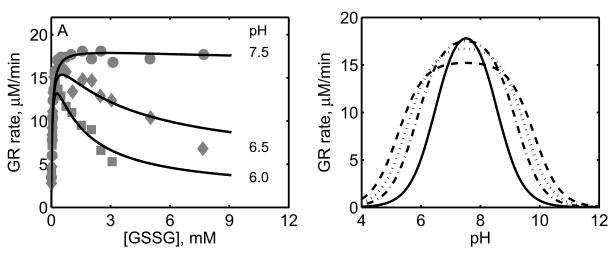
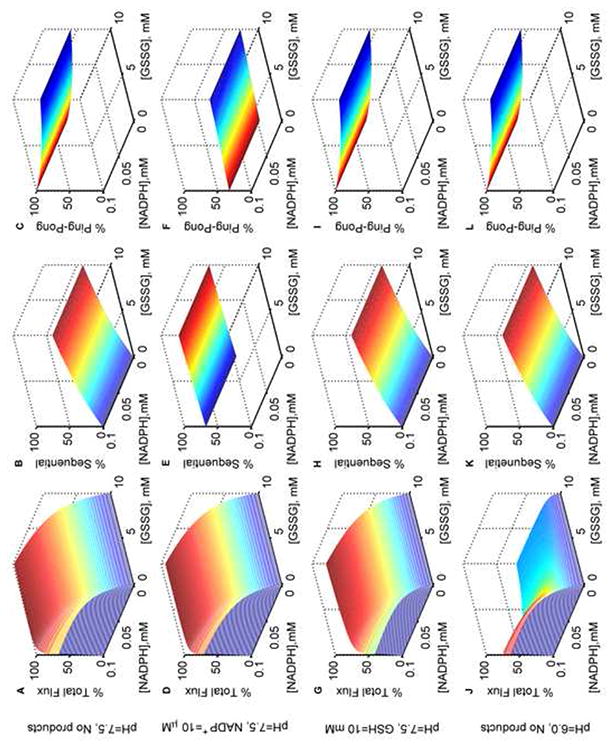
Glutathione reductase (GR) catalyzes the reduction of oxidized glutathione (GSSG) to reduced glutathione (GSH) using NADPH as the reducing cofactor, and thereby maintains a constant GSH level in the system. GSH scavenges superoxide (O2(*-)) and hydroxyl radicals (OH) nonenzymatically or by serving as an electron donor to several enzymes involved in reactive oxygen species (ROS) detoxification. In either case, GSH oxidizes to GSSG and is subsequently regenerated by the catalytic action of GR. Although the GR kinetic mechanism has been extensively studied under various experimental conditions with variable substrates and products, the catalytic mechanism has not been studied in terms of a mechanistic model that accounts for the effects of the substrates and products on the reaction kinetics. The aim of this study is therefore to develop a comprehensive mathematical model for the catalytic mechanism of GR. We use available experimental data on GR kinetics from various species/sources to develop the mathematical model and estimate the associated model parameters. The model simulations are consistent with the experimental observation that GR operates via both ping-pong and sequential branching mechanisms based on relevant concentrations of its reaction substrate GSSG. Furthermore, we show the observed pH-dependent substrate inhibition of GR activity by GSSG and bimodal behavior of GR activity with pH. The model presents a unique opportunity to understand the effects of products on the kinetics of GR. The model simulations show that under physiological conditions, where both substrates and products are present, the flux distribution depends on the concentrations of both GSSG and NADP(+), with ping-pong flux operating at low levels and sequential flux dominating at higher levels. The kinetic model of GR may serve as a key module for the development of integrated models for ROS-scavenging systems to understand protection of cells under normal and oxidative stress conditions.
谷胱甘肽还原酶(GR)以烟酰胺腺嘌呤二核苷酸磷酸(NADPH)作为还原辅因子,催化氧化型谷胱甘肽(GSSG)还原为还原型谷胱甘肽(GSH),从而在系统中维持恒定的GSH水平。GSH可通过非酶促方式清除超氧阴离子(O2(*-))和羟基自由基(OH),也可作为电子供体参与几种活性氧(ROS)解毒相关酶的反应。在这两种情况下,GSH都会氧化为GSSG,随后通过GR的催化作用再生。尽管在各种实验条件下,使用不同的底物和产物对GR的动力学机制进行了广泛研究,但尚未从解释底物和产物对反应动力学影响的机制模型角度研究其催化机制。因此,本研究的目的是建立一个关于GR催化机制的综合数学模型。我们利用来自不同物种/来源的GR动力学实验数据来建立数学模型并估计相关模型参数。模型模拟结果与实验观察一致,即基于其反应底物GSSG的相关浓度,GR通过乒乓机制和顺序分支机制发挥作用。此外,我们展示了观察到的GSSG对GR活性的pH依赖性底物抑制以及GR活性随pH的双峰行为。该模型为理解产物对GR动力学的影响提供了独特的机会。模型模拟表明,在生理条件下,当底物和产物都存在时,通量分布取决于GSSG和烟酰胺腺嘌呤二核苷酸磷酸(NADP(+))的浓度,乒乓通量在低水平运行,顺序通量在较高水平占主导。GR的动力学模型可作为开发ROS清除系统综合模型的关键模块,以了解细胞在正常和氧化应激条件下的保护机制。