School of Biomolecular and Biomedical Science, Centre for Synthesis and Chemical Biology, UCD Conway Institute, University College Dublin , Belfield, Dublin 4, Ireland.
J Am Chem Soc. 2013 Nov 13;135(45):16968-76. doi: 10.1021/ja406995j. Epub 2013 Oct 31.
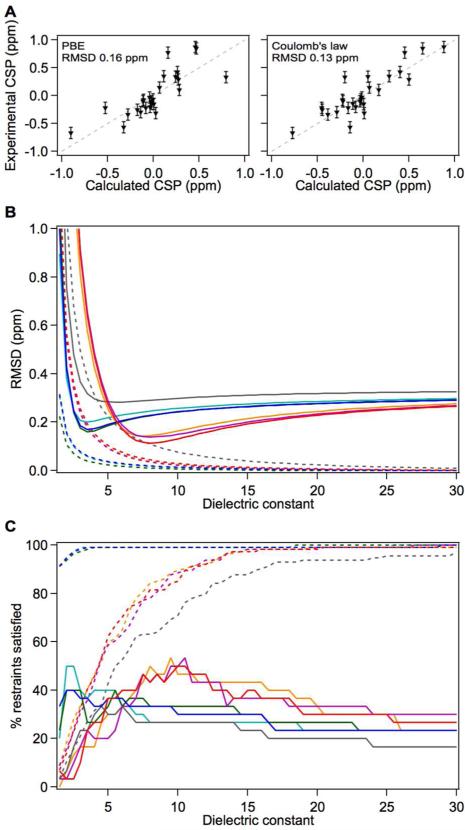
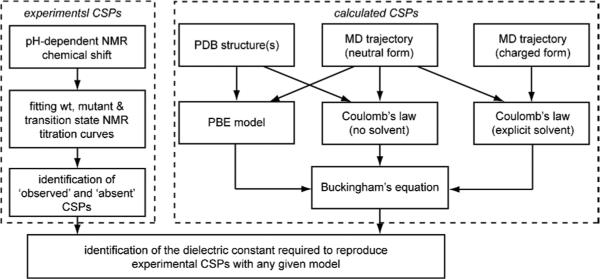
Understanding the connection between protein structure and function requires a quantitative understanding of electrostatic effects. Structure-based electrostatic calculations are essential for this purpose, but their use has been limited by a long-standing discussion on which value to use for the dielectric constants (ε(eff) and ε(p)) required in Coulombic and Poisson-Boltzmann models. The currently used values for ε(eff) and ε(p) are essentially empirical parameters calibrated against thermodynamic properties that are indirect measurements of protein electric fields. We determine optimal values for ε(eff) and ε(p) by measuring protein electric fields in solution using direct detection of NMR chemical shift perturbations (CSPs). We measured CSPs in 14 proteins to get a broad and general characterization of electric fields. Coulomb's law reproduces the measured CSPs optimally with a protein dielectric constant (ε(eff)) from 3 to 13, with an optimal value across all proteins of 6.5. However, when the water-protein interface is treated with finite difference Poisson-Boltzmann calculations, the optimal protein dielectric constant (ε(p)) ranged from 2 to 5 with an optimum of 3. It is striking how similar this value is to the dielectric constant of 2-4 measured for protein powders and how different it is from the ε(p) of 6-20 used in models based on the Poisson-Boltzmann equation when calculating thermodynamic parameters. Because the value of ε(p) = 3 is obtained by analysis of NMR chemical shift perturbations instead of thermodynamic parameters such as pK(a) values, it is likely to describe only the electric field and thus represent a more general, intrinsic, and transferable ε(p) common to most folded proteins.
理解蛋白质结构与功能之间的关系需要定量了解静电效应。为此,基于结构的静电计算至关重要,但由于库仑和泊松-玻尔兹曼模型中所需介电常数 (ε(eff) 和 ε(p)) 的值的长期讨论,其应用受到限制。目前使用的 ε(eff) 和 ε(p) 值本质上是针对热力学性质校准的经验参数,而热力学性质是蛋白质电场的间接测量。我们通过使用 NMR 化学位移扰动 (CSP) 的直接检测在溶液中测量蛋白质电场,确定 ε(eff) 和 ε(p) 的最佳值。我们测量了 14 种蛋白质的 CSP,以广泛而全面地描述电场。库仑定律使用 3 到 13 的蛋白质介电常数 (ε(eff)) 最佳地再现了测量的 CSP,所有蛋白质的最佳值为 6.5。然而,当用水处理蛋白质界面时,使用有限差分泊松-玻尔兹曼计算,最佳蛋白质介电常数 (ε(p)) 范围从 2 到 5,最佳值为 3。令人惊讶的是,这个值与测量的蛋白质粉末的介电常数 2-4 如此相似,与用于计算热力学参数的基于泊松-玻尔兹曼方程的模型中使用的 6-20 的 ε(p) 如此不同。由于 ε(p) = 3 的值是通过分析 NMR 化学位移扰动而不是 pK(a) 值等热力学参数获得的,因此它可能仅描述电场,因此代表更普遍、内在和可转移的 ε(p),这是大多数折叠蛋白质所共有的。