
展望全球森林转型。
Outlook on a worldwide forest transition.
机构信息
School of Environmental Sciences, University of Guelph, Guelph, Ontario, Canada ; Department of Mathematics and Statistics, University of Guelph, Guelph, Ontario, Canada.
出版信息
PLoS One. 2013 Oct 9;8(10):e75890. doi: 10.1371/journal.pone.0075890. eCollection 2013.
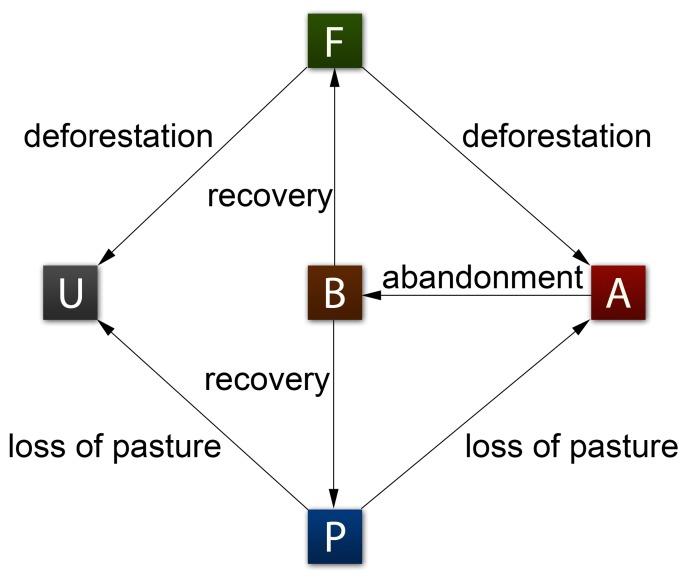
It is not clear whether a worldwide "forest transition" to net reforestation will ever occur, and the need to address the main driver--agriculture--is compelling. We present a mathematical model of land use dynamics based on the world food equation that explains historical trends in global land use on the millennial scale. The model predicts that a global forest transition only occurs under a small and very specific range of parameter values (and hence seems unlikely) but if it does occur, it would have to occur within the next 70 years. In our baseline scenario, global forest cover continues to decline until it stabilizes within the next two centuries at 22% of global land cover, and wild pasture at 1.4%. Under other scenarios the model predicts unanticipated dynamics wherein a forest transition may relapse, heralding a second era of deforestation; this brings into question national-level forest transitions observed in recent decades, and suggests we need to expand our lexicon of possibilities beyond the simple "forest transition/no forest transition" dichotomy. This research also underscores that the challenge of feeding a growing population while conserving natural habitat will likely continue for decades to come.
目前尚不清楚全球是否会出现净造林的“森林转型”,而解决主要驱动因素——农业——的需求迫在眉睫。我们提出了一个基于世界粮食方程的土地利用动态数学模型,该模型解释了千年尺度上全球土地利用的历史趋势。该模型预测,只有在很小且非常特定的参数值范围内(因此似乎不太可能)才会发生全球森林转型,但如果确实发生,它必须在未来 70 年内发生。在我们的基准情景中,全球森林覆盖率持续下降,直到在未来两个世纪内稳定在全球土地覆盖的 22%和野生牧场的 1.4%。在其他情景下,该模型预测出了意想不到的动态,森林转型可能会反复出现,预示着第二个砍伐森林的时代;这对近几十年来观察到的国家层面的森林转型提出了质疑,并表明我们需要在简单的“森林转型/无森林转型”二分法之外,扩大我们的可能性词汇。这项研究还强调,在未来几十年内,养活不断增长的人口同时保护自然栖息地的挑战可能会持续存在。



 Zotero 插件