Department of Geography, Environment and Geomatics, University of Guelph, Guelph, Canada.
School of Environment, Enterprise and Development, University of Waterloo, Waterloo, Canada.
PLoS One. 2018 Oct 23;13(10):e0205683. doi: 10.1371/journal.pone.0205683. eCollection 2018.
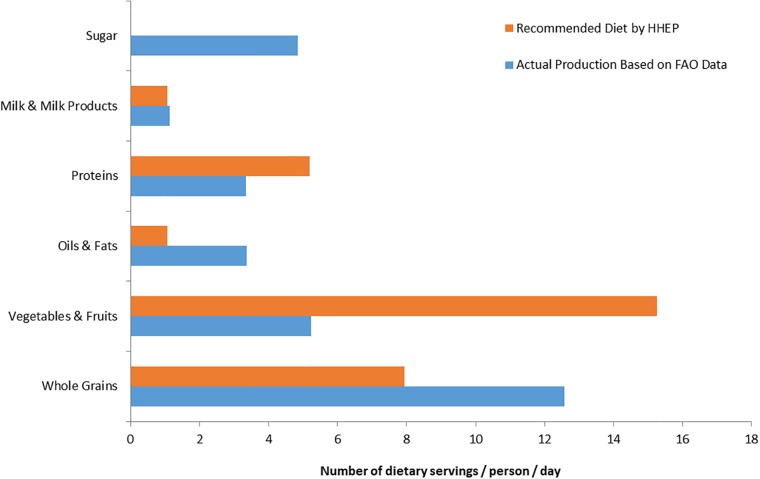
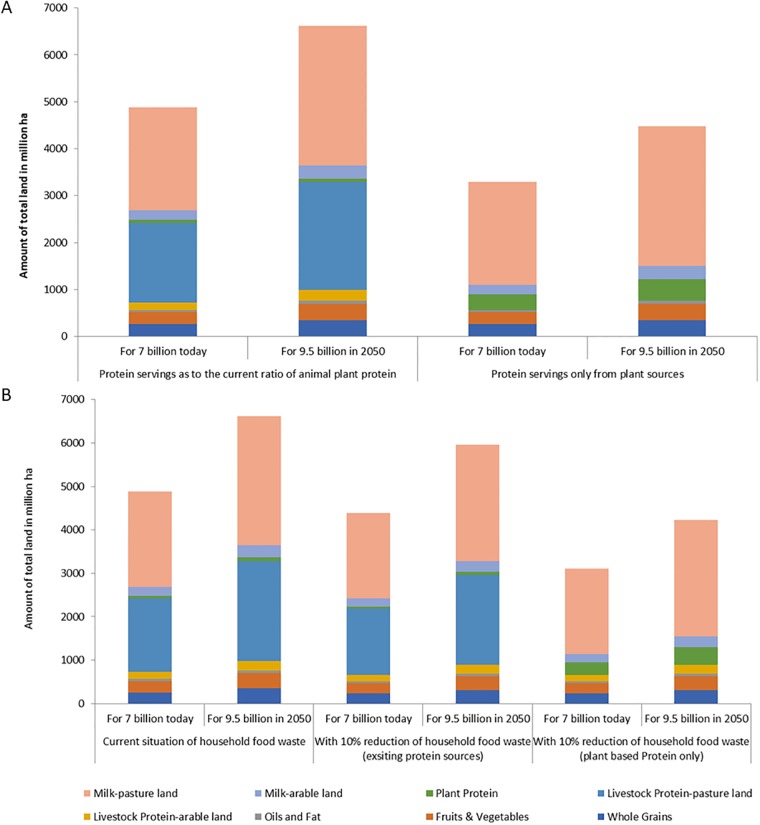
Sustainably feeding the next generation is often described as one of the most pressing "grand challenges" facing the 21st century. Generally, scholars propose addressing this problem by increasing agricultural production, investing in technology to boost yields, changing diets, or reducing food waste. In this paper, we explore whether global food production is nutritionally balanced by comparing the diet that nutritionists recommend versus global agricultural production statistics. Results show that the global agricultural system currently overproduces grains, fats, and sugars while production of fruits and vegetables and protein is not sufficient to meet the nutritional needs of the current population. Correcting this imbalance could reduce the amount of arable land used by agriculture by 51 million ha globally but would increase total land used for agriculture by 407 million ha and increase greenhouse gas emissions. For a growing population, our calculations suggest that the only way to eat a nutritionally balanced diet, save land and reduce greenhouse gas emissions is to consume and produce more fruits and vegetables as well as transition to diets higher in plant-based protein. Such a move will help protect habitats and help meet the Sustainable Development Goals.
养活下一代通常被描述为 21 世纪面临的最紧迫的“重大挑战”之一。通常,学者们提出通过增加农业产量、投资技术以提高产量、改变饮食或减少食物浪费来解决这个问题。在本文中,我们通过比较营养学家推荐的饮食与全球农业生产统计数据,探讨了全球粮食生产在营养上是否均衡。结果表明,全球农业系统目前谷物、脂肪和糖的产量过剩,而水果、蔬菜和蛋白质的产量不足以满足当前人口的营养需求。纠正这种不平衡可能会使全球农业用地减少 5100 万公顷,但会使农业用地总量增加 4.07 亿公顷,并增加温室气体排放。对于不断增长的人口来说,我们的计算表明,要想实现营养均衡的饮食、节约土地和减少温室气体排放,唯一的方法是增加水果、蔬菜的消费和生产,并转向以植物性蛋白质为主的饮食。这一举措将有助于保护栖息地,并有助于实现可持续发展目标。