Department of Physics and Astronomy, College of Charleston Charleston, SC, USA.
Front Integr Neurosci. 2011 Sep 23;5:52. doi: 10.3389/fnint.2011.00052. eCollection 2011.
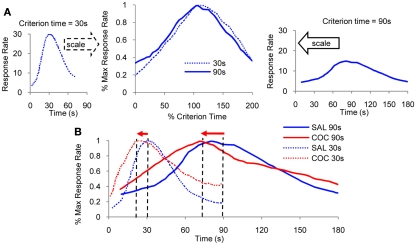
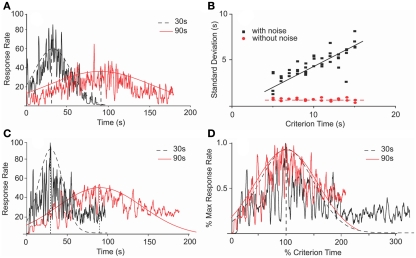
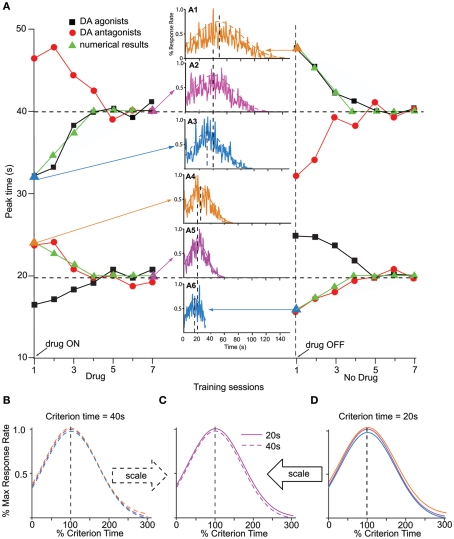
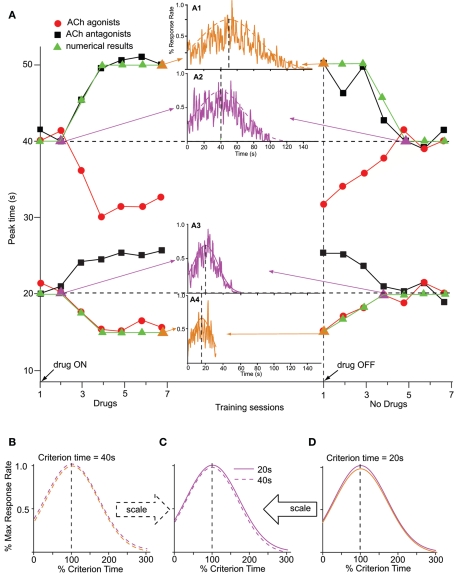
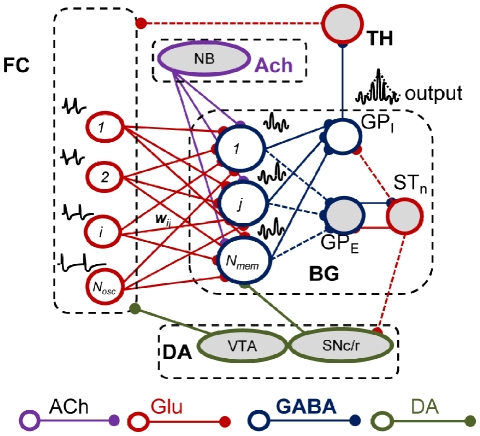
In most species, the capability of perceiving and using the passage of time in the seconds-to-minutes range (interval timing) is not only accurate but also scalar: errors in time estimation are linearly related to the estimated duration. The ubiquity of scalar timing extends over behavioral, lesion, and pharmacological manipulations. For example, in mammals, dopaminergic drugs induce an immediate, scalar change in the perceived time (clock pattern), whereas cholinergic drugs induce a gradual, scalar change in perceived time (memory pattern). How do these properties emerge from unreliable, noisy neurons firing in the milliseconds range? Neurobiological information relative to the brain circuits involved in interval timing provide support for an striatal beat frequency (SBF) model, in which time is coded by the coincidental activation of striatal spiny neurons by cortical neural oscillators. While biologically plausible, the impracticality of perfect oscillators, or their lack thereof, questions this mechanism in a brain with noisy neurons. We explored the computational mechanisms required for the clock and memory patterns in an SBF model with biophysically realistic and noisy Morris-Lecar neurons (SBF-ML). Under the assumption that dopaminergic drugs modulate the firing frequency of cortical oscillators, and that cholinergic drugs modulate the memory representation of the criterion time, we show that our SBF-ML model can reproduce the pharmacological clock and memory patterns observed in the literature. Numerical results also indicate that parameter variability (noise) - which is ubiquitous in the form of small fluctuations in the intrinsic frequencies of neural oscillators within and between trials, and in the errors in recording/retrieving stored information related to criterion time - seems to be critical for the time-scale invariance of the clock and memory patterns.
在大多数物种中,感知和使用秒到分钟范围内的时间流逝的能力(间隔计时)不仅准确,而且具有标度性:时间估计中的误差与估计的持续时间呈线性关系。标度计时的普遍性延伸到行为、损伤和药理学操作。例如,在哺乳动物中,多巴胺能药物会立即引起感知时间的标度变化(时钟模式),而胆碱能药物会引起感知时间的逐渐标度变化(记忆模式)。这些特性是如何从毫秒范围内不可靠、嘈杂的神经元发射中产生的?与涉及间隔计时的大脑回路相关的神经生物学信息为纹状体拍频(SBF)模型提供了支持,其中时间通过皮质神经振荡器偶然激活纹状体棘神经元来编码。虽然从生物学角度来看是合理的,但由于完美振荡器的不切实际性或缺乏完美振荡器,这个机制在一个具有嘈杂神经元的大脑中受到了质疑。我们使用具有生物物理现实性和嘈杂性 Morris-Lecar 神经元的 SBF 模型(SBF-ML)探索了时钟和记忆模式所需的计算机制。假设多巴胺能药物调节皮质振荡器的发射频率,而胆碱能药物调节标准时间的记忆表示,我们表明我们的 SBF-ML 模型可以再现文献中观察到的药理学时钟和记忆模式。数值结果还表明,参数可变性(噪声)——它以神经振荡器内在频率和试验之间的小波动以及与标准时间相关的存储信息的记录/检索误差的形式普遍存在——似乎对于时钟和记忆模式的时间尺度不变性至关重要。