Choo Byung Kil, Roh Seong-Soo
Department of Crop Agriculture and Life Science, Chonbuk National University, Jeonju 561-756, Republic of Korea.
Exp Ther Med. 2013 Sep;6(3):663-670. doi: 10.3892/etm.2013.1202. Epub 2013 Jul 4.
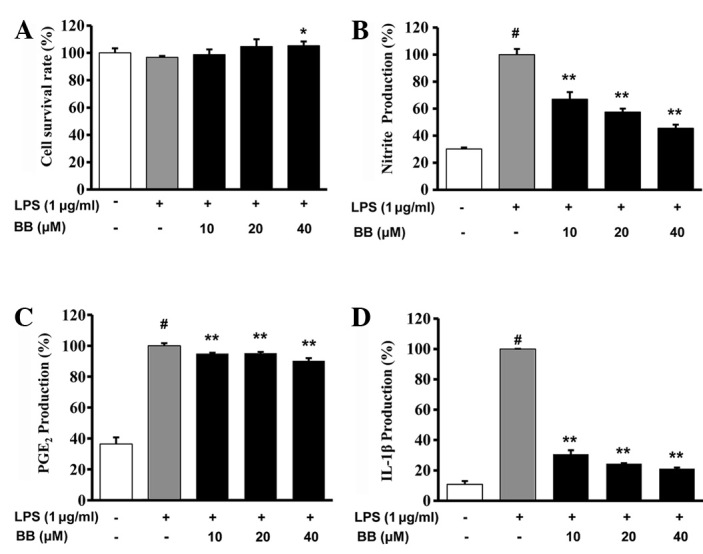
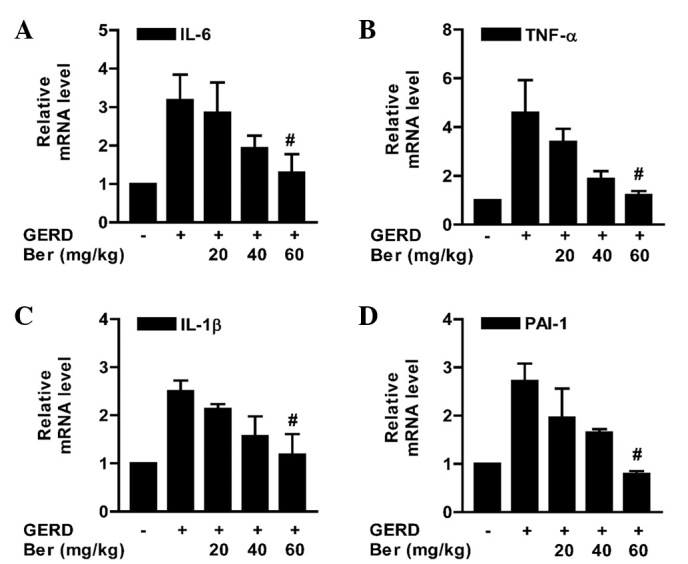
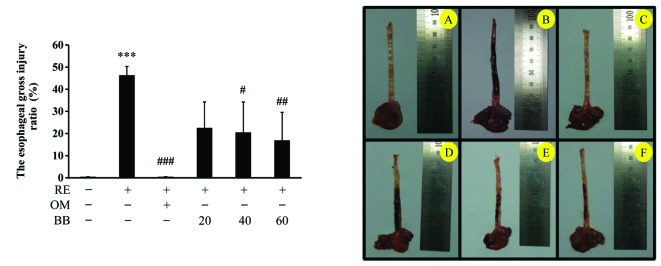
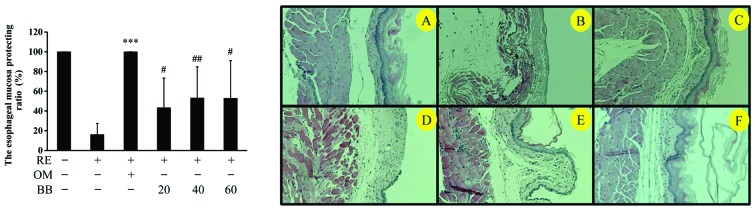
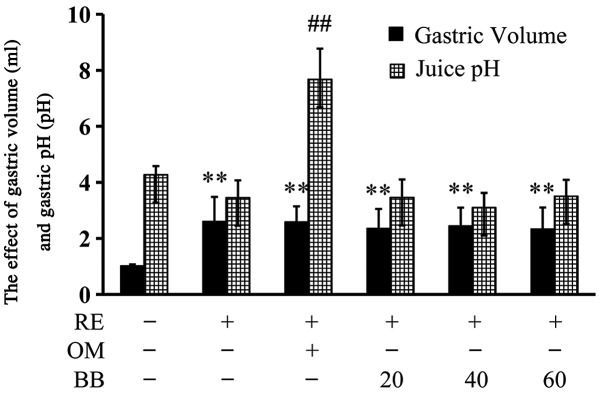
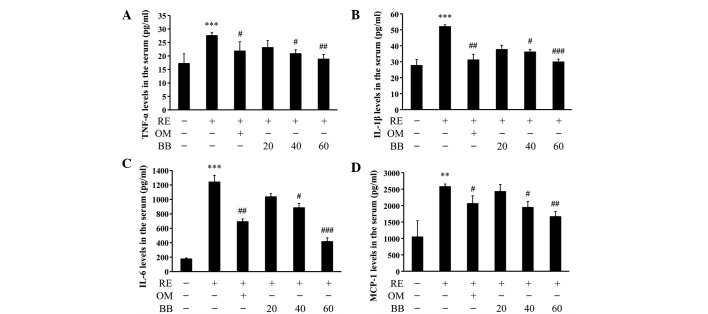
This study was performed to investigate the effects of berberine (BB) in a rat model of gastroesophageal reflux disease (GERD), induced by pylorus and forestomach ligation. We evaluated cytotoxicity and proinflammatory biomarkers (nitric oxide, interleukin (IL)-1β and prostaglandin E2) in RAW 264.7 cells and anti-inflammatory effects . A total of 54 Sprague Dawley rats were divided into six groups: intact control rats; reflux esophagitis (RE) control rats; RE rats treated with 20 mg/kg omeprazole and RE rats treated with BB at doses of 20, 40 and 60 mg/kg, respectively. All rats were fasted. RE was induced by pylorus and forestomach ligation one hour subsequent to the oral treatment. Six hours subsequent to the surgery, the rats were sacrificed, blood was collected from the abdominal vein and the esophagus and stomach were dissected. The gastric volume and the pH of the gastric juice were evaluated, prior to the esophagus being cut longitudinally and an inner mucosal area being imaged, to analyze mucosal damage indices. Proinflammatory biomarkers in the serum, including tumor necrosis factor (TNF)-α, IL-1β, IL-6 and monocyte chemoattractant protein (MCP)-1 were analyzed using an enzyme-linked immunosorbent assay (ELISA) kit, while the mRNA expression of TNF-α, IL-1β, IL-6 and plasminogen activator inhibitor (PAI)-1 was analyzed using a quantitative polymerase chain reaction (qPCR). Esophagic tissue damage in the BB groups was dose-dependently decreased compared with that in the RE control group. This result was consistent with significant reductions in the levels of proinflammatory biomarkers in the serum and in the expression of proinflammatory mRNA, specifically, TNF-α, IL-1β, IL-6 and PAI-1. The results suggest that the anti-inflammatory and protective effects of BB may attenuate the severity of RE and prevent esophageal mucosal damage, in addition to validating the use of BB as a pharmacological treatment for esophageal reflux disease.
本研究旨在探讨黄连素(BB)对幽门和前胃结扎诱导的大鼠胃食管反流病(GERD)模型的影响。我们评估了RAW 264.7细胞中的细胞毒性和促炎生物标志物(一氧化氮、白细胞介素(IL)-1β和前列腺素E2)以及抗炎作用。总共54只Sprague Dawley大鼠被分为六组:完整对照大鼠;反流性食管炎(RE)对照大鼠;用20 mg/kg奥美拉唑治疗的RE大鼠以及分别用20、40和60 mg/kg剂量的BB治疗的RE大鼠。所有大鼠均禁食。口服治疗1小时后,通过幽门和前胃结扎诱导RE。手术后6小时,处死大鼠,从腹静脉采集血液,并解剖食管和胃。在纵向切开食管并对内部黏膜区域成像之前,评估胃体积和胃液pH值,以分析黏膜损伤指数。使用酶联免疫吸附测定(ELISA)试剂盒分析血清中的促炎生物标志物,包括肿瘤坏死因子(TNF)-α、IL-1β、IL-6和单核细胞趋化蛋白(MCP)-1,同时使用定量聚合酶链反应(qPCR)分析TNF-α、IL-1β、IL-6和纤溶酶原激活物抑制剂(PAI)-1的mRNA表达。与RE对照组相比,BB组的食管组织损伤呈剂量依赖性降低。这一结果与血清中促炎生物标志物水平和促炎mRNA表达的显著降低一致,具体而言,即TNF-α、IL-1β、IL-6和PAI-1。结果表明,BB的抗炎和保护作用可能减轻RE的严重程度并预防食管黏膜损伤,此外还验证了BB作为食管反流病药物治疗的用途。