Lin Shin-Yu, Hsieh Chia-Jung, Chen Yi-Li, Shaw S W Steven, Lin Ming-Wei, Chen Pau-Chung, Lee Chien-Nan
Department of Obstetrics and Gynecology, National Taiwan University Hospital, Hsin Chu Branch, Hsin Chu, Taiwan ; Graduate Institute of Clinical Medicine, National Taiwan University College of Medicine, Taipei, Taiwan.
PLoS One. 2013 Sep 20;8(9):e75428. doi: 10.1371/journal.pone.0075428. eCollection 2013.
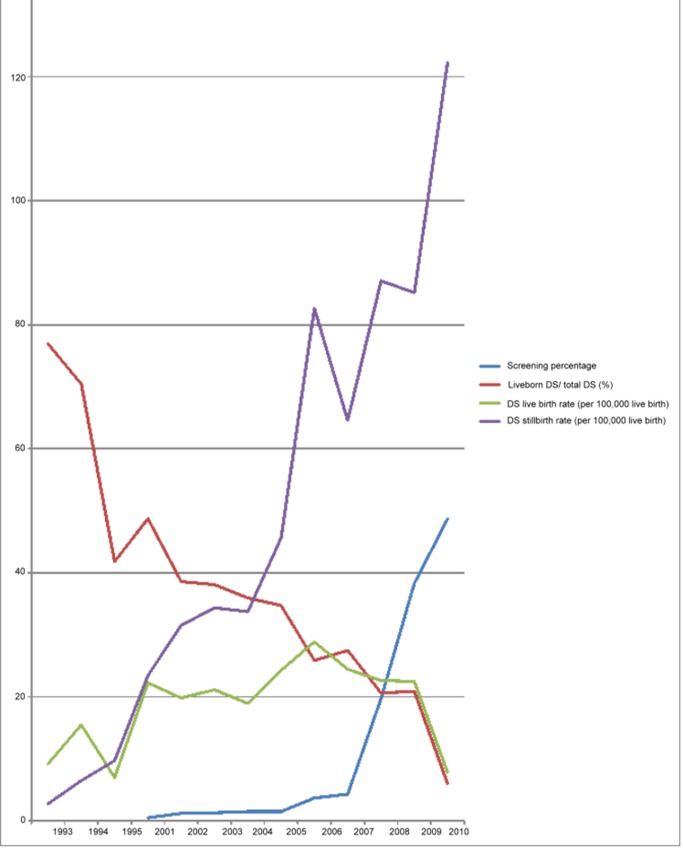
A retrospective analysis of the Taiwanese National Birth Defect Registration and Notification System was conducted in order to determine the live birth- and stillbirth rates in infants with Down syndrome, trisomy 18, trisomy 13 and Turner syndrome between 2001 and 2010. The objective was to investigate the impact of Down syndrome screening on the Taiwanese Down syndrome live birth rate. In addition, the results of first-trimester Down syndrome screening between 2006 and 2011, and of second-trimester quadruple testing between 2008 and 2011, were obtained from the National Taiwan University Hospital. All Taiwanese infants born between 2001 and 2010 were included in the first part of the analysis, and women receiving first-trimester Down syndrome screening or second-trimester quadruple testing from the National Taiwan University Hospital were included in the second part. The live birth rate of infants with Down syndrome, per 100 000 live births, decreased from 22.28 in 2001 to 7.79 in 2010. The ratio of liveborn DS to total DS was 48.74% in 2001, and then decreased to 25.88% in 2006, when first-trimester screening was widely introduced in Taiwan. This ratio dropped to 20.64% in 2008, when the second-trimester quadruple test was implemented. The overall positive rate in first-trimester screening in the National Taiwan University Hospital was 3.1%, with a Down syndrome detection rate of 100%; the quadruple test had values of 9.0% and 75%, respectively. The use of first-trimester screening and the second-trimester quadruple test may be responsible for the marked decrease in the Taiwanese Down syndrome live birth rate observed between 2001 and 2010.
为了确定2001年至2010年间唐氏综合征、18三体综合征、13三体综合征和特纳综合征婴儿的活产率和死产率,对台湾地区国家出生缺陷登记和通报系统进行了回顾性分析。目的是研究唐氏综合征筛查对台湾地区唐氏综合征活产率的影响。此外,2006年至2011年的孕早期唐氏综合征筛查结果以及2008年至2011年的孕中期四联检测结果来自台湾大学附属医院。2001年至2010年出生的所有台湾地区婴儿纳入分析的第一部分,接受台湾大学附属医院孕早期唐氏综合征筛查或孕中期四联检测的妇女纳入第二部分。每10万例活产中,唐氏综合征婴儿的活产率从2001年的22.28降至2010年的7.79。2001年活产唐氏综合征婴儿与唐氏综合征婴儿总数的比例为48.74%,2006年台湾地区广泛引入孕早期筛查时降至25.88%。2008年实施孕中期四联检测时,该比例降至20.64%。台湾大学附属医院孕早期筛查的总体阳性率为3.1%,唐氏综合征检测率为100%;四联检测的相应数值分别为9.0%和75%。孕早期筛查和孕中期四联检测的应用可能是导致2001年至2010年间台湾地区唐氏综合征活产率显著下降的原因。