Department of Neurobiology, University of Pittsburgh Pittsburgh, PA, USA.
Front Hum Neurosci. 2013 Oct 22;7:671. doi: 10.3389/fnhum.2013.00671. eCollection 2013.
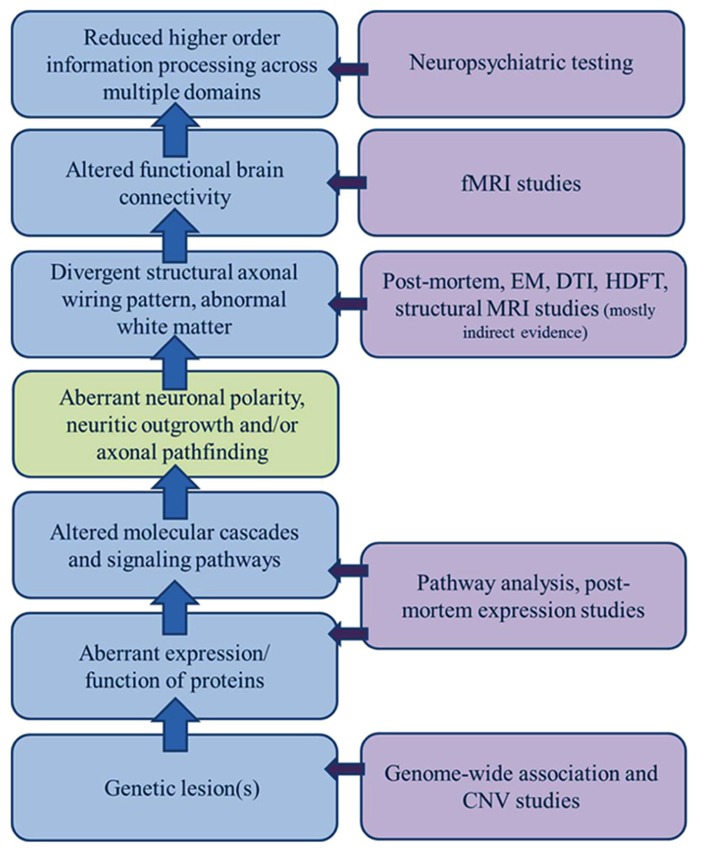
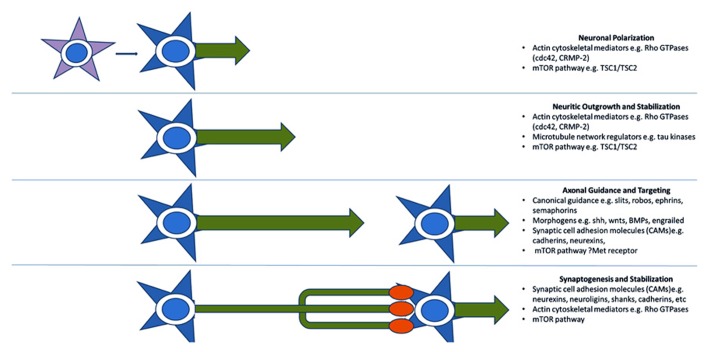
Current theories concerning the cause of autism spectrum disorders (ASDs) have converged on the concept of abnormal development of brain connectivity. This concept is supported by accumulating evidence from functional imaging, diffusion tensor imaging, and high definition fiber tracking studies which suggest altered microstructure in the axonal tracts connecting cortical areas may underly many of the cognitive manifestations of ASD. Additionally, large-scale genomic studies implicate numerous gene candidates known or suspected to mediate neuritic outgrowth and axonal guidance in fetal and perinatal life. Neuropathological observations in postmortem ASD brain samples further support this model and include subtle disturbances of cortical lamination and subcortical axonal morphology. Of note is the relatively common finding of poor differentiation of the gray-white junction associated with an excess superficial white matter or "interstitial" neurons (INs). INs are thought to be remnants of the fetal subplate, a transient structure which plays a key role in the guidance and morphogenesis of thalamocortical and cortico-cortical connections and the organization of cortical columnar architecture. While not discounting the importance of synaptic dysfunction in the etiology of ASD, this paper will briefly review the cortical abnormalities and genetic evidence supporting a model of dysregulated axonal growth and guidance as key developmental processes underlying the clinical manifestations of ASD.
目前关于自闭症谱系障碍(ASD)病因的理论已经集中在大脑连接异常发育的概念上。这一概念得到了越来越多的功能性成像、弥散张量成像和高清晰度纤维追踪研究的证据支持,这些研究表明,连接皮质区域的轴突束的微观结构改变可能是 ASD 许多认知表现的基础。此外,大规模基因组研究表明,许多已知或疑似在胎儿和围产期介导神经突生长和轴突导向的基因候选物都与 ASD 有关。在 ASD 死后脑组织样本中的神经病理学观察进一步支持了这一模型,包括皮质层状结构和皮质下轴突形态的细微干扰。值得注意的是,与过多的浅表白质或“间质”神经元(INs)相关的灰白质交界处分化不良的相对常见发现。INs 被认为是胎儿基板的残留物,基板是一种短暂的结构,在丘脑皮质和皮质皮质连接的引导和形态发生以及皮质柱状结构的组织中起着关键作用。虽然不排除突触功能障碍在 ASD 病因学中的重要性,但本文将简要回顾支持异常轴突生长和引导模型的皮质异常和遗传证据,该模型是 ASD 临床表现的关键发育过程。