Taher Leila, Smith Robin P, Kim Mee J, Ahituv Nadav, Ovcharenko Ivan
Genome Biol. 2013;14(10):R117. doi: 10.1186/gb-2013-14-10-r117.
Gene expression is controlled by proximal promoters and distal regulatory elements such as enhancers. While the activity of some promoters can be invariant across tissues, enhancers tend to be highly tissue-specific.
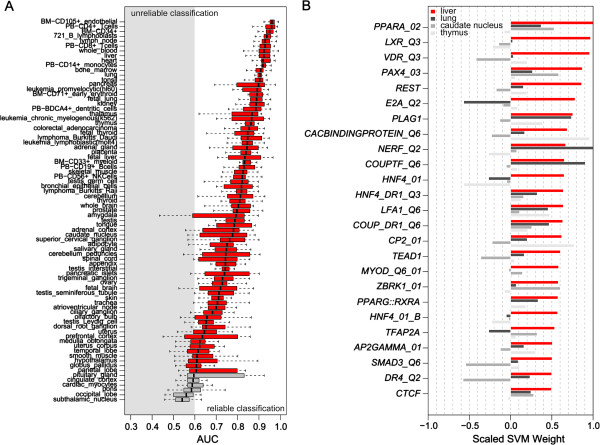
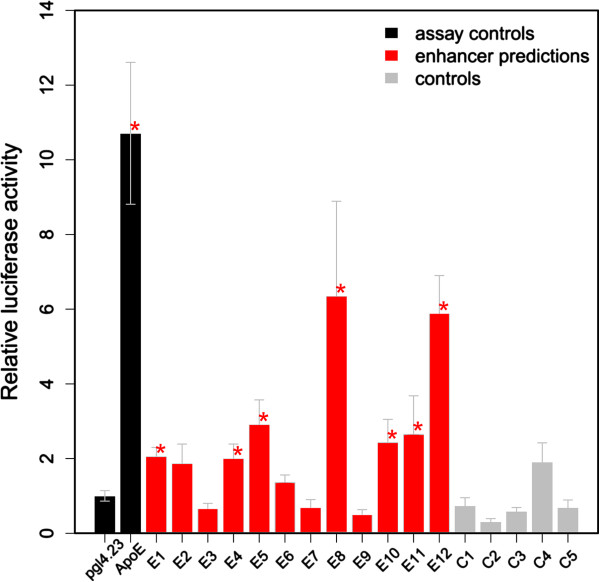
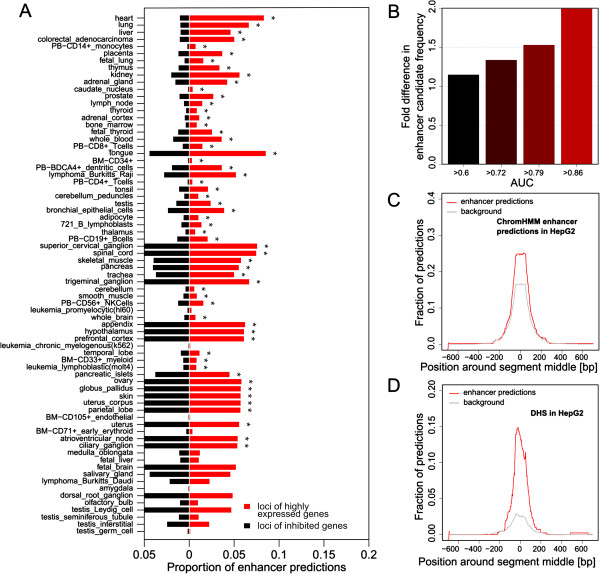
We compiled sets of tissue-specific promoters based on gene expression profiles of 79 human tissues and cell types. Putative transcription factor binding sites within each set of sequences were used to train a support vector machine classifier capable of distinguishing tissue-specific promoters from control sequences. We obtained reliable classifiers for 92% of the tissues, with an area under the receiver operating characteristic curve between 60% (for subthalamic nucleus promoters) and 98% (for heart promoters). We next used these classifiers to identify tissue-specific enhancers, scanning distal non-coding sequences in the loci of the 200 most highly and lowly expressed genes. Thirty percent of reliable classifiers produced consistent enhancer predictions, with significantly higher densities in the loci of the most highly expressed compared to lowly expressed genes. Liver enhancer predictions were assessed in vivo using the hydrodynamic tail vein injection assay. Fifty-eight percent of the predictions yielded significant enhancer activity in the mouse liver, whereas a control set of five sequences was completely negative.
We conclude that promoters of tissue-specific genes often contain unambiguous tissue-specific signatures that can be learned and used for the de novo prediction of enhancers.
基因表达受近端启动子和增强子等远端调控元件控制。虽然一些启动子的活性在不同组织中可能是不变的,但增强子往往具有高度的组织特异性。
我们基于79种人类组织和细胞类型的基因表达谱汇编了组织特异性启动子集。每组序列中的推定转录因子结合位点用于训练能够区分组织特异性启动子和对照序列的支持向量机分类器。我们获得了92%组织的可靠分类器,受试者操作特征曲线下面积在60%(丘脑底核启动子)至98%(心脏启动子)之间。接下来,我们使用这些分类器来识别组织特异性增强子,扫描200个表达最高和最低基因位点中的远端非编码序列。30%的可靠分类器产生了一致的增强子预测,与低表达基因相比,高表达基因位点中的密度显著更高。使用尾静脉注射水动力法在体内评估肝脏增强子预测。58%的预测在小鼠肝脏中产生了显著的增强子活性,而一组五个对照序列则完全呈阴性。
我们得出结论,组织特异性基因的启动子通常包含明确的组织特异性特征,这些特征可用于从头预测增强子。