Departamento de Fitossanidade, Faculdade de Agronomia, Universidade Federal do Rio Grande do Sul, Porto Alegre, RS, Brazil.
Braz J Microbiol. 2013 May 31;44(1):89-95. doi: 10.1590/S1517-83822013000100012.
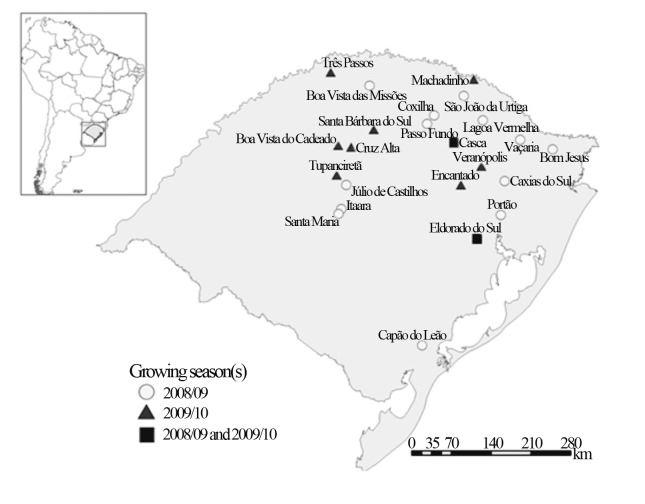
Ear rots caused by Fusarium spp. are among the main fungal diseases that contribute to poor quality and the contamination of maize grains with mycotoxins. This study aimed to determine the visual incidence of fungal-damaged kernels (FDKs), the incidence of two main Gibberella (a teleomorph of Fusarium) complexes (G. fujikuroi and G. zeae) associated with maize using a seed health blotter test, and the fumonisin levels, using high performance liquid chromatography, in samples of maize grains grown across 23 municipalities during the 2008/09 and 2009/10 growing seasons. Additionally, 104 strains that were representative of all of the analysed samples were identified to species using PCR assays. The mean FDK was seven per cent, and only six of the samples had levels greater than six per cent. Fusarium spp. of the G. fujikuroi complex were present in 96% of the samples, and G. zeae was present in 18% of the samples (5/27). The mean incidence of G. fujikuroi was 58%, and the incidence of G. zeae varied from 2 to 6%. FB1 was found in 58.6%, FB2 in 37.9%, and both toxins in 37.9% of the samples. The FB1 and FB2 levels were below the quantification limits for 41.3% of the samples, and the mean FB1 levels (0.66 μg/g) were higher than the mean FB2 levels (0.42 μg/g). The PCR identification separated the 104 isolates into three of the G. fujikuroi complex: F. verticillioides (76%), F. subglutinans (4%) and F. proliferatum (2%); and G. zeae (anamorph = F. graminearum) (18%). Our results confirmed the dominance of F. verticillioides, similar to other regions of Brazil, but they differed due to the relatively higher incidence of F. graminearum. Total fumonisin levels were below the maximum limit determined by current Brazilian regulations.
耳腐病是由镰刀菌属引起的主要真菌病害之一,它会导致玉米籽粒质量下降,并污染霉菌毒素。本研究旨在测定 2008/09 和 2009/10 生长季节 23 个市的玉米籽粒样本中,使用种子健康检测试纸(seed health blotter test)检测与玉米相关的两个主要镰孢菌(镰刀菌的有性态)复合体(藤仓镰刀菌和玉蜀黍镰刀菌)的真菌损伤籽粒(fungal-damaged kernels,FDK)的视觉发生率,以及使用高效液相色谱法(high performance liquid chromatography)检测伏马菌素水平。此外,使用 PCR 检测对所有分析样本中具有代表性的 104 株菌进行了种属鉴定。平均 FDK 为 7%,只有 6 个样本的水平大于 6%。96%的样本中存在藤仓镰刀菌复合体的镰刀菌属,18%的样本中存在玉蜀黍镰刀菌(5/27)。藤仓镰刀菌复合体的平均发生率为 58%,玉蜀黍镰刀菌的发生率从 2%到 6%不等。58.6%的样本中发现了 FB1,37.9%的样本中发现了 FB2,37.9%的样本中同时发现了这两种毒素。41.3%的样本中 FB1 和 FB2 的含量低于定量限,平均 FB1 水平(0.66μg/g)高于平均 FB2 水平(0.42μg/g)。PCR 鉴定将 104 个分离株分为藤仓镰刀菌复合体的三个种:层出镰刀菌(76%)、拟枝孢镰刀菌(4%)和茄病镰刀菌(2%);以及玉蜀黍镰刀菌(无性型=玉蜀黍赤霉)(18%)。我们的结果证实了巴西其他地区一样,层出镰刀菌占主导地位,但由于禾谷镰刀菌的发病率相对较高,结果有所不同。总伏马菌素水平低于巴西现行法规规定的最高限量。