Saw Swee Hock School of Public Health, National University of Singapore, MD3, 16 Medical Drive, Singapore 117597, Singapore.
BMC Public Health. 2013 Oct 26;13:1012. doi: 10.1186/1471-2458-13-1012.
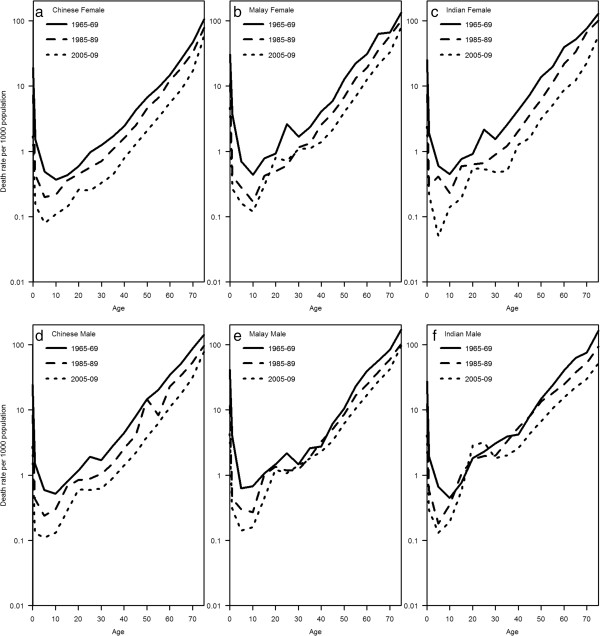
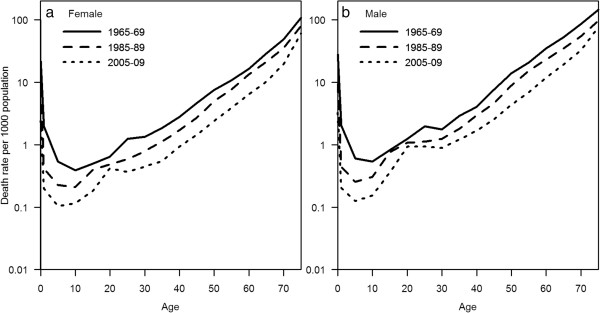
The increase in life expectancy and the persistence of expectancy gaps between different social groups in the 20th century are well-described in Western developed countries, but less well documented in the newly industrialised countries of Asia. Singapore, a multiethnic island-state, has undergone a demographic and epidemiologic transition concomitant with economic development. We evaluate secular trends and differences in life expectancy by ethnicity and gender in Singapore, from independence to the present.
Period abridged life tables were constructed to derive the life expectancy of the Singapore population from 1965 to 2009 using data from the Department of Statistics and the Registry of Births and Deaths, Singapore.
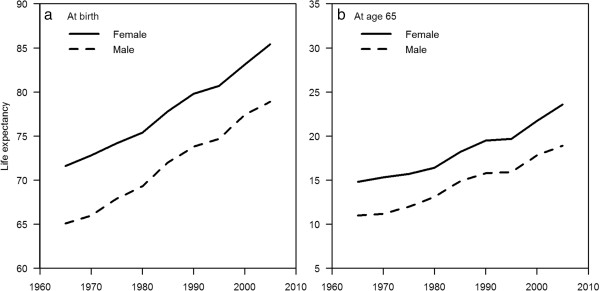
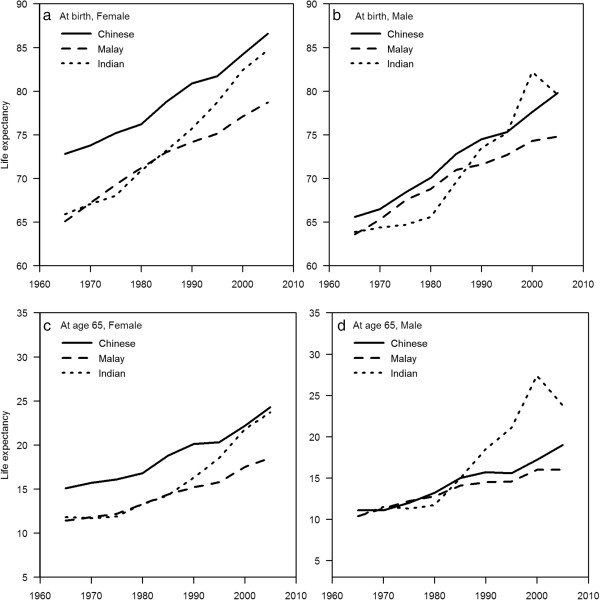
All 3 of Singapore's main ethnic groups, and both genders, experienced an increase in life expectancy at birth and at 65 years from 1965 to 2009, though at substantially different rates. Although there has been a convergence in life expectancy between Indians and Chinese, the (substantial) gap between Malays and the other two ethnic groups has remained. Females continued to have a higher life expectancy at birth and at 65 years than males throughout this period, with no evidence of convergence.
Ethnic and gender differences in life expectancy persist in Singapore despite its rapid economic development. Targeted chronic disease prevention measures and health promotion activities focusing on people of Malay ethnicity and the male community may be needed to remedy this inequality.
20 世纪,在西方发达国家,人们的预期寿命延长,不同社会群体之间的预期寿命差距持续存在,这一现象得到了很好的描述。但在亚洲新兴工业化国家,这方面的记录却较少。新加坡是一个多种族的岛国,经历了人口和流行病学的转变,同时经济也得到了发展。我们评估了新加坡自独立以来,按种族和性别划分的预期寿命的长期趋势和差异。
我们使用新加坡统计局和出生与死亡登记处的数据,构建了时期简表,以推导出新加坡人口从 1965 年到 2009 年的预期寿命。
从 1965 年到 2009 年,新加坡的三个主要种族群体和两性都经历了出生时和 65 岁时预期寿命的增加,尽管增长速度有很大的不同。尽管印度人和华人之间的预期寿命差距有所缩小,但马来人与其他两个种族群体之间的差距仍然很大。在此期间,女性的出生时和 65 岁时预期寿命一直高于男性,而且没有趋同的迹象。
尽管新加坡经济发展迅速,但预期寿命的种族和性别差异仍然存在。可能需要针对马来族裔和男性群体开展有针对性的慢性病预防措施和健康促进活动,以纠正这种不平等现象。