Cognitive Mechanisms Laboratories and Brain Information Communication Research Laboratory Group, Advanced Telecommunications Research Institute International Kyoto, Japan ; Research Fellow of the Japan Society for the Promotion of Science Tokyo, Japan.
Front Psychol. 2013 Oct 23;4:760. doi: 10.3389/fpsyg.2013.00760. eCollection 2013.
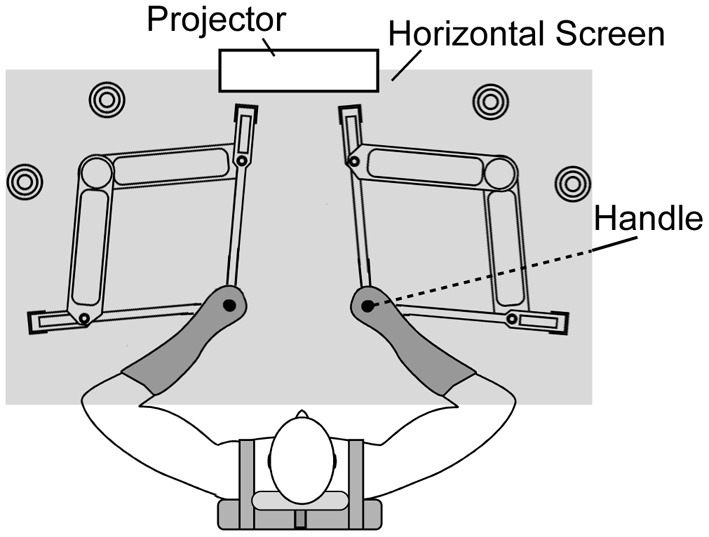
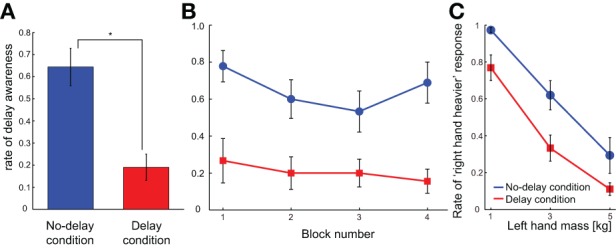
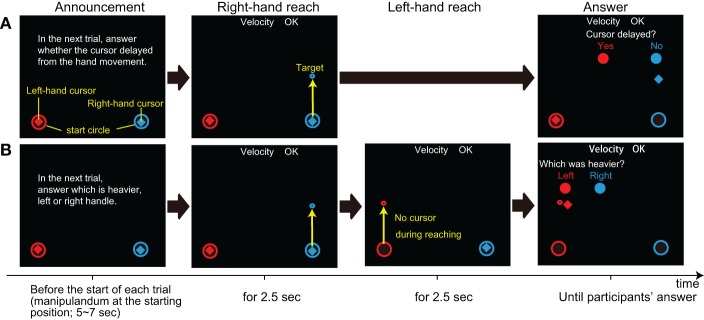
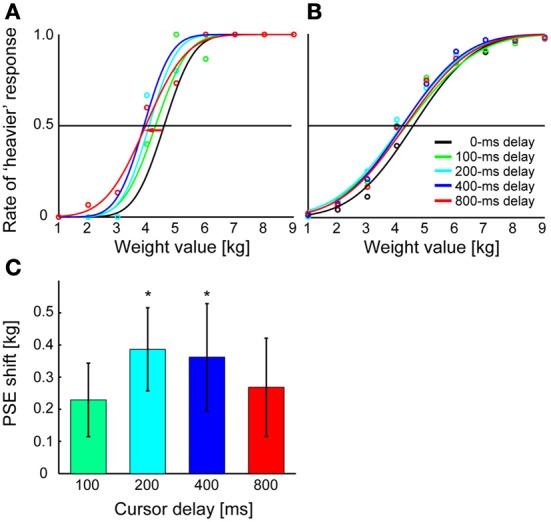
While performing an action, the timing of when the sensory feedback is given can be used to establish the causal link between the action and its consequence. It has been shown that delaying the visual feedback while carrying an object makes people feel the mass of the object to be greater, suggesting that the feedback timing can also impact the perceived quality of an external object. In this study, we investigated the origin of the feedback timing information that influences the mass perception of the external object. Participants made a straight reaching movement while holding a manipulandum. The movement of the manipulandum was presented as a cursor movement on a monitor. In Experiment 1, various delays were imposed between the actual trajectory and the cursor movement. The participants' perceived mass of the manipulandum significantly increased as the delay increased to 400 ms, but this gain did not reach significance when the delay was 800 ms. This suggests the existence of a temporal tuning mechanism for incorporating the visual feedback into the perception of mass. In Experiment 2, we examined whether the increased mass perception during the visual delay was due to the prediction error of the visual consequence of an action or to the actual delay of the feedback itself. After the participants adapted to the feedback delay, the perceived mass of the object became lighter than before, indicating that updating the temporal prediction model for the visual consequence diminishes the overestimation of the object's mass. We propose that the misattribution of the visual delay into mass perception is induced by the sensorimotor prediction error, possibly when the amount of delay (error) is within the range that can reasonably include the consequence of an action.
在执行动作时,给予感官反馈的时间可以用来建立动作与其后果之间的因果关系。已经表明,在搬运物体时延迟视觉反馈会使人感觉物体的质量更大,这表明反馈时间也会影响对外界物体的感知质量。在这项研究中,我们研究了影响外部物体质量感知的反馈时间信息的来源。参与者在握持操纵杆的同时进行直线伸手动作。操纵杆的运动显示在监视器上的光标运动。在实验 1 中,在实际轨迹和光标运动之间施加了各种延迟。随着延迟增加到 400 毫秒,参与者对操纵杆的感知质量显著增加,但当延迟为 800 毫秒时,这种增加没有达到显著水平。这表明存在一种时间调谐机制,用于将视觉反馈纳入质量感知中。在实验 2 中,我们研究了在视觉延迟期间增加的质量感知是否是由于动作的视觉后果的预测误差或反馈本身的实际延迟所致。在参与者适应反馈延迟后,物体的感知质量变得比以前轻,表明更新视觉后果的时间预测模型会减少对物体质量的高估。我们提出,将视觉延迟错误归因于质量感知是由感觉运动预测误差引起的,可能是当延迟量(误差)在可以合理包含动作后果的范围内时。