Strong Amy L, Strong Thomas A, Rhodes Lyndsay V, Semon Julie A, Zhang Xiujuan, Shi Zhenzhen, Zhang Shijia, Gimble Jeffrey M, Burow Matthew E, Bunnell Bruce A
Breast Cancer Res. 2013;15(5):R102. doi: 10.1186/bcr3569.
Obesity has been associated with increased incidence and mortality of breast cancer. While the precise correlation between obesity and breast cancer remains to be determined, recent studies suggest that adipose tissue and adipose stem cells (ASCs) influence breast cancer tumorigenesis and tumor progression.
Breast cancer cells lines were co-cultured with ASCs (n = 24), categorized based on tissue site of origin and body mass index (BMI), and assessed for enhanced proliferation, alterations in gene expression profile with PCR arrays, and enhanced tumorigenesis in immunocompromised mice. The gene expression profile of ASCs was assess with PCR arrays and qRT-PCR and confirmed with Western blot analysis. Inhibitory studies were conducted by delivering estrogen antagonist ICI182,780, leptin neutralizing antibody, or aromatase inhibitor letrozole and assessing breast cancer cell proliferation. To assess the role of leptin in human breast cancers, Oncomine and Kaplan Meier plot analyses were conducted.
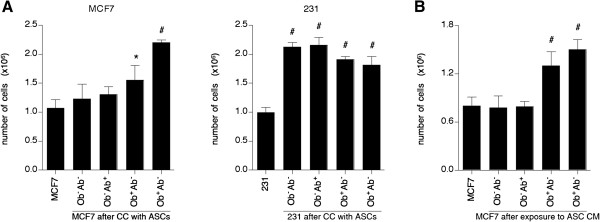
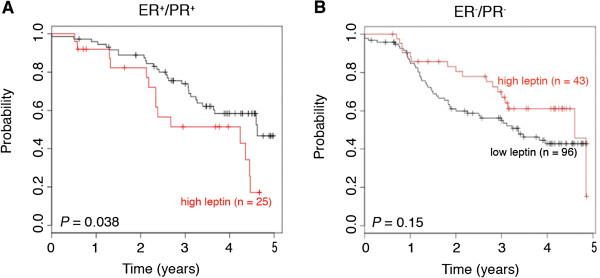
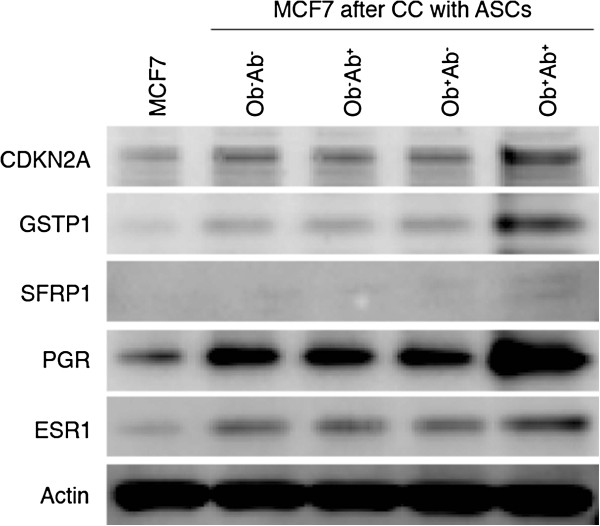
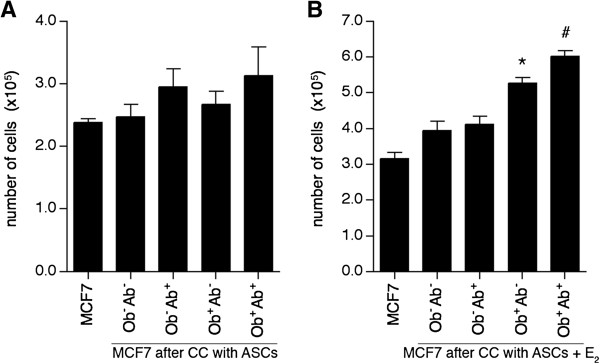
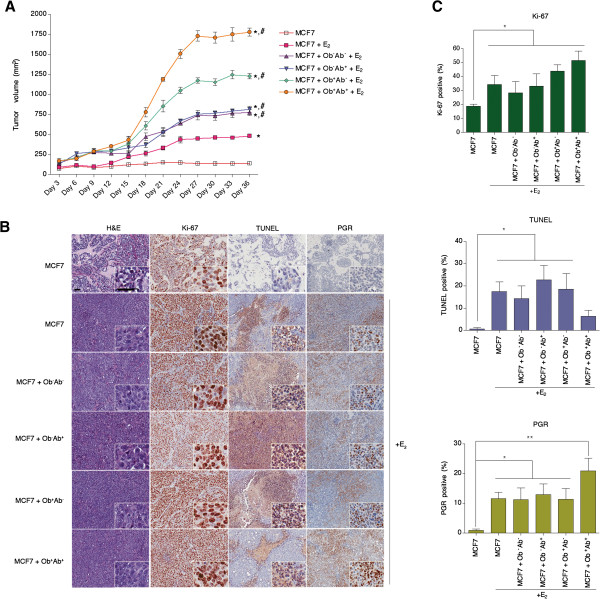
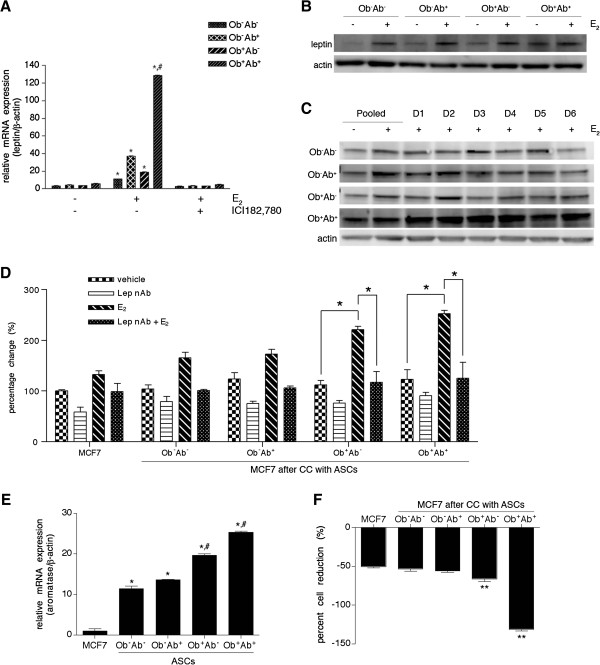
ASCs derived from the abdominal subcutaneous adipose tissue of obese subjects (BMI > 30) enhanced breast cancer cell proliferation in vitro and tumorigenicity in vivo. These findings were correlated with changes in the gene expression profile of breast cancer cells after co-culturing with ASCs, particularly in estrogen receptor-alpha (ESR1) and progesterone receptor (PGR) expression. Analysis of the gene expression profile of the four groups of ASCs revealed obesity induced alterations in several key genes, including leptin (LEP). Blocking estrogen signaling with ICI182,780, leptin neutralizing antibody, or letrozole diminished the impact of ASCs derived from obese subjects. Women diagnosed with estrogen receptor/progesterone receptor positive (ER+/PR+) breast cancers that also expressed high levels of leptin had poorer prognosis than women with low leptin expression.
ASCs isolated from the abdomen of obese subjects demonstrated increased expression of leptin, through estrogen stimulation, which increased breast cancer cell proliferation. The results from this study demonstrate that abdominal obesity induces significant changes in the biological properties of ASCs and that these alterations enhance ER+/PR+ breast cancer tumorigenesis through estrogen dependent pathways.
肥胖与乳腺癌发病率和死亡率的增加有关。虽然肥胖与乳腺癌之间的确切关联仍有待确定,但最近的研究表明,脂肪组织和脂肪干细胞(ASC)会影响乳腺癌的发生和肿瘤进展。
将乳腺癌细胞系与ASC(n = 24)共培养,根据组织起源部位和体重指数(BMI)进行分类,并评估其增殖增强情况、通过PCR阵列检测基因表达谱的变化以及在免疫受损小鼠中的致瘤性增强情况。用PCR阵列和qRT-PCR评估ASC的基因表达谱,并用蛋白质印迹分析进行确认。通过给予雌激素拮抗剂ICI182,780、瘦素中和抗体或芳香化酶抑制剂来曲唑并评估乳腺癌细胞增殖进行抑制研究。为评估瘦素在人类乳腺癌中的作用,进行了Oncomine和Kaplan Meier绘图分析。
来自肥胖受试者(BMI>30)腹部皮下脂肪组织的ASC在体外增强了乳腺癌细胞的增殖,并在体内增强了致瘤性。这些发现与ASC共培养后乳腺癌细胞基因表达谱的变化相关,特别是雌激素受体α(ESR1)和孕激素受体(PGR)的表达。对四组ASC的基因表达谱分析显示,肥胖诱导了包括瘦素(LEP)在内的几个关键基因的改变。用ICI182,780、瘦素中和抗体或来曲唑阻断雌激素信号减弱了来自肥胖受试者的ASC的影响。诊断为雌激素受体/孕激素受体阳性(ER+/PR+)乳腺癌且瘦素表达水平高的女性比瘦素表达水平低的女性预后更差。
从肥胖受试者腹部分离出的ASC通过雌激素刺激表现出瘦素表达增加,这增加了乳腺癌细胞的增殖。本研究结果表明,腹部肥胖会引起ASC生物学特性的显著变化,并且这些改变通过雌激素依赖途径增强ER+/PR+乳腺癌的肿瘤发生。