Hudson Institute of Medical Research, Clayton, Victoria, Australia.
Faculty of Applied Medical Science, Taibah University, Medina, Saudi Arabia.
Int J Obes (Lond). 2018 Apr;42(4):711-720. doi: 10.1038/ijo.2017.273. Epub 2017 Nov 6.
BACKGROUND/OBJECTIVES: Obesity (body mass index (BMI)⩾30 kg m) is associated with an increased risk of estrogen-dependent breast cancer after menopause. Levels of aromatase, the rate-limiting enzyme in estrogen biosynthesis, are elevated in breast tissue of obese women. Recently, the regulation of aromatase by the p53-hypoxia-inducible factor-1α (HIF1α)/pyruvate kinase M2 (PKM2) axis was characterized in adipose stromal cells (ASCs) of women with Li-Fraumeni Syndrome, a hereditary cancer syndrome that predisposes to estrogen-dependent breast cancer. The current study aimed to determine whether stimulation of aromatase by obesity-associated adipokine leptin involves the regulation of the p53-HIF1α/PKM2 axis.
SUBJECTS/METHODS: Human breast ASCs were used to characterize the p53-HIF1α/PKM2-aromatase axis in response to leptin. The effect of pharmacological or genetic modulation of protein kinase C (PKC), mitogen-activated protein kinase (MAPK), p53, Aha1, Hsp90, HIF1α and PKM2 on aromatase promoter activity, expression and enzyme activity was examined. Semiquantitative immunofluorescence and confocal imaging were used to assess ASC-specific protein expression in formalin-fixed paraffin-embedded tissue sections of breast of women and mammary tissue of mice following a low-fat (LF) or high-fat (HF) diet for 17 weeks.
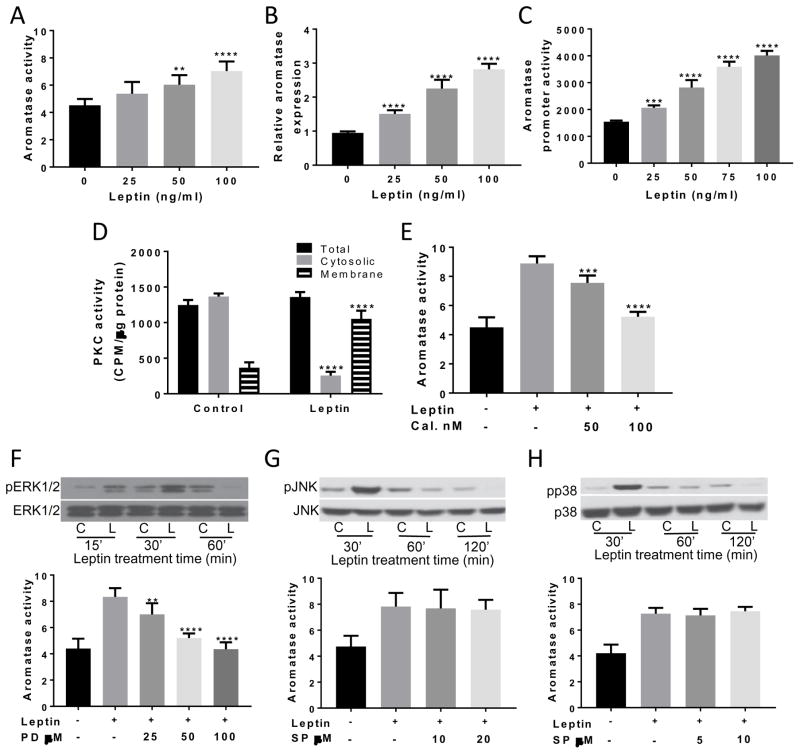
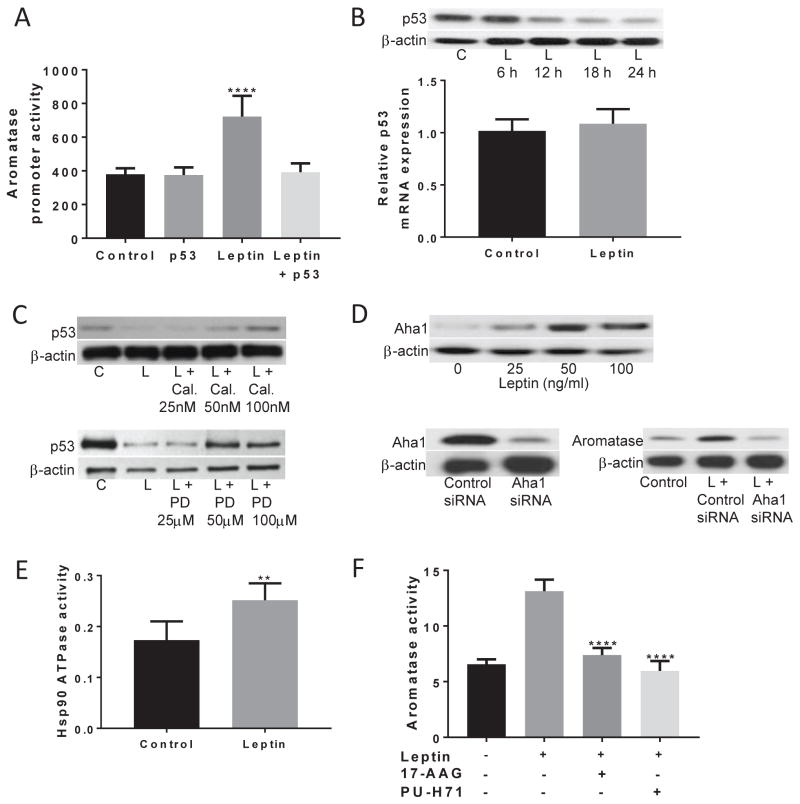
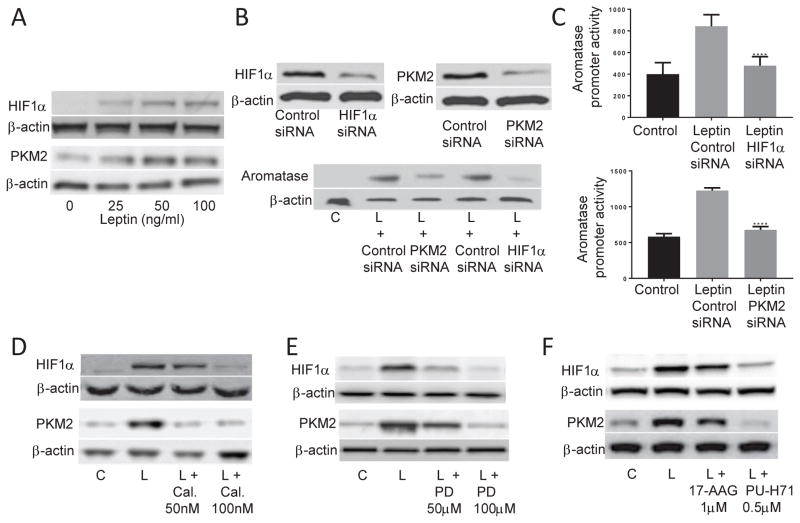
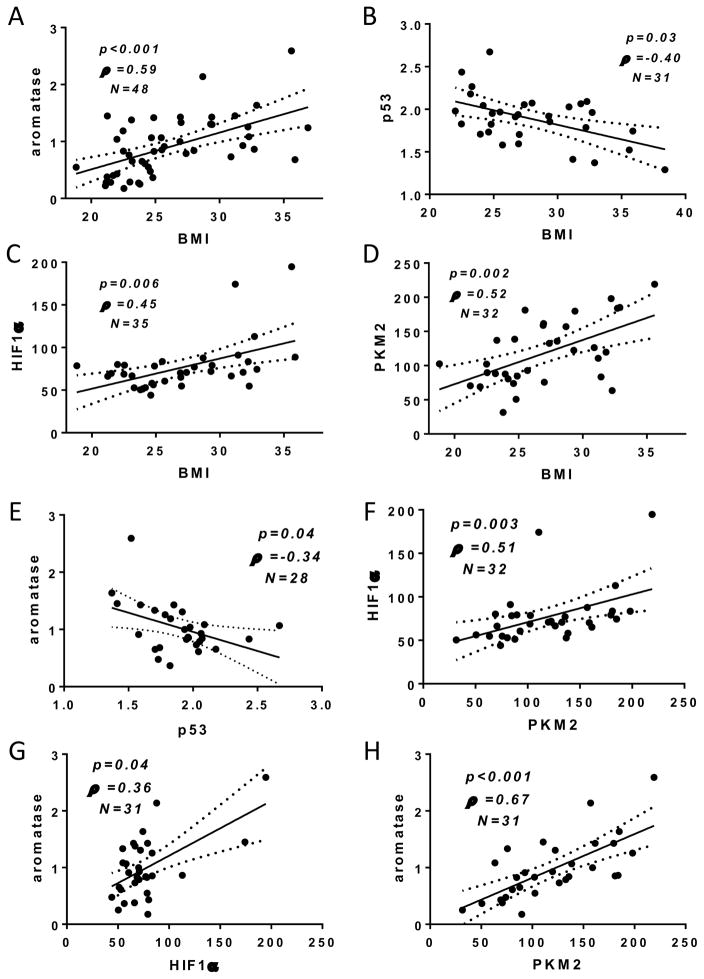
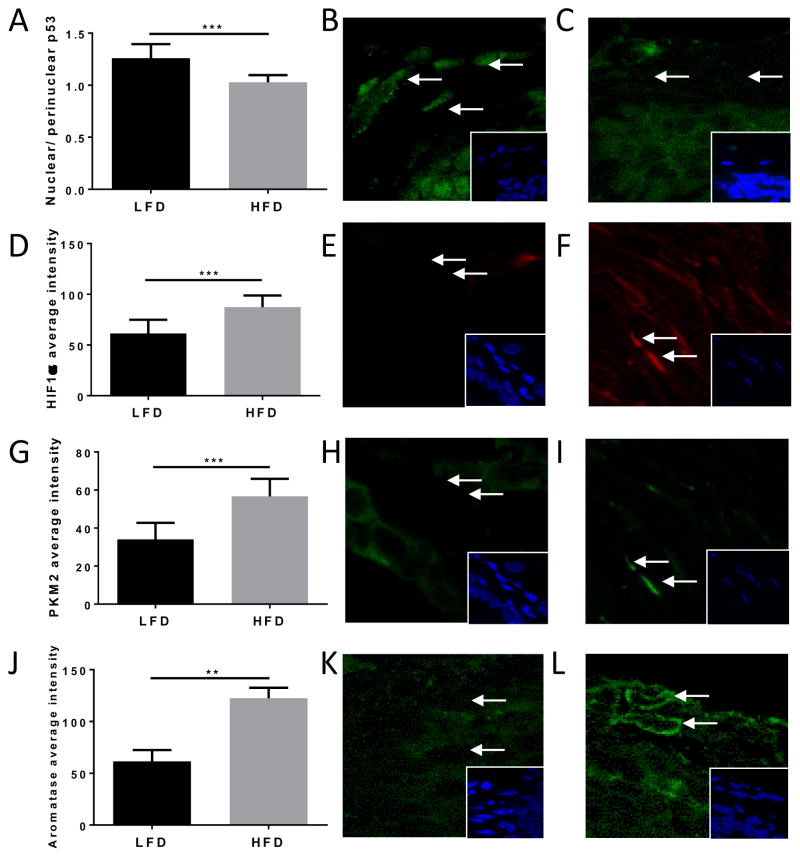
Leptin-mediated induction of aromatase was dependent on PKC/MAPK signaling and the suppression of p53. This, in turn, was associated with an increase in Aha1 protein expression, activation of Hsp90 and the stabilization of HIF1α and PKM2, known stimulators of aromatase expression. Consistent with these findings, ASC-specific immunoreactivity for p53 was inversely associated with BMI in breast tissue, while HIF1α, PKM2 and aromatase were positively correlated with BMI. In mice, HF feeding was associated with significantly lower p53 ASC-specific immunoreactivity compared with LF feeding, while immunoreactivity for HIF1α, PKM2 and aromatase were significantly higher.
Overall, findings demonstrate a novel mechanism for the obesity-associated increase in aromatase in ASCs of the breast and support the study of lifestyle interventions, including weight management, which may reduce breast cancer risk via effects on this pathway.
背景/目的:肥胖(体重指数(BMI)≥30kg/m²)与绝经后雌激素依赖性乳腺癌的风险增加有关。芳香化酶是雌激素生物合成的限速酶,在肥胖女性的乳腺组织中升高。最近,在具有 Li-Fraumeni 综合征的女性脂肪基质细胞(ASCs)中,p53-缺氧诱导因子-1α(HIF1α)/丙酮酸激酶 M2(PKM2)轴对芳香化酶的调节作用得到了表征,Li-Fraumeni 综合征是一种遗传性癌症综合征,易发生雌激素依赖性乳腺癌。本研究旨在确定肥胖相关脂肪因子瘦素刺激芳香化酶是否涉及 p53-HIF1α/PKM2 轴的调节。
受试者/方法:使用人乳腺 ASC 来描述瘦素对 p53-HIF1α/PKM2-芳香化酶轴的反应。研究了蛋白激酶 C(PKC)、丝裂原活化蛋白激酶(MAPK)、p53、Aha1、Hsp90、HIF1α 和 PKM2 的药理学或遗传学调节对芳香酶启动子活性、表达和酶活性的影响。采用半定量免疫荧光和共聚焦成像技术,检测了低脂(LF)或高脂(HF)饮食 17 周后女性乳腺和小鼠乳腺组织中 ASC 特异性蛋白表达。
瘦素介导的芳香化酶诱导依赖于 PKC/MAPK 信号转导和 p53 的抑制。这反过来又与 Aha1 蛋白表达的增加、Hsp90 的激活以及 HIF1α 和 PKM2 的稳定有关,HIF1α 和 PKM2 是芳香化酶表达的已知刺激物。与这些发现一致的是,乳腺组织中 p53 的 ASC 特异性免疫反应性与 BMI 呈负相关,而 HIF1α、PKM2 和芳香化酶与 BMI 呈正相关。在小鼠中,与 LF 喂养相比,HF 喂养与 ASC 特异性 p53 免疫反应性显著降低相关,而 HIF1α、PKM2 和芳香化酶的免疫反应性显著升高。
总的来说,这些发现证明了肥胖相关的乳腺 ASC 中芳香化酶增加的新机制,并支持通过对该途径的影响进行生活方式干预,包括体重管理,以降低乳腺癌风险的研究。