State Key Laboratory of Crop Stress Biology in Arid Region, Northwest A&F University, Yangling 712100, Shaanxi, China.
Int J Mol Sci. 2013 Nov 6;14(11):21983-96. doi: 10.3390/ijms141121983.
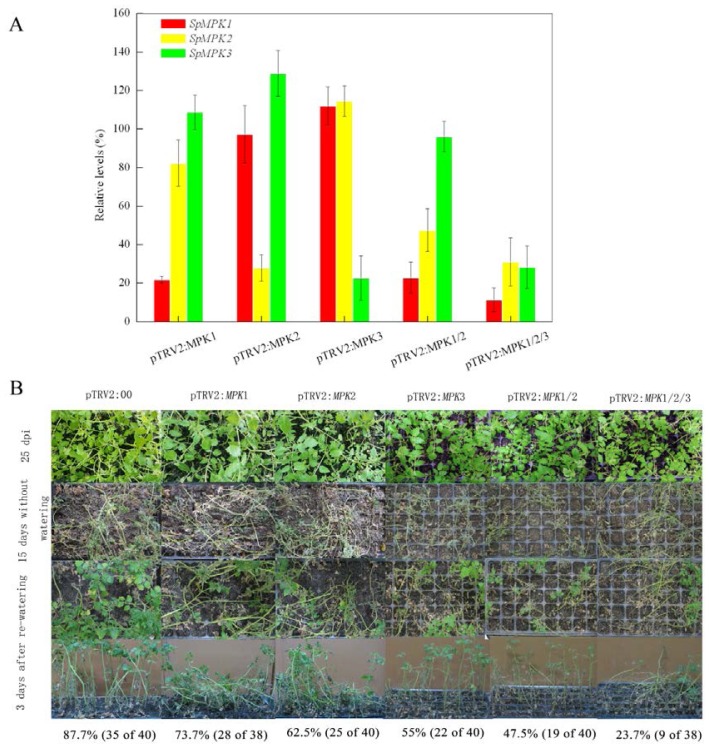
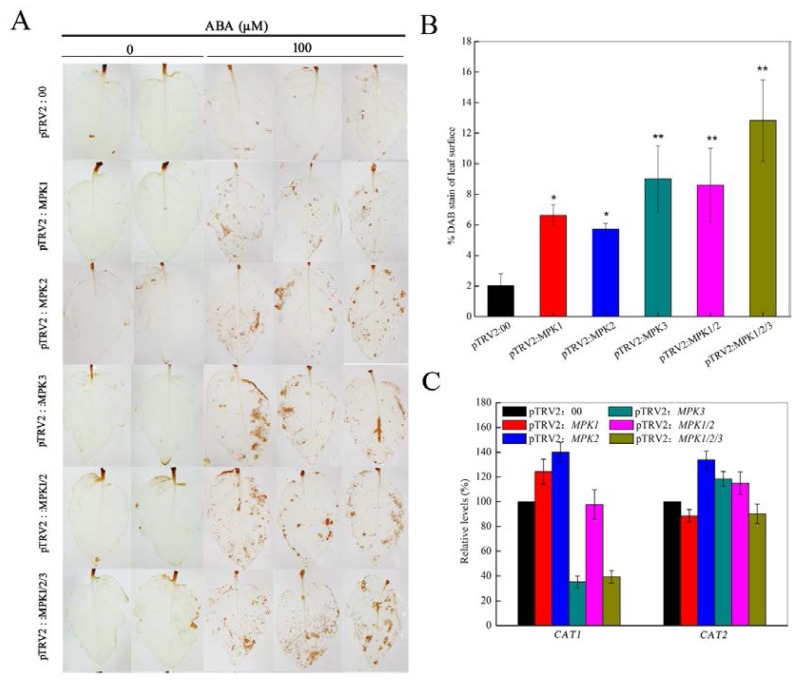
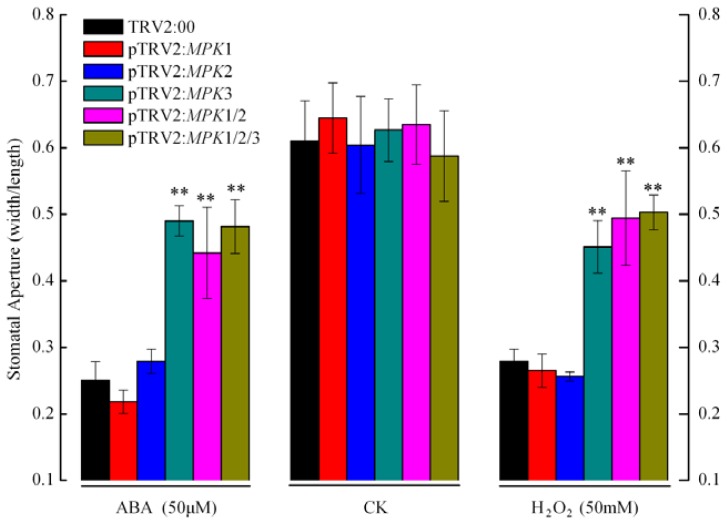
Drought is a major threat to agriculture production worldwide. Mitogen-activated protein kinases (MAPKs) play a pivotal role in sensing and converting stress signals into appropriate responses so that plants can adapt and survive. To examine the function of MAPKs in the drought tolerance of tomato plants, we silenced the SpMPK1, SpMPK2, and SpMPK3 genes in wild-type plants using the virus-induced gene silencing (VIGS) method. The results indicate that silencing the individual genes or co-silencing SpMPK1, SpMPK2, and SpMPK3 reduced the drought tolerance of tomato plants by varying degrees. Co-silencing SpMPK1 and SpMPK2 impaired abscisic acid (ABA)-induced and hydrogen peroxide (H2O2)-induced stomatal closure and enhanced ABA-induced H2O2 production. Similar results were observed when silencing SpMPK3 alone, but not when SpMPK1 and SpMPK2 were individually silenced. These data suggest that the functions of SpMPK1 and SpMPK2 are redundant, and they overlap with that of SpMPK3 in drought stress signaling pathways. In addition, we found that SpMPK3 may regulate H2O2 levels by mediating the expression of CAT1. Hence, SpMPK1, SpMPK2, and SpMPK3 may play crucial roles in enhancing tomato plants' drought tolerance by influencing stomatal activity and H2O2 production via the ABA-H2O2 pathway.
干旱是全球农业生产的主要威胁。丝裂原活化蛋白激酶(MAPKs)在感应和将应激信号转化为适当的反应方面起着关键作用,使植物能够适应和生存。为了研究 MAPKs 在番茄植物耐旱性中的功能,我们使用病毒诱导的基因沉默(VIGS)方法沉默了野生型植物中的 SpMPK1、SpMPK2 和 SpMPK3 基因。结果表明,沉默单个基因或共同沉默 SpMPK1、SpMPK2 和 SpMPK3 会不同程度地降低番茄植物的耐旱性。共同沉默 SpMPK1 和 SpMPK2 损害了脱落酸(ABA)诱导和过氧化氢(H2O2)诱导的气孔关闭,并增强了 ABA 诱导的 H2O2 产生。单独沉默 SpMPK3 时也观察到类似的结果,但单独沉默 SpMPK1 和 SpMPK2 时则没有。这些数据表明,SpMPK1 和 SpMPK2 的功能是冗余的,它们在干旱胁迫信号通路中与 SpMPK3 重叠。此外,我们发现 SpMPK3 可能通过调节 CAT1 的表达来调节 H2O2 水平。因此,SpMPK1、SpMPK2 和 SpMPK3 可能通过影响 ABA-H2O2 途径中的气孔活动和 H2O2 产生来增强番茄植物的耐旱性中发挥关键作用。