Department of Molecular Biosciences, the Wenner-Gren Institute, Stockholm University, Stockholm, Sweden.
PLoS One. 2013 Oct 18;8(10):e77893. doi: 10.1371/journal.pone.0077893. eCollection 2013.
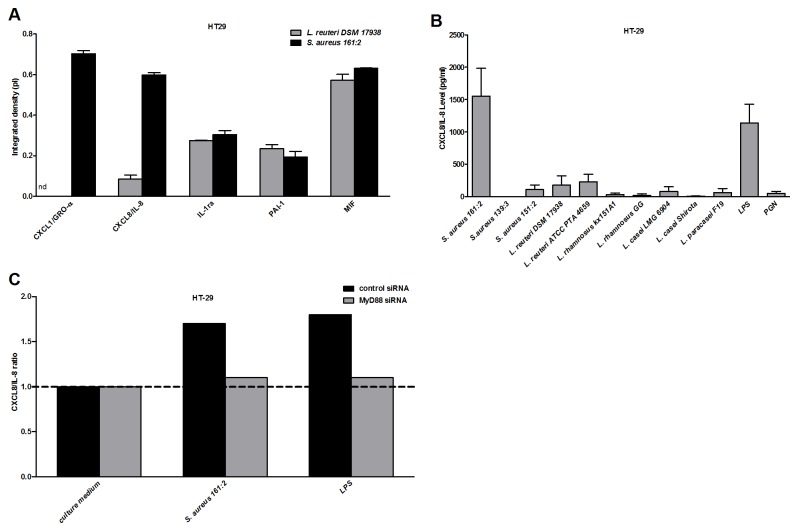
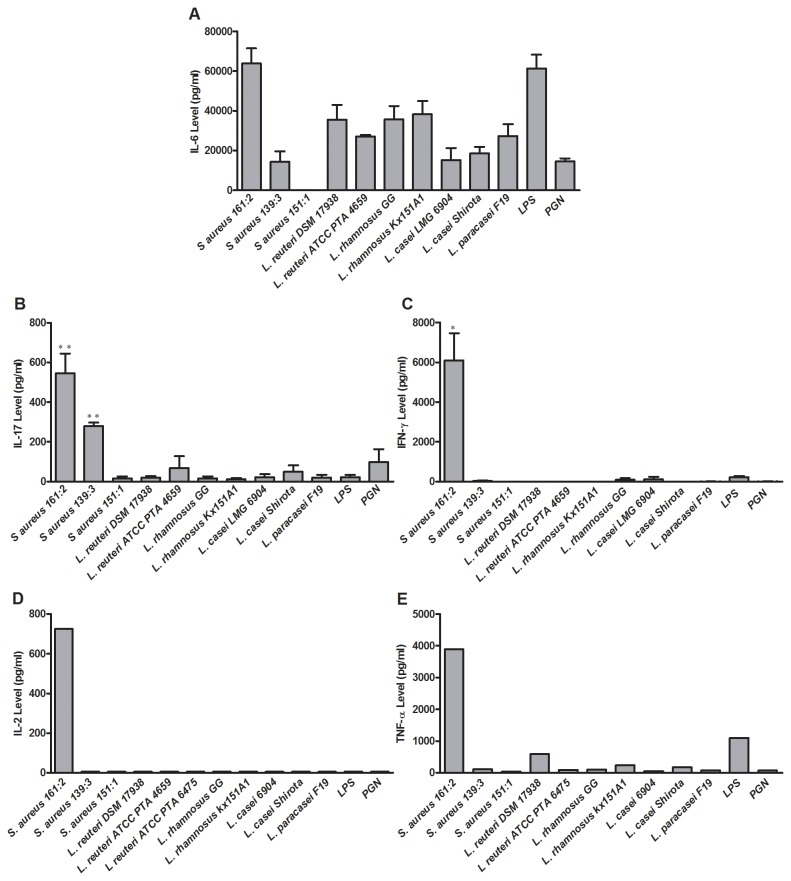
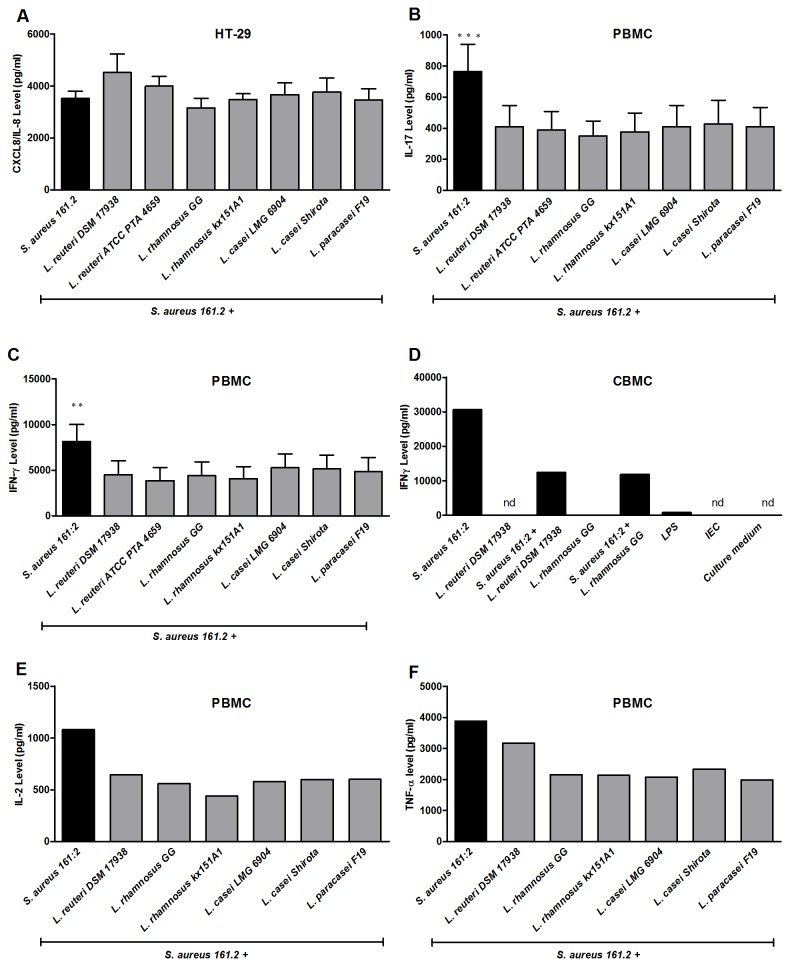
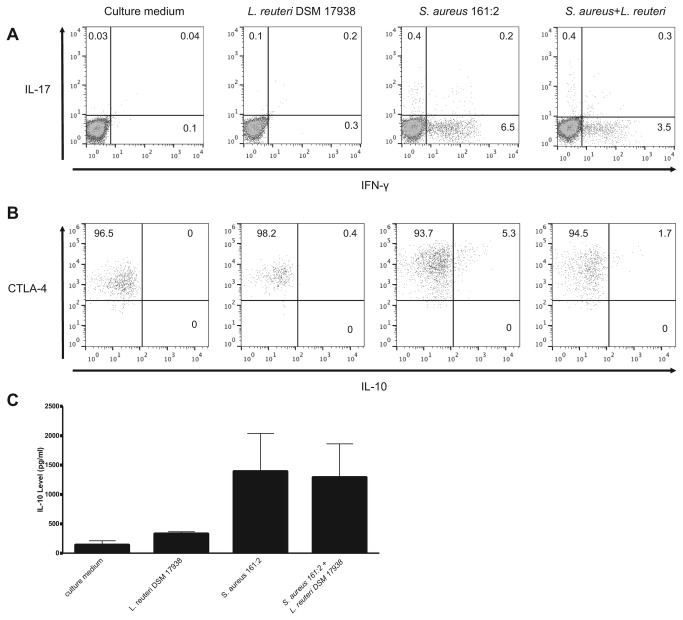
There seems to be a correlation between early gut microbiota composition and postnatal immune development. Alteration in the microbial composition early in life has been associated with immune mediated diseases, such as autoimmunity and allergy. We have previously observed associations between the presence of lactobacilli and Staphylococcus (S.) aureus in the early-life gut microbiota, cytokine responses and allergy development in children. Consistent with the objective to understand how bacteria modulate the cytokine response of intestinal epithelial cell (IEC) lines and immune cells, we exposed IEC lines (HT29, SW480) to UV-killed bacteria and/or culture supernatants (-sn) from seven Lactobacillus strains and three S. aureus strains, while peripheral blood mononuclear cells (PBMC) and cord blood mononuclear cells (CBMC) from healthy donors were stimulated by bacteria-sn or with bacteria conditioned IEC-sn. Although the overall IEC response to bacterial exposure was characterized by limited sets of cytokine and chemokine production, S. aureus 161:2-sn induced an inflammatory response in the IEC, characterized by CXCL1/GROα and CXCL8/IL-8 production, partly in a MyD88-dependent manner. UV-killed bacteria did not induce a response in the IEC line, and a combination of both UV-killed bacteria and the bacteria-sn had no additive effect to that of the supernatant alone. In PBMC, most of the Lactobacillus-sn and S. aureus-sn strains were able to induce a wide array of cytokines, but only S. aureus-sn induced the T-cell associated cytokines IL-2, IL-17 and IFN-γ, independently of IEC-produced factors, and induced up regulation of CTLA-4 expression and IL-10 production by T-regulatory cells. Notably, S. aureus-sn-induced T-cell production of IFN- γ and IL-17 was down regulated by the simultaneous presence of any of the different Lactobacillus strains, while the IEC CXCL8/IL-8 response was unaltered. Thus these studies present a possible role for lactobacilli in induction of immune cell regulation, although the mechanisms need to be further elucidated.
似乎早期肠道微生物群落组成与出生后免疫发育之间存在关联。生命早期微生物组成的改变与免疫介导的疾病有关,如自身免疫和过敏。我们之前观察到,儿童早期肠道微生物群落中乳杆菌和金黄色葡萄球菌(S. aureus)的存在与细胞因子反应和过敏发展之间存在关联。为了了解细菌如何调节肠上皮细胞(IEC)系和免疫细胞的细胞因子反应,我们使 IEC 系(HT29、SW480)暴露于紫外线杀死的细菌和/或来自七种乳杆菌菌株和三种金黄色葡萄球菌菌株的培养上清液(-sn),而来自健康供体的外周血单核细胞(PBMC)和脐带血单核细胞(CBMC)则通过细菌-sn 或经细菌处理的 IEC-sn 进行刺激。尽管细菌暴露引起的 IEC 总体反应特征是细胞因子和趋化因子产生的有限集,但金黄色葡萄球菌 161:2-sn 会在 IEC 中引起炎症反应,其特征是 CXCL1/GROα 和 CXCL8/IL-8 的产生,部分依赖于 MyD88。紫外线杀死的细菌不会引起 IEC 系的反应,并且紫外线杀死的细菌与细菌-sn 的组合对单独上清液没有附加作用。在 PBMC 中,大多数乳杆菌-sn 和金黄色葡萄球菌-sn 菌株能够诱导广泛的细胞因子,但只有金黄色葡萄球菌-sn 能够诱导与 T 细胞相关的细胞因子 IL-2、IL-17 和 IFN-γ,而不依赖于 IEC 产生的因子,并诱导 T 调节细胞中 CTLA-4 表达和 IL-10 产生的上调。值得注意的是,金黄色葡萄球菌-sn 诱导的 IFN-γ和 IL-17 的 T 细胞产生被同时存在的任何一种不同的乳杆菌菌株下调,而 IEC 的 CXCL8/IL-8 反应则保持不变。因此,这些研究表明,乳杆菌在诱导免疫细胞调节方面可能发挥作用,尽管需要进一步阐明其机制。