Sendelius Malin, Axelsson Jakob, Liu Peidi, Roos Stefan
BioGaia AB, SE- 241 38 Eslöv, Sweden.
MetaboGen, SE- 411 26, Gothenburg, Sweden.
J Ind Microbiol Biotechnol. 2023 Feb 17;50(1). doi: 10.1093/jimb/kuad041.
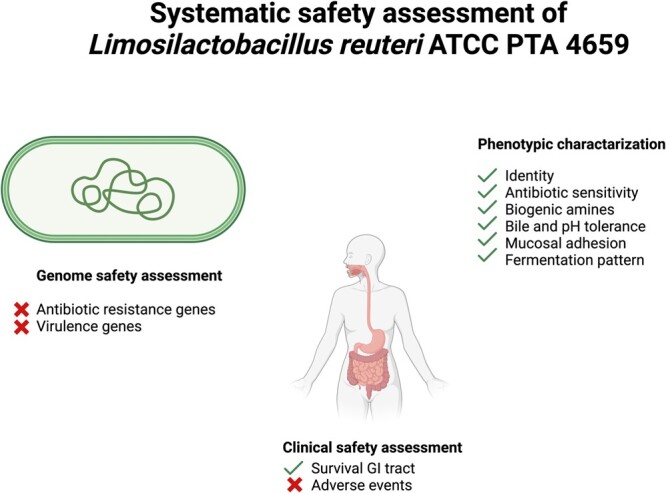
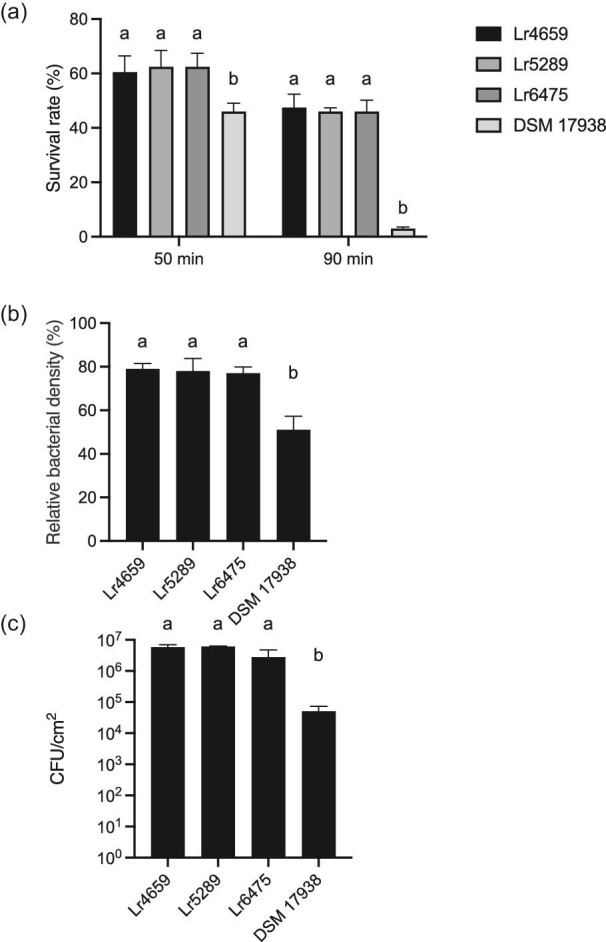
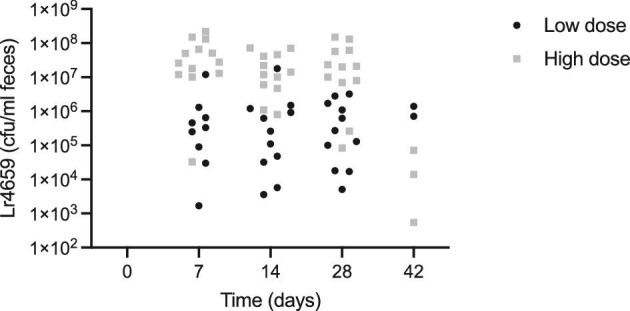
Evaluating the safety of probiotic microorganisms is an important part of the development of probiotic products. In this study, we have performed a systematic safety assessment of Limosilactobacillus reuteri American Type Culture Collection (ATCC) PTA 4659 based on genome analysis, antibiotic susceptibility testing, phenotypic characterization, and a human clinical safety study. Genome sequence analysis showed that the strain is free from virulence and antibiotic resistance genes. Connected to this, phenotypic characterization showed that the strain is susceptible to the main classes of antibiotics. Limosilactobacillus reuteri ATCC PTA 4659 was shown to produce histamine, which has previously been described as an anti-inflammatory mediator produced by certain L. reuteri strains. However, the amount of histamine, a biogenic amine, poses no safety concern of a potential product. The strain was investigated in a human clinical safety study and was shown to survive passage through the gastrointestinal tract, both when administered at high [1 × 10¹¹ colony-forming units (CFU)/day] and low doses (1 × 10⁹ CFU/day). The clinical safety evaluation showed that the doses administered are safe for human consumption. Furthermore, carbohydrate utilization, mucus adhesion, and tolerance to acid and bile were studied. It was shown that L. reuteri ATCC PTA 4659 has a very high adhesion to mucus and tolerance to both gastric pH and bile, all potentially important properties for a probiotic strain. Altogether, this study has demonstrated that Limosilactobacillus reuteri ATCC PTA 4659 is safe for human consumption and along with its phenotypic characteristics and previously described anti-inflammatory effects, makes it a promising strain for future probiotic development. NCT01033539.
评估益生菌微生物的安全性是益生菌产品开发的重要组成部分。在本研究中,我们基于基因组分析、抗生素敏感性测试、表型特征分析以及一项人体临床安全性研究,对罗伊氏乳杆菌美国模式培养物集存库(ATCC)PTA 4659进行了系统的安全性评估。基因组序列分析表明,该菌株没有毒力基因和抗生素抗性基因。与此相关的是,表型特征分析表明该菌株对主要类别的抗生素敏感。罗伊氏乳杆菌ATCC PTA 4659被证明能产生组胺,组胺此前被描述为某些罗伊氏乳杆菌菌株产生的一种抗炎介质。然而,作为一种生物胺,组胺的含量对潜在产品不存在安全问题。该菌株在一项人体临床安全性研究中接受了调查,结果表明,无论是高剂量[1×10¹¹ 菌落形成单位(CFU)/天]还是低剂量(1×10⁹ CFU/天)给药,该菌株都能在胃肠道中存活。临床安全性评估表明,所给药剂量对人体食用是安全的。此外,还研究了碳水化合物利用情况、黏液黏附性以及对酸和胆汁的耐受性。结果表明,罗伊氏乳杆菌ATCC PTA 4659对黏液具有很高的黏附性,对胃酸pH值和胆汁都具有耐受性,所有这些对于益生菌菌株来说都是潜在的重要特性。总之,本研究表明罗伊氏乳杆菌ATCC PTA 4659对人体食用是安全的,连同其表型特征和先前描述的抗炎作用,使其成为未来益生菌开发中一个有前景的菌株。临床试验编号:NCT01033539。