Plaza-Diaz Julio, Gomez-Llorente Carolina, Campaña-Martin Laura, Matencio Esther, Ortuño Inmaculada, Martínez-Silla Rosario, Gomez-Gallego Carlos, Periago Maria Jesús, Ros Gaspar, Chenoll Empar, Genovés Salvador, Casinos Beatriz, Silva Angela, Corella Dolores, Portolés Olga, Romero Fernando, Ramón Daniel, Perez de la Cruz Antonio, Gil Angel, Fontana Luis
Department of Biochemistry & Molecular Biology II, School of Pharmacy, University of Granada, Granada, Spain ; Institute of Nutrition & Food Technology "José Mataix", Biomedical Research Center, University of Granada, Granada, Spain.
PLoS One. 2013 Oct 28;8(10):e78111. doi: 10.1371/journal.pone.0078111. eCollection 2013.
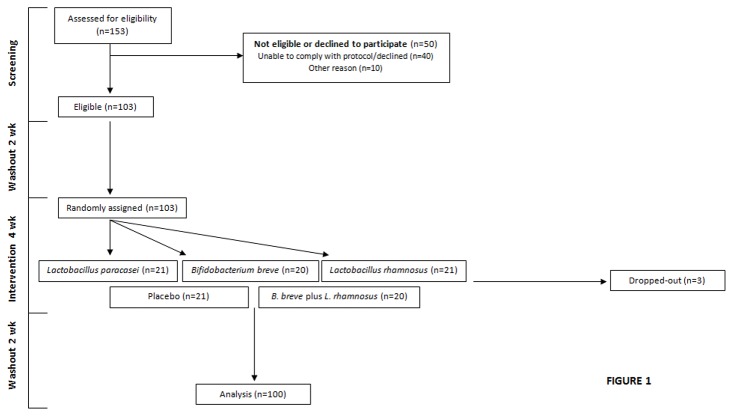
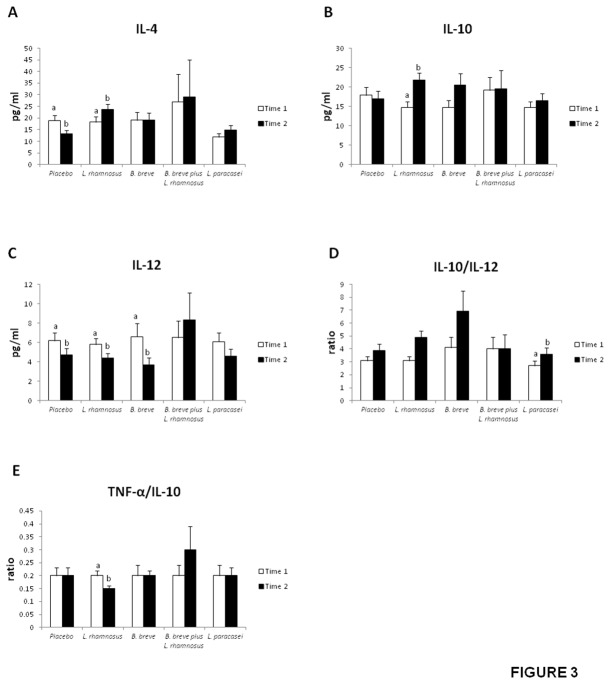
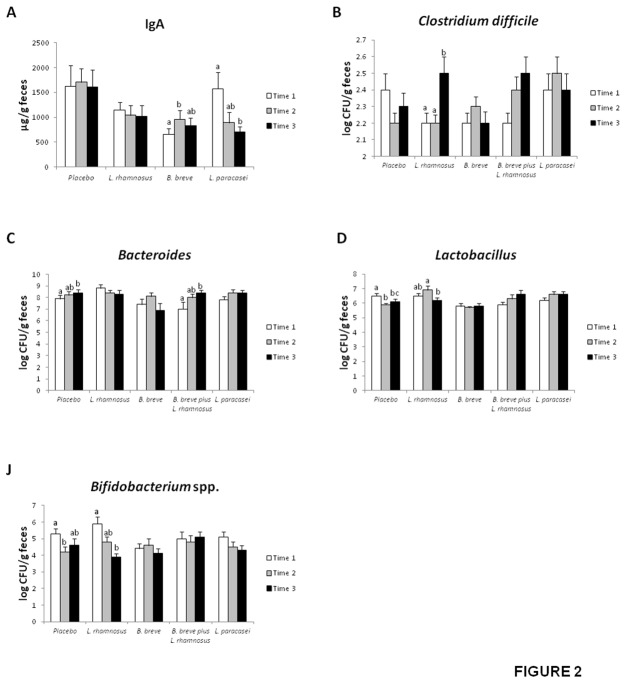
We previously described the isolation and characterization of three probiotic strains from the feces of exclusively breast-fed newborn infants: Lactobacillus paracasei CNCM I-4034, Bifidobacterium breve CNCM I-4035 and Lactobacillus rhamnosus CNCM I-4036. These strains were shown to adhere to intestinal mucus in vitro, to be sensitive to antibiotics and to resist biliary salts and low pH. In the present study, a multicenter, randomized, double-blind, placebo-controlled trial with 100 healthy volunteers in three Spanish cities was carried out to evaluate the tolerance, safety, gut colonization and immunomodulatory effects of these three probiotics. Volunteers underwent a 15-day washout period, after which they were randomly divided into 5 groups that received daily a placebo, a capsule containing one of the 3 strains or a capsule containing a mixture of two strains for 30 days. The intervention was followed by another 15-day washout period. Patients did not consume fermented milk for the entire duration of the study. Gastrointestinal symptoms, defecation frequency and stool consistency were not altered by probiotic intake. No relevant changes in blood and serum, as well as no adverse events occurred during or after treatment. Probiotic administration slightly modified bacterial populations in the volunteers' feces. Intestinal persistence occurred in volunteers who received L. rhamnosus CNCM I-4036. Administration of B. breve CNCM I-4035 resulted in a significant increase in fecal secretory IgA content. IL-4 and IL-10 increased, whereas IL-12 decreased in the serum of volunteers treated with any of the three strains. These results demonstrate that the consumption of these three bacterial strains was safe and exerted varying degrees of immunomodulatory effects.
ClinicalTrials.gov NCT01479543.
我们之前描述了从纯母乳喂养的新生儿粪便中分离和鉴定出的三株益生菌:副干酪乳杆菌CNCM I-4034、短双歧杆菌CNCM I-4035和鼠李糖乳杆菌CNCM I-4036。这些菌株在体外显示出能黏附于肠道黏液,对抗生素敏感,并且能抵抗胆盐和低pH值。在本研究中,在西班牙三个城市对100名健康志愿者进行了一项多中心、随机、双盲、安慰剂对照试验,以评估这三种益生菌的耐受性、安全性、肠道定植及免疫调节作用。志愿者经历了15天的洗脱期,之后他们被随机分为5组,每天分别接受安慰剂、含有三株菌株之一的胶囊或含有两株菌株混合物的胶囊,持续30天。干预之后是另一个15天的洗脱期。在整个研究期间,患者未食用发酵乳。摄入益生菌未改变胃肠道症状、排便频率和粪便稠度。治疗期间及之后,血液和血清未出现相关变化,也未发生不良事件。益生菌给药轻微改变了志愿者粪便中的细菌种群。接受鼠李糖乳杆菌CNCM I-4036的志愿者出现了肠道定植。给予短双歧杆菌CNCM I-4035导致粪便分泌型IgA含量显著增加。用这三株菌株中的任何一株治疗的志愿者血清中,IL-4和IL-10增加,而IL-12减少。这些结果表明,食用这三株菌株是安全的,并发挥了不同程度的免疫调节作用。
ClinicalTrials.gov NCT01479543。