Xiao Fei, Liu Deruo, Guo Yongqing, Shi Bin, Song Zhiyi, Tian Yanchu, Liang Chaoyang
Department of Thoracic Surgery, China-Japan Friendship Hospital, Beijing, China.
PLoS One. 2013 Oct 29;8(10):e78271. doi: 10.1371/journal.pone.0078271. eCollection 2013.
To study risk factors that affect the evaluation of malignancy in patients with solitary pulmonary nodules (SPN) and verify different predictive models for malignant probability of SPN.
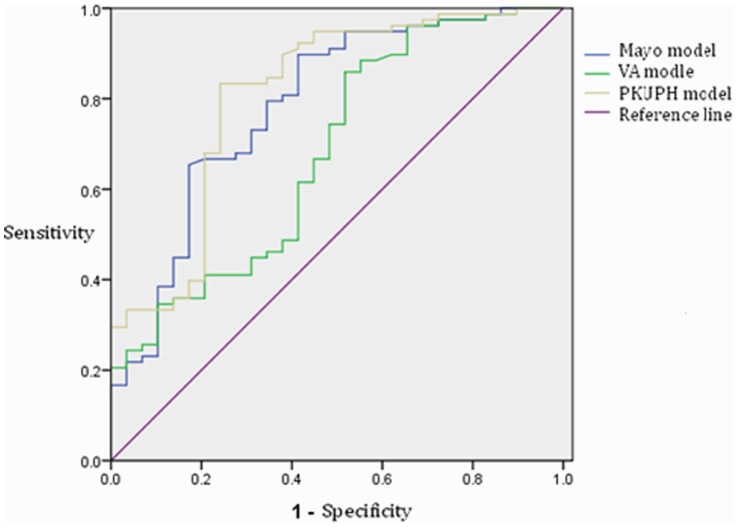
Retrospectively analyzed 107 cases of SPN with definite post-operative histological diagnosis whom underwent surgical procedures in China-Japan Friendship Hospital from November of 2010 to February of 2013. Age, gender, smoking history, malignancy history of patients, imaging features of the nodule including maximum diameter, position, spiculation, lobulation, calcification and serum level of CEA and Cyfra21-1 were assessed as potential risk factors. Univariate analysis model was used to establish statistical correlation between risk factors and post-operative histological diagnosis. Receiver operating characteristic (ROC) curves were drawn using different predictive models for malignant probability of SPN to get areas under the curves (AUC values), sensitivity, specificity, positive predictive values, negative predictive values for each model, respectively. The predictive effectiveness of each model was statistically assessed subsequently.
In 107 patients, 78 cases were malignant (72.9%), 29 cases were benign (27.1%). Statistical significant difference was found between benign and malignant group in age, maximum diameter, serum level of Cyfra21-1, spiculation, lobulation and calcification of the nodules. The AUC values were 0.786±0.053 (Mayo model), 0.682±0.060 (VA model) and 0.810±0.051 (Peking University People's Hospital model), respectively.
Serum level of Cyfra21-1, patient's age, maximum diameter of the nodule, spiculation, lobulation and calcification of the nodule are independent risk factors associated with the malignant probability of SPN. Peking University People's Hospital model is of high accuracy and clinical value for patients with SPN. Adding serum index (e.g. Cyfra21-1) into the prediction models as a new risk factor and adjusting the weight of age in the models might improve the accuracy of prediction for SPN.
研究影响孤立性肺结节(SPN)患者恶性肿瘤评估的危险因素,并验证不同的SPN恶性概率预测模型。
回顾性分析2010年11月至2013年2月间在中国-日本友好医院接受手术治疗且术后组织学诊断明确的107例SPN患者。评估患者的年龄、性别、吸烟史、恶性肿瘤病史、结节的影像学特征(包括最大直径、位置、毛刺征、分叶征、钙化)以及癌胚抗原(CEA)和细胞角蛋白19片段(Cyfra21-1)的血清水平作为潜在危险因素。采用单因素分析模型建立危险因素与术后组织学诊断之间的统计相关性。使用不同的SPN恶性概率预测模型绘制受试者工作特征(ROC)曲线,分别得到各模型的曲线下面积(AUC值)、敏感性、特异性、阳性预测值、阴性预测值。随后对各模型的预测有效性进行统计学评估。
107例患者中,78例为恶性(72.9%),29例为良性(27.1%)。良性组和恶性组在年龄、最大直径、Cyfra21-1血清水平、毛刺征、分叶征和结节钙化方面存在统计学显著差异。AUC值分别为0.786±0.053(梅奥模型)、0.682±0.060(VA模型)和0.810±0.051(北京大学人民医院模型)。
Cyfra21-1血清水平、患者年龄、结节最大直径、毛刺征、分叶征和结节钙化是与SPN恶性概率相关的独立危险因素。北京大学人民医院模型对SPN患者具有较高的准确性和临床价值。将血清指标(如Cyfra21-1)作为新的危险因素纳入预测模型并调整模型中年龄的权重可能会提高SPN预测的准确性。