Lemke Hilger W, Tarka Maja, Klaassen Raymond H G, Åkesson Mikael, Bensch Staffan, Hasselquist Dennis, Hansson Bengt
Molecular Ecology and Evolution Laboratory, Department of Biology, Lund University, Lund, Sweden.
PLoS One. 2013 Oct 18;8(10):e79209. doi: 10.1371/journal.pone.0079209. eCollection 2013.
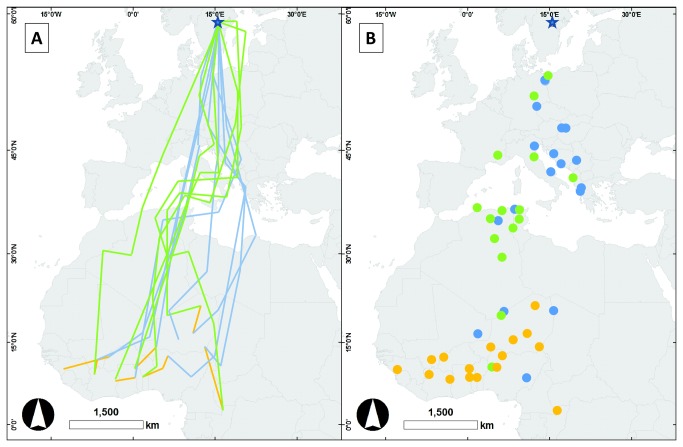
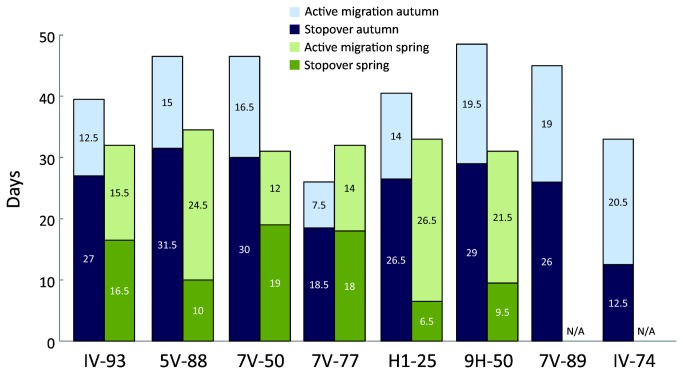
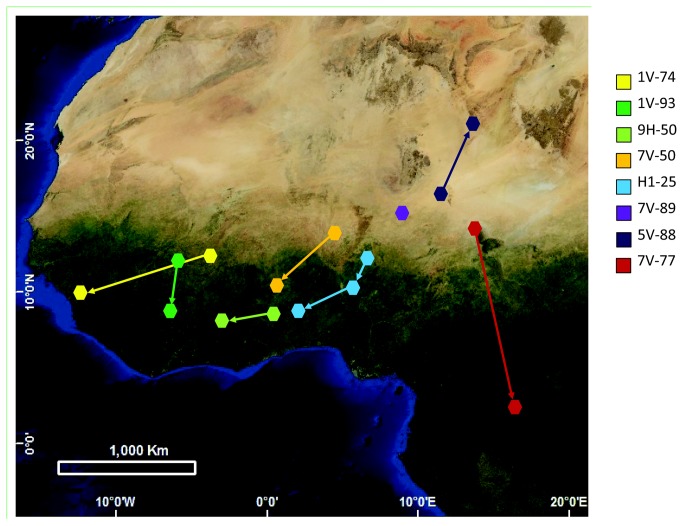
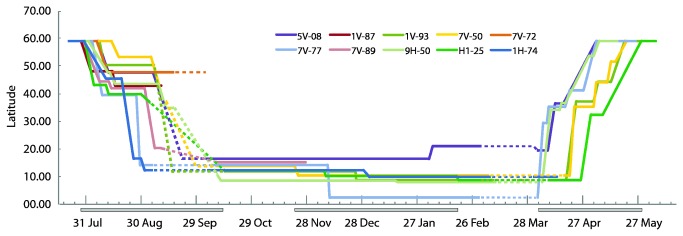
Recent technological advancements now allow us to obtain geographical position data for a wide range of animal movements. Here we used light-level geolocators to study the annual migration cycle in great reed warblers (Acrocephalus arundinaceus), a passerine bird breeding in Eurasia and wintering in sub-Saharan Africa. We were specifically interested in seasonal strategies in routes and schedules of migration. We found that the great reed warblers (all males, no females were included) migrated from the Swedish breeding site in early August. After spending up to three weeks at scattered stopover sites in central to south-eastern Europe, they resumed migration and crossed the Mediterranean Sea and Sahara Desert without lengthy stopovers. They then spread out over a large overwintering area and each bird utilised two (or even three) main wintering sites that were spatially separated by a distinct mid-winter movement. Spring migration initiation date differed widely between individuals (1-27 April). Several males took a more westerly route over the Sahara in spring than in autumn, and in general there were fewer long-distance travels and more frequent shorter stopovers, including one in northern Africa, in spring. The shorter stopovers made spring migration on average faster than autumn migration. There was a strong correlation between the spring departure dates from wintering sites and the arrival dates at the breeding ground. All males had a high migration speed in spring despite large variation in departure dates, indicating a time-minimization strategy to achieve an early arrival at the breeding site; the latter being decisive for high reproductive success in great reed warblers. Our results have important implications for the understanding of long-distance migrants' ability to predict conditions at distant breeding sites and adapt to rapid environmental change.
最近的技术进步使我们能够获取各种动物活动的地理位置数据。在这里,我们使用光级地理定位器研究大苇莺(Acrocephalus arundinaceus)的年度迁徙周期,大苇莺是一种在欧亚大陆繁殖、在撒哈拉以南非洲越冬的雀形目鸟类。我们特别关注迁徙路线和时间表中的季节性策略。我们发现,大苇莺(均为雄性,未包括雌性)于8月初从瑞典繁殖地迁徙。在欧洲中部至东南部的分散中途停留地停留长达三周后,它们继续迁徙,穿越地中海和撒哈拉沙漠,没有长时间停留。然后,它们分散在一个很大的越冬区域,每只鸟利用两个(甚至三个)主要越冬地点,这些地点在空间上由明显的越冬中期移动分隔开。春季迁徙开始日期在个体之间差异很大(4月1日至27日)。几只雄性在春季穿越撒哈拉的路线比秋季更偏西,总体而言,春季长途迁徙较少,短时间停留更频繁,包括在北非停留一次。较短的停留使得春季迁徙平均比秋季迁徙更快。从越冬地春季出发日期与到达繁殖地日期之间存在很强的相关性。尽管出发日期差异很大,但所有雄性在春季都有很高的迁徙速度,这表明它们采用了时间最小化策略以尽早到达繁殖地;后者对于大苇莺的高繁殖成功率至关重要。我们的研究结果对于理解长途迁徙者预测遥远繁殖地条件并适应快速环境变化的能力具有重要意义。