Carvalho Augusto M, Magalhães Andréa, Carvalho Lucas P, Bacellar Olívia, Scott Phillip, Carvalho Edgar M
Serviço de Imunologia, Hospital Universitário Prof, Edgard Santos, Universidade Federal da Bahia, Salvador, Rua João das Botas s/n, Canela 40110-160, BA, Brazil.
BMC Infect Dis. 2013 Nov 9;13:529. doi: 10.1186/1471-2334-13-529.
The main clinical forms of tegumentary leishmaniasis are cutaneous leishmaniasis (CL) and mucosal leishmaniasis (ML). L.braziliensis infection is characterized by an exaggerated production of IFN-gamma and TNF-alpha, cytokines involved in parasite destruction, but also in the pathology. Maintenance of an antigen-specific immune response may be important for resistance to re-infection and will contribute for vaccine development. In the present work we investigated the immune response in CL and ML cured individuals.
Participants in the present study included 20 CL and 20 ML patients, who were evaluated prior to, as well as 2 to 15 years after therapy. IFN-gamma, IL-2 and TNF-alpha production were determined by ELISA in supernatants of mononuclear cells stimulated with soluble L.braziliensis antigen (SLA). The frequency of memory CD4+ T cell populations was determined by FACS.
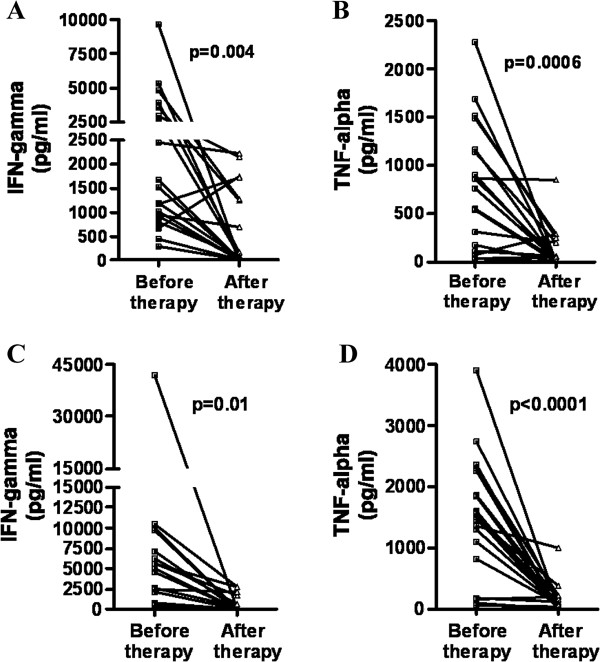
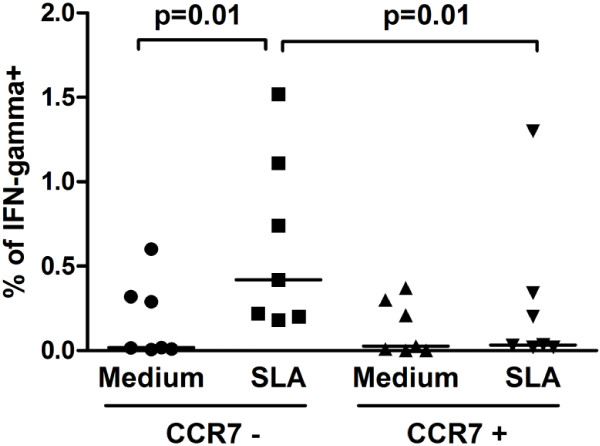
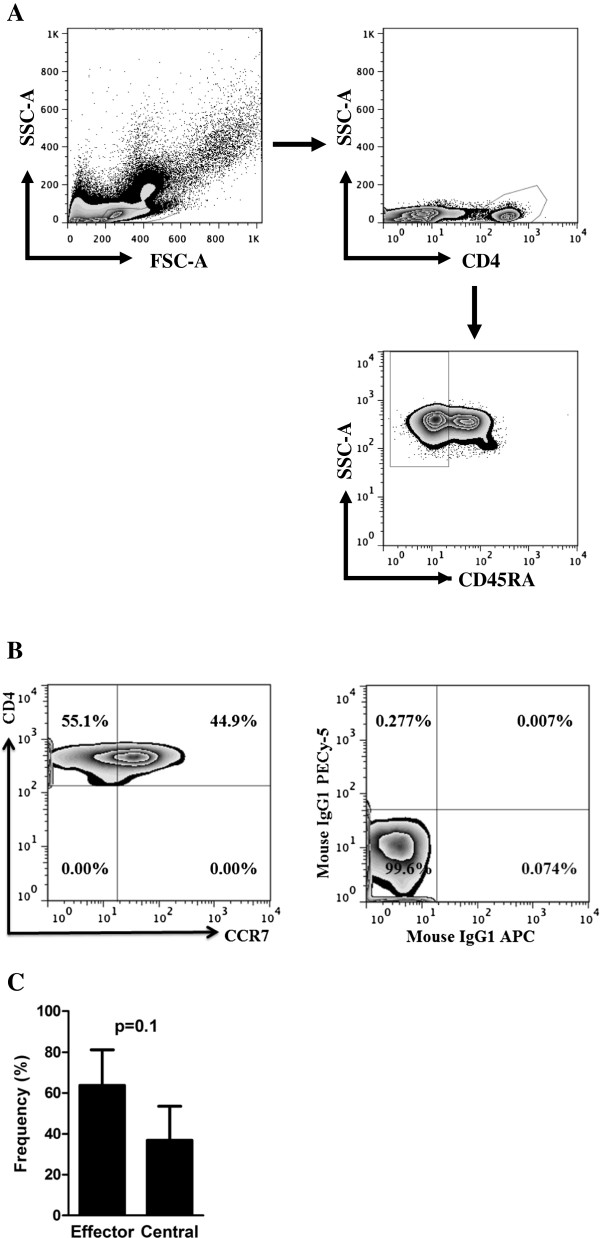
Here we show that the majority of CL and ML patients did not produce in vitro IFN-gamma in response to SLA after cure. In the cured individuals who responded to SLA, effector memory (CD45RA-CCR7-) CD4+ T cells were the ones producing IFN-gamma. Because a large percent of CL and ML cured patients lost SLA-induced IFN-gamma production in peripheral blood, we performed Leishmania skin test (LST). A positive LST was found in 87.5% and 100% of CL and ML cured individuals, respectively, who did not produce IFN-gamma or IL-2 in vitro.
This study shows that in spite of losing in vitro antigen-specific response to Leishmania, cured CL and ML subjects retain the ability to respond to SLA in vivo. These findings indicate that LST, rather than IFN-gamma production, may be a better assessment of lasting immunity to leishmaniasis in human studies, and thus a better tool for assessing immunization after vaccine. Furthermore, in cured individuals which maintains Leishmania-specific IFN-gamma production, effector memory CD4+ T cells were the main source of this cytokine.
皮肤利什曼病的主要临床形式为皮肤利什曼病(CL)和黏膜利什曼病(ML)。巴西利什曼原虫感染的特征是干扰素-γ(IFN-γ)和肿瘤坏死因子-α(TNF-α)过度产生,这些细胞因子既参与寄生虫的破坏,也参与病理过程。维持抗原特异性免疫反应对于抵抗再次感染可能很重要,并且将有助于疫苗的研发。在本研究中,我们调查了CL和ML治愈个体的免疫反应。
本研究的参与者包括20例CL患者和20例ML患者,在治疗前以及治疗后2至15年进行评估。用可溶性巴西利什曼原虫抗原(SLA)刺激单核细胞的上清液,通过酶联免疫吸附测定法(ELISA)测定IFN-γ、白细胞介素-2(IL-2)和TNF-α的产生。通过荧光激活细胞分选术(FACS)测定记忆性CD4+T细胞群体的频率。
我们在此表明,大多数CL和ML患者在治愈后对SLA体外刺激不产生IFN-γ。在对SLA有反应的治愈个体中,则是效应记忆(CD45RA-CCR7-)CD4+T细胞产生IFN-γ。由于很大比例的CL和ML治愈患者在外周血中失去了SLA诱导的IFN-γ产生,我们进行了利什曼原虫皮肤试验(LST)。在分别对体外不产生IFN-γ或IL-2的CL和ML治愈个体中,LST阳性率分别为87.5%和100%。
本研究表明,尽管CL和ML治愈个体失去了对利什曼原虫的体外抗原特异性反应,但他们在体内仍保留对SLA的反应能力。这些发现表明,在人体研究中,LST而非IFN-γ的产生可能是评估对利什曼病持久免疫力的更好指标,因此是评估疫苗接种后免疫情况的更好工具。此外,在维持利什曼原虫特异性IFN-γ产生的治愈个体中,效应记忆CD4+T细胞是这种细胞因子的主要来源。