Old Dominion University, Department of Psychology, 244D Mills Godwin Building, Norfolk, VA 23529-0267, USA.
Addict Behav. 2014 Jan;39(1):308-15. doi: 10.1016/j.addbeh.2013.10.017. Epub 2013 Oct 17.
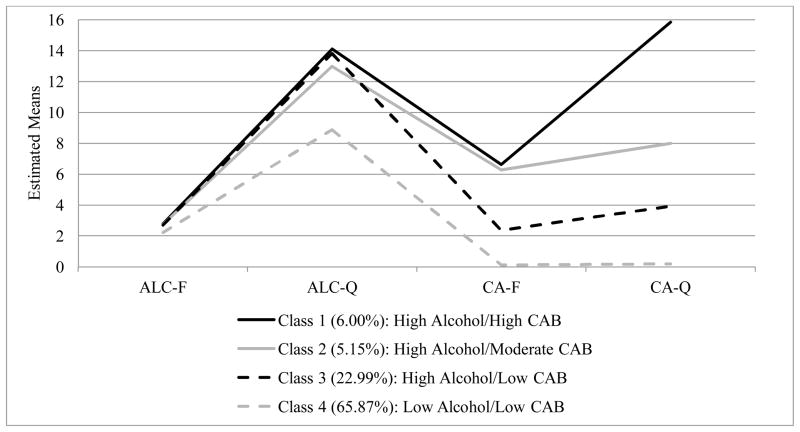
Growing evidence suggests that the consumption of caffeinated alcoholic beverages (CAB) may be riskier than alcohol alone. Efforts to identify patterns of CAB use and the correlates of such drinking patterns could further our conceptualization of and intervention for this health issue. Consequently, the current study aimed to (1) identify distinct classes of CAB users, (2) examine differences between classes on measures of alcohol and caffeine problems, and (3) compare distinct classes of CAB users on caffeine and alcohol outcome expectancies. Participants were 583 (31% men) undergraduate students from a psychology research pool. Latent profile analysis models were derived using four indicators: CAB use quantity, CAB use frequency, alcohol use quantity, and alcohol use frequency. Finding revealed four classes of drinkers: High Alcohol/High CAB (6.00%), High Alcohol/Moderate CAB (5.15%), High Alcohol/Low CAB (22.99%), and Low Alcohol/Low CAB (65.87%). The Low Alcohol/Low CAB class reported the lowest relative levels of caffeine dependence symptoms, caffeine withdrawal, alcohol use problems, and heavy episodic drinking frequency. Further, results indicated differential expectancy endorsement based on use profiles. CAB users in the High Alcohol/Low CAB class endorsed more positive alcohol expectancies than the Low Alcohol/Low CAB group. Those in the High Alcohol/High CAB class endorsed stronger withdrawal symptom caffeine expectancies than all other classes. Inclusion of substance-specific expectancies into larger theoretical frameworks in future work of CAB use may be beneficial. Findings may inform intervention efforts for those at greatest risk related to CAB consumption.
越来越多的证据表明,饮用含咖啡因的酒精饮料(CAB)可能比单独饮酒风险更大。努力识别 CAB 的使用模式以及这些饮酒模式的相关因素,可以进一步深化我们对这一健康问题的认识,并为其提供干预措施。因此,本研究旨在:(1)确定不同类型的 CAB 用户;(2)研究不同类型的 CAB 用户在酒精和咖啡因问题方面的差异;(3)比较不同类型的 CAB 用户在咖啡因和酒精预期结果方面的差异。参与者是来自心理学研究小组的 583 名(31%为男性)本科生。使用四个指标(CAB 使用量、CAB 使用频率、酒精使用量和酒精使用频率)得出潜在剖面分析模型。研究结果发现了四类饮酒者:高酒精/高 CAB(6.00%)、高酒精/中量 CAB(5.15%)、高酒精/低 CAB(22.99%)和低酒精/低 CAB(65.87%)。低酒精/低 CAB 类报告的咖啡因依赖症状、咖啡因戒断、酒精使用问题和重度间歇性饮酒频率相对较低。此外,结果表明基于使用情况的不同预期认可。高酒精/低 CAB 类的 CAB 用户比低酒精/低 CAB 组更认可积极的酒精预期。高酒精/高 CAB 类的 CAB 用户比其他所有类别更认可更强的戒断症状咖啡因预期。在未来的 CAB 使用研究中,将特定物质的预期纳入更大的理论框架中可能会有所帮助。研究结果可能为与 CAB 消费相关的高风险人群的干预措施提供信息。